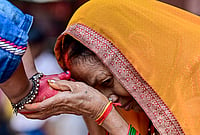
National School of Drama alumna and veteran theatre activist Anamika Haksar took a short-term filmmaking course in Mumbai, believing—rather innocently—that it would qualify her to make a feature that would find a place in multiplexes. After being rejected by several production houses, she plowed in all the money she got from a builder who had taken over her ancestral house in Delhi for redevelopment. She also had to dig into her savings and depend on contributions from friends and well-wishers to complete the film that took 75 days, over two years, to shoot. Sixty and not in good health, the experience left Haksar exhausted. Then came the next stage of struggle: nobody was willing to acquire the film, even the streaming platforms that had come as a beacon of hope to independent filmmakers. After doing the rounds of over 40 film festivals all over the world, her film was picked up and released in India by Platoon Distribution in 2022. It was a journey that took five years, plus the years it took to research and write the script. Her dazzling collage of Old Delhi’s underbelly—Ghode Ko Jalebi Khilane Le Ja Riya Hoon (Taking the Horse to Eat Jalebis; 2018), eventually reached the Indian audience and vindicated her singular vision.
After honing his skills in ad filmmaking in Mumbai, Goan filmmaker Bardroy Barretto crowdfunded his debut feature Nachom-ia Kumpasar (Come, Let’s Dance to the Music; 2014) with contributions from 102 friends and relatives. The elegantly mounted Konkani musical biopic on legendary singer Lorna and musician Chris Perry, set against the backdrop of ’60s Bombay and Goa, went on to collect three national awards, 10 state awards and 24 international ones! Convinced that a conventional theatrical release would be short-lived, Barretto instead organised screenings across Goa in auditoriums and community halls over two years. The film played to packed houses, attained cult status and proved that an independent film could become a commercial success without being commercially released.


Rima Das’ journey epitomises the resilience of Indian independent filmmakers. She self-financed her debut feature Village Rockstars (2017), serving as writer, director, producer, cinematographer and editor. Shot over nearly four years with non-professional actors in her home state, Assam, the film gained international recognition after its festival run before securing theatrical distribution in India through word-of-mouth. It became India’s official entry for the Academy Awards in 2019.
Many Hurdles on the Way
Devoid of studio backing and a traditional distribution network, independent filmmakers relied on their own conviction and the benevolence of friends, families and well-wishers. Unlike the parallel cinema of the ’70s and ’80s that depended mostly on government funding through agencies like the Film Finance Corporation, which later became the National Film Development Corporation (NFDC) in 1975, the new generation’s of filmmakers shaped by the post-liberalisation era did not have institutional funding to fall back on. By the turn of this century, corporate houses had taken over. They had their own vision of what constituted a successful film. Crowd-funding became a major source of resources that led to the systemisation of the process. Companies like Wishberry sprang up to help aspiring filmmakers through innovative campaigns.
But crowdfunding alone cannot sustain a film. Filmmakers realised that it has to be combined with grants, private investments, self-financing and international co-productions. Recognising this shift, NFDC reinvented its role by launching Film Bazaar (now WAVES Film Bazaar) in Goa, which for the past two decades has connected filmmakers across South Asia with prospective producers, distributors and international partners. Films such as The Lunchbox (2013), Court (2014), Newton (2017) and Bombay Rose (2019), among others, have benefitted from this.
Streaming platforms once offered a lifeline to independent filmmakers.
Alongside these developments, boutique production houses such as Sikhya Entertainment, JAR Pictures, Drishyam Films, Matchbox Shots and Good Bad Films helped nurture independent cinema. Their involvement improved production values and visibility, but it also introduced market considerations that sometimes diluted the uncompromising spirit that had originally defined independent films.
But many of these films, despite entering into co-productions, have found it tough to get a release. Desperate to make a film, Anand Gandhi and his cinematographer Pankaj Kumar began their arduous journey through the usual route of crowd- and self-financing that gradually bloomed into Ship of Theseus (2012). But there weren’t any takers. Luckily, Kiran Rao, then married to Aamir Khan, happened to watch the film at a private screening and was impressed enough to use her industry reputation to present the film, strategising its marketing through online and word-of-mouth publicity. UTV Motion Pictures soon picked it up for Indian theatrical distribution while the international sales were handled by Fortissimo Films.
Film and Television Institute of India (FTII) alumna Payal Kapadia’s All We Imagine as Light (2024) is a fascinating case study in how contemporary independent cinema gets made. The film was assembled through a complex network of production companies, public film funds, broadcasters, sales agents and executive producers across several European countries.
Since 2018, she spent several years developing the screenplay and applying to international labs and funding programmes which allowed her to spend time in Europe writing and refining the project—and understanding the market. When people mention ‘23 co-producers’ in relation to the film, they are generally referring to the long credit list. Each business partner contributed cash, equipment, post-production facilities like laboratory work, sound mixing and colour grading, insurance and tax incentives. When the film went on to win the Grand Prix in Cannes, it was picked up by Spirit Media, the distribution company founded by Telugu superstar Rana Daggubati, that released it in India.
Another FTII alumnus Aranya Sahay, after assisting Imtiaz Ali and directing a few acclaimed short films, developed his debut feature Humans in the Loop with support from the Museum of Imagined Futures Impact Fellowship, Storiculture and SAUV Films. After premiering at the Mumbai Academy of Moving Image (MAMI) festival in 2024, the film struggled to find a commercial release until it won the Film Independent Sloan Distribution Grant in 2025. It was eventually released theatrically in India before being acquired by Netflix for a global premiere later that year.
Streaming platforms once offered a lifeline to independent filmmakers. Unfortunately, in recent years these platforms have become far more selective in the films they acquire, increasingly favouring projects with stars and a proven commercial record. A theatrical release has become an important prerequisite for securing an OTT deal, yet, getting even a limited commercial release remains a major hurdle for filmmakers who lack the marketing budgets and distribution support of mainstream cinema. As a result, the struggle of independent filmmakers to reach audiences goes on.
Ranjan Das is a Mumbai-based filmmaker and screenwriter. He also serves as visiting faculty at universities and film institutes across India

MORE FROM THIS ISSUE


(This story appeared in Outlook magazine’s August 3 issue, 'The AI Divide', which focuses on how India's AI education ambitions are colliding with the reality of inadequate digital infrastructure, undertrained teachers and AI tools that are not built around Indian students' cultural context)