The state government is working to make education more practice-oriented than theory-based. To prepare students for the future, an artificial intelligence (AI) curriculum will be introduced from next month, enabling them to compete successfully in the global job market,” declared the education minister of Punjab at an award function recently. The statement hints at both the necessity and the urgency of the introduction of an AI curriculum considering its importance in the job market. The Central Board of Secondary Education (CBSE) has already included AI in its options of skill subjects for the past three years for students from Class 6 onwards in different formats. And from the current session, it will be introduced for students from Class 3 onwards. As the principal of a CBSE-affiliated school, I have seen the increasing trend among students and parents to opt for AI out of a variety of choices given to them. This is an indication of a growing awareness among people about the usefulness of this subject. Everyone seems to be willing to learn about AI so as not to be left behind by a technology that may change the way the world operates in the future.
So, education departments, the education industry and institutions are creating pathways for the country’s education system to take a leadership position in emerging knowledge fields by integrating technologies such as AI, machine learning, big data and computational thinking into the school curriculum. Already, the introductory and foundational levels of AI curricula are being incorporated and taught in schools. This foundational knowledge is aimed to help students further learn and engage with AI as they advance to higher education. So, we can say that our education ecosystem is witnessing a revolution, as was seen in the late 1980s and early 1990s when the subject of computers was introduced in schools. Perhaps, the AI revolution has even more potential, since it’s not about one additional subject to study, but a subject that impacts all other academic subjects.




The AI revolution has more potential, since it’s not about one additional subject to study, but a subject which impacts all other academic subjects.
AI is not a new concept. In fact, the idea has been in circulation for more than five decades, at least in the field of computational machines. Computer scientist and mathematician Richard E. Bellman, as early as in 1978, defined it as “the automation of activities that we associate with human thinking, activities such as decision making, problem solving, learning…” According to American philosopher John Haugeland, AI is “the exciting new effort to make computers think… machines with minds, in the full and literal sense”. For the computer scientist late Patrick Henry Winston, it is “the study of the computations that make it possible to perceive reason and act”. AI, for computer scientist Ray Kurzweil, is “the art of creating machines that perform functions that require intelligence when performed by people”. So we can see the history of the concept of AI and its scope defined by the early scientists in the field of AI and machine learning.
I have been a part of educational forums and panel discussions where it is still being debated whether AI is good or bad for education and for society at large. In my view, we need to move on from such debates and realise that AI is already in use in almost every field in more ways than we naively think. The industry is discovering newer ways to expand our engagement with AI to increase their productivity and efficiency. Our daily lives are being affected by applications of AI in a variety of ways without our being aware of it. In fact, the new generation of students is making use of AI tools like ChatGPT, Gemini, NotebookLM and others very aggressively for their assignments and preparation. Teachers are finding it challenging to differentiate between original and AI-assisted work, apart from their complaints about students relying less on teachers and more on AI.
CBSE’s Intervention
This brings us to a new frontier where substantive work needs to be done at both the policy level and within pedagogical frameworks to define new guidelines. Whether we like it or not, the technology is going to penetrate deeper in education at all levels. Interestingly, the latest curriculum framework released by CBSE called the Computational Thinking and Artificial Intelligence for students from Class 3 to 8 to create AI-literate learners by 2030 appears to include human dimensions in it. The curriculum mandates CT (computational thinking) + AI + Ethics + Unplugged learning. The curriculum design seems to have taken into consideration the ethical implications of AI and the overdependence on technology. The curriculum ambitiously strives to make students think the way the machines think and to understand the concept of AI. This is an interesting turn, which makes one realise how far AI technology has increased its infiltration into our world, as earlier, the machines were being taught how to think like humans.
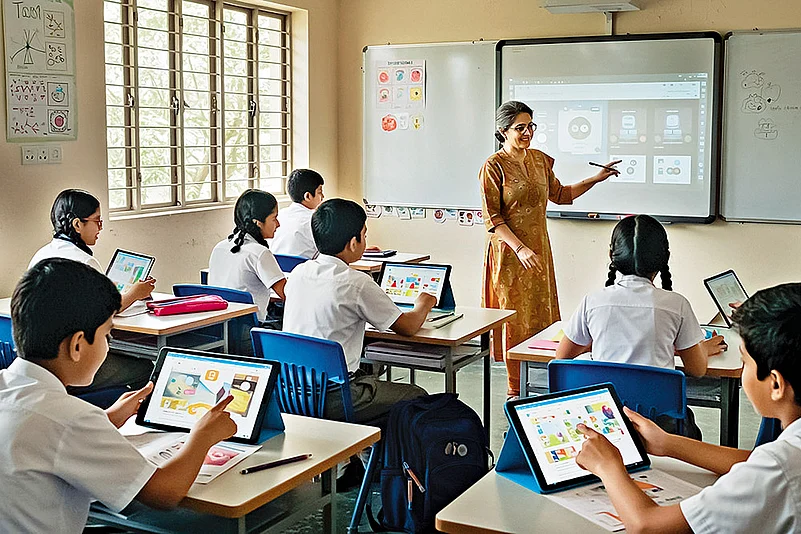
For schools, all these changes bring new paradigms along with new challenges. Cyber-security and the debates over ‘how much is too much’ are always a part of smart technologies. AI as a pedagogical tool has far broader implications than AI as a subject. Availability of digital academic content and AI-based assessment tools has already opened an alternative platform for teaching-learning, threatening the monopoly of printed textbooks and pen-paper assessments. Smart interactive-panels in classrooms, tablet-based education modules, self-paced and self-learning platforms are already in use. Digital education technology is amongst the fastest-growing industries, aggressively targeting educational institutions, particularly schools.
High Costs and Digital Divide
This opens the debate about the digital divide due to the high costs involved in the adoption of smart technologies in schools. It not only requires huge investments but also teacher-training which puts a lot of strain on the fragile ecosystem of school education in India. Not all schools can afford such investments, leaving a gap between those who can have access to the new technology and those who cannot. But is there a choice? If we have to fulfil the aim of creating AI-literate learners by 2030, we have to promote technology-enabled learning using tools such as augmented reality, virtual reality and virtual labs to foster creativity, problem-solving and interdisciplinary exploration.
The story doesn’t end here. The pros and cons are part and parcel of technology. We have no choice but to come on board, willingly or unwilling. It’s better to come with a positive frame of mind, even as we continue to explore how we can find solutions to the emerging challenges posed by AI and other technological developments. Who knows, a new generation well-versed in AI might be able to suggest better solutions for the complex problems being faced by the world. Alongside, we must spare a thought to find ways to continue developing human cognitive capabilities and intellect rather than diminish these uniquely human traits by completely outsourcing our thinking to machines.
(Views expressed are personal)
Rajiv Kumar Sharma is Principal, Spring Dale Senior School, Amritsar

MORE FROM THIS ISSUE





(This story appeared in Outlook magazine’s August 3 issue, 'The AI Divide', which focuses on how India's AI education ambitions are colliding with the reality of inadequate digital infrastructure, undertrained teachers and AI tools that are not built around Indian students' cultural context)