FIFA World Cup 2026 has just witnessed the 3000th goal of its history
Enzo Fernandez of Argentina scored the 3000th goal during a dramatic comeback against Egypt in Round of 16
The occasion of a milestone goal celebrates the evolution and the rich history of the FIFA World Cup
As the FIFA World Cup 2026 enters its high-stakes business end, the tournament has cemented its status as a historic celebration of attacking football. Across North America, fans have witnessed a surge in offensive creativity, tactical boldness, and clinical finishing that has pushed the record books into uncharted territory.
The latest addition to the record books is the 3,000th goal in the history of the World Cup, realized in a moment of pure, high-octane drama that perfectly encapsulated the spirit of this tournament.
During the Round of 16 encounter between Argentina and Egypt, the match was locked in a tense, back-and-forth battle that threatened to spill into extra time. In the dying embers of stoppage time, with the pressure reaching a fever pitch, Argentina launched one final, desperate foray into the Egyptian penalty area.
As a perfectly flighted cross curled toward the center of the box, Enzo Fernández surged through a thicket of defenders, rising high to meet the ball with a powerful, precision header.
The ball bypassed the outstretched hands of the Egyptian goalkeeper and rippled the back of the net, securing a dramatic 3-2 comeback victory for Argentina. It was a goal that demanded technical perfection under immense duress, forever marking Fernández’s name in the history books as the man who brought the World Cup scoring tally to the 3,000 mark.


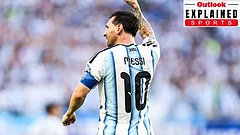
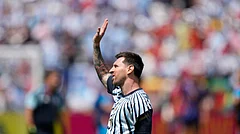
Evolution Of The Milestone Goals
The journey to the 3,000th goal is a fascinating reflection of football’s tactical evolution from the rigid, positional play of 1930 to the high-tempo, high-pressing spectacle of the modern era.
The Beginning: The inaugural goal was struck by France’s Lucien Laurent on July 13, 1930, in Montevideo. His 19th-minute volley against Mexico ignited a journey that has spanned nearly a hundred years.
The 100th Goal: Just weeks after the start of the 1930 tournament, American forward Bert Patenaude etched his name in history, solidifying the rapid pace at which the early World Cups were contested.
The 500th Goal: By the 1958 tournament in Sweden, the game had become significantly more structured. Scottish forward Bobby Collins reached this milestone during an era defined by attacking flair and tactical experimentation.
The 1,000th Goal: As the tournament’s prestige and participation grew, the 1,000th goal arrived in 1978. Dutch master Rob Rensenbrink scored it via a penalty against Scotland, marking a golden era for the "Total Football" philosophy.
The 2,000th Goal: The milestone moved into the 21st century during the 2006 tournament. Sweden’s Marcus Allbäck scored a historic equalizer against England, showcasing the increased physicality and tactical discipline of the modern game.
Legacy Of The Golden Boot
The evolution of the Golden Boot—awarded to the tournament’s top scorer—reflects the changing tactical landscape of global football. The inaugural 1930 tournament saw Argentina’s Guillermo Stábilé lead with eight goals, while Brazil’s Leônidas topped the charts in 1938 with seven. Following the war, the 1950s introduced legendary marksmen, with Ademir (1950), Sándor Kocsis (1954), and the record-shattering Just Fontaine (1958) defining an era of prolific attacking.
The 1960s and 70s saw consistent brilliance from figures like Garrincha (1962), Eusébio (1966), Gerd Müller (1970), Grzegorz Lato (1974), and Mario Kempes (1978). As the game became more tactical in the 80s and 90s, stars such as Paolo Rossi (1982), Gary Lineker (1986), Salvatore Schillaci (1990), Hristo Stoichkov and Oleg Salenko (1994), and Davor Šuker (1998) claimed the honor.
The new millennium brought icons like Ronaldo Nazário (2002), Miroslav Klose (2006), Thomas Müller (2010), James Rodríguez (2014), Harry Kane (2018), and Kylian Mbappé (2022), each cementing their legacy through clinical finishing and unwavering composure on the world's biggest stage.
All-Time Scoring And Assist Leaders
Lionel Messi stands alone at the pinnacle of FIFA World Cup history, holding the record for both the most goals and the most assists in the tournament's storied existence. With his 21 goals, the Argentine icon officially surpassed Miroslav Klose’s previous record of 16, solidifying his status as the competition's all-time leading marksman.
Kylian Mbappé has rapidly ascended the ranks, currently sitting in second place with 19 career goals, closely trailing Messi's record. Behind them, Germany's Miroslav Klose holds third with 16 goals, followed by Brazil's Ronaldo "O Fenômeno" with 15 and Gerd Müller with 14.
In terms of playmaking, Messi now officially holds the tournament record with nine assists, having surpassed the long-standing benchmark set by Diego Maradona, who tallied eight across his career between 1982 and 1994. Other prolific creators in tournament history include legends like Pelé, Pierre Littbarski, and Grzegorz Lato, who each anchored their respective teams' attacking play through different eras of the beautiful game.
Best Goals That Stunned The World
The tapestry of World Cup history is woven with threads of early-century ingenuity and mid-century technical evolution. In the tournament’s formative years, legends like Leônidas da Silva mesmerized crowds with his acrobatic flair, most notably his bicycle kick for Brazil in 1938, which redefined what was physically possible on a football pitch.
By the 1950s and 60s, the world saw the emergence of the "King," Pelé, whose youthful, composed strike in the 1958 final against Sweden showcased the predatory instinct that would become his trademark, while his deft dribbling and team-oriented goals throughout his career helped define the "Joga Bonito" philosophy.
As the tournament entered the 1970s and 80s, the tactical complexity of the game met individual genius, producing some of the sport's most debated and celebrated moments. The 1970 final featured a perfectly orchestrated team goal by Carlos Alberto, whose thunderous strike from a thunderous pass capped off Brazil's dominance
The 1980s, however, belonged to the individualists; the 1986 tournament witnessed Diego Maradona’s "Goal of the Century" against England, a 60-yard slalom run that remains the ultimate testament to individual ball control, as well as Manuel Negrete’s stunning scissors-kick for Mexico in the same tournament, a strike that showcased the sheer aesthetic beauty of the game.
Notable highlights from recent decades include Maxi Rodríguez’s thunderous volley for Argentina (2006), Diego Forlán’s precise strike for Uruguay (2010), and the poetic, clinical finishes from James Rodríguez (2014) and Benjamin Pavard (2018), both of whom utilized sensational technique to find the net. Richarlison’s acrobatic scissor-kick for Brazil in 2022 further solidified the standard for modern excellence.
Beyond these official winners, the tournament’s history is anchored by legendary individual efforts that remain etched in memory. Dennis Bergkamp’s iconic 90th-minute winner for the Netherlands against Argentina (1998), Ronaldinho’s audacious long-range free-kick against England (2002), and Robin van Persie’s soaring "Flying Dutchman" header against Spain (2014) are frequently cited as the most sensational goals ever witnessed on the world stage.
These players, through their unique skill and vision, transformed pressure-filled matches into works of art, cementing their legacies as architects of the greatest moments in World Cup history.
Pioneers Of Goal Scoring
The record for the most goals scored by a team in a single FIFA World Cup edition is a testament to the sheer attacking dominance of legendary squads. The gold standard remains the "Mighty Magyars" of Hungary in 1954, who amassed an astonishing 27 goals in just five matches, a benchmark for offensive efficiency that has never been eclipsed.
Other teams have come close to this level of dominance; the 1958 Brazil side, propelled by a young Pelé, tallied 16 goals en route to the title, while the 1970 Brazil team, widely considered the greatest attacking unit in history, scored 19 times.
The history of the tournament also highlights other monumental scoring displays from across different eras. Brazil’s 1950 side, which reached the final round as host nation, netted 22 goals in their six matches, showcasing a prolific strike force led by Ademir.
Similarly, Argentina’s 1930 team, the inaugural tournament's runners-up, registered 18 goals in just five games, while the 2002 Brazil squad matched that figure by scoring 18 times over their seven-match campaign to claim their fifth title.
These teams were characterized by their fluid movement, tactical innovation, and a relentless desire to penetrate the opponent's defensive lines, turning the pitch into a theater of relentless offensive pressure.
In the modern era, high-scoring campaigns have often been defined by clinical tactical systems rather than pure open-field dominance. The 2014 German team exemplified this with 18 goals in their championship run, capped by their historic 7-1 semi-final performance against Brazil, while France in 2018 showcased their rapid-transition attacking style with 14 goals.
The 2002 Brazil squad, which clinched their fifth world title in South Korea and Japan, remains one of the most iconic attacking units in modern football history. Central to their relentless offensive output were the "Three R’s"—Ronaldo, Rivaldo, and Ronaldinho—a trio whose chemistry, technical flair, and clinical precision dismantled defenses throughout the tournament. By the end of their seven-match campaign, the team had amassed a stellar 18 goals.
Goals Nobody Want
In the history of the FIFA World Cup, own goals have remained a relatively rare occurrence, with only 68 recorded over the tournament’s 23 editions prior to the current 2026 event. Historically, Mexico and Morocco share the unenviable record for the most own goals scored by a single nation, with four each.
Conversely, France has often been the beneficiary of such defensive lapses, as opposing teams have turned the ball into their own nets to France's advantage on six occasions. The 2026 tournament, however, has set a new, chaotic precedent, shattering the previous record of 12 own goals set in 2018; as of early July 2026, the tally has already climbed to 13, reflecting the increased volatility and defensive pressures seen in the expanded format.
While most own goals are viewed as unfortunate accidents, some have left an indelible, tragic mark on the sport. The most haunting instance occurred during the 1994 World Cup, when Colombian defender Andrés Escobar scored an own goal in a group stage match against the United States.
The error proved catastrophic for Colombia’s campaign and led to devastating consequences, as Escobar was tragically murdered just days after his return home
Other "disastrous" moments are remembered for their tactical impact, such as the 2026 tournament featuring Egypt’s Mohamed Hany, who became only the second player in history—joining Bulgaria’s Ivan Vutsov from 1966—to record two own goals in a single World Cup edition.
In the opening match of the 2014 tournament, Brazilian defender Marcelo inadvertently scored the first goal of the World Cup into his own net against Croatia. Though Brazil eventually won 3-1, the moment is remembered for the shock it sent through the host nation during the tournament's inaugural match.
In a high-stakes group stage match, Spanish goalkeeper Andoni Zubizarreta—an absolute legend of the game—fumbled a cross into his own net during a 3-2 defeat to Nigeria. The blunder proved critical to Spain's early exit from the 1998 tournament.
In a rare twist, the 2018 final between France and Croatia featured the first-ever own goal in a World Cup final, when Mandžukić inadvertently headed a French free-kick into his own net to open the scoring.
Sentinels Between The Post
The history of the FIFA World Cup is defined not only by attacking artistry but also by goalkeeping performances that have single-handedly altered the destiny of nations. Need goals and saves in the same breath. Scoring and saving effectively the interplay that makes football the game it is.
One of the most legendary displays remains Gordon Banks’ "save of the century" in 1970, where the England goalkeeper defied gravity to claw away a point-blank header from Pelé, a moment that remains the gold standard for reflexes and positioning.
Lev Yashin, the "Black Spider," solidified his status as the greatest keeper of his era during the 1958 and 1966 tournaments, combining fearless command of his area with agility that seemed decades ahead of its time. In a similar vein of dominance, Oliver Kahn turned the 2002 tournament into his personal fortress; his relentless intensity and technical precision guided a relatively underdog German squad to the final, earning him the Golden Ball—a rare and historic feat for a goalkeeper.
The tournament has also seen specialists who thrived on the psychological battlefield of penalty shootouts. Sergio Goycochea’s miraculous performance for Argentina in 1990 is the stuff of legend; entering the tournament as a backup, he became an overnight hero by saving crucial penalties against Yugoslavia and Italy to carry his team to the final.
Similarly, Gianluigi Buffon’s stoic performance in 2006 for Italy stands as a masterclass in focus; he conceded only two goals in the entire tournament—one an own goal and the other a penalty—and acted as the unbreakable foundation for Italy’s fourth world title.
In more recent tournaments, the role of the goalkeeper has evolved into an offensive-defensive hybrid, with modern legends delivering displays of exceptional composure under duress. Tim Howard’s record-breaking 16-save performance against Belgium in 2014 remains a testament to individual resistance against overwhelming pressure, while Emiliano Martínez’s heroics in 2022, particularly his last-gasp save against France in the final’s dying seconds, perfectly illustrated the clutch factor required at the highest level.
Whether through the acrobatic reflexes of Iker Casillas in Spain’s 2010 run or the imposing, tactical presence of Manuel Neuer, these keepers proved that world-class goalkeeping is often the final, insurmountable barrier to tournament glory.
With FIFA World Cup 2026 reaching a crescendo, we are witnessing a tournament where the boundaries of possibility are being pushed further than ever before. With iconic superstars delivering career-defining performances on the world's most pressurized stage, the existing historical benchmarks—from goalscoring tallies to assist records—are under constant threat of being rewritten..
This edition has served as a transition point where legendary eras are meeting the next generation of greatness, ensuring that as the competition reaches its ultimate climax, we are likely to see long-standing records topple under the weight of unprecedented intensity.