Trump declared the interim Iran accord over after fresh Iranian attacks
Iran targeted US military bases in Bahrain and Kuwait with missiles and drones
NATO announced a $40 billion investment in counter-drone and defence capabilities
Alliance leaders backed US military action while expanding long-term security initiatives
US President Donald Trump said on Wednesday that the interim agreement to end the war with Iran was "over" after Tehran carried out new attacks on US bases in the Gulf, even as NATO allies unveiled tens of billions of dollars in new defence investments at the alliance's summit in Ankara.
"As far as I'm concerned, it's over," Trump told reporters in Ankara when asked whether the memorandum of understanding reached last month was still in effect. "It's just a waste of time dealing with them," he said, referring to the Iranian government and calling the leadership in Tehran "sick people."
According to a Reuters, The US military unleashed a new wave of strikes against Iran on Tuesday and revoked a license allowing Tehran to sell oil after three tankers were hit by projectiles in the Strait of Hormuz, putting pressure on an already fragile ceasefire.

Iran Strikes US bases in Bahrain, Kuwait
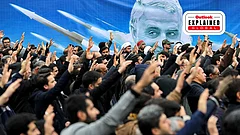
Iran's Islamic Revolutionary Guard Corps (IRGC) said it had carried out a joint missile and drone operation targeting US military facilities in Bahrain and Kuwait in response to American strikes. Air raid sirens sounded across Bahrain and Kuwait as Iranian projectiles headed towards US facilities, including Bahrain's Fifth Naval District at Bandar Salman and Kuwait's Ali Al Salem Air Base, according to an Outlook India report. Kuwaiti authorities said air defences intercepted "hostile" missiles and drones, while Bahrain activated missile alerts twice during the morning, the report said.

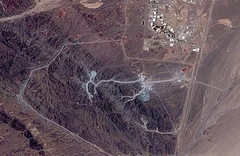

According to US Central Command, American forces struck more than 80 targets, including Iranian air defence systems, command-and-control networks, coastal radar sites, surface-to-air missile batteries, anti-ship cruise missile positions, drone launch sites, port facilities and more than 60 small boats belonging to the IRGC.
Iran Summons Swiss Chargé D'Affaires
In response to the US strikes, Iran's Foreign Ministry summoned the Swiss chargé d'affaires in Tehran, who represents US interests in the country, to protest what it called "America's aggressive actions and violations of international law," according to a statement from the Iranian Foreign Ministry. The ministry warned that "any aggressive action against Iran's territorial integrity will be met with a decisive and proportionate response."

NATO Chief Backs US Strikes
NATO Secretary General Mark Rutte defended the new US strikes as "absolutely necessary." "When you have a ceasefire and Iran is basically violating the ceasefire, I think it is totally crucial that the US forcefully react," Rutte told reporters before the summit.
Rutte said there could be no doubt over the "complete commitment of the United States to NATO," but added that "there's also the expectation that the Europeans and the Canadians will equalise their spending with the United States, which I think is completely fair." "The good news is that this is the big win today. It's the loss for Putin, it is a win for President Trump that the Europeans and the Canadians are doing exactly that," he said.
German Foreign Minister Johann Wadephul said the latest US attacks on Iran were warranted, telling German broadcaster NDR Info: "Iran must now truly understand that serious negotiations are necessary."
NATO Unveils $40 Billion Counter-Drone Push
The summit also saw major defence announcements. NATO Allies announced that over $40 billion will be invested in counter-drone capabilities over the next five years, with a goal to train five times as many drone operators by the end of 2027. NATO will also establish a counter-drone marketplace to ensure systems are NATO-tested and compatible, according to a NATO statement.
NATO Deputy Secretary General Radmila Shekerinska presented new initiatives in space, strike capabilities, and integrated air and missile defence. Eight Allies launched a new project to explore the development of a mega-constellation called HALO, which would improve high-speed communications, intelligence gathering, and missile tracking. Spain joined NATO's Alliance Persistent Surveillance from Space initiative, becoming the 19th participating country.
On strike capabilities, Allies announced multinational projects including efforts to develop a generic NATO 155mm munition and scale up production of loitering munitions. The NATO Support and Procurement Agency will acquire 700 PAC-2 and 200 PAC-3 missiles for air defence. Belgium and the Netherlands signed a Memorandum of Understanding for government-to-government procurement of air defence systems, while Türkiye announced major investments in its domestic air defence production.
Denmark, Finland, Germany and Norway also announced the procurement of up to five Northrop Grumman MQ-4C Triton high-altitude, long-endurance unmanned aircraft to enhance NATO's Intelligence, Surveillance and Reconnaissance Force. The aircraft can sustain 24-hour flights at an altitude of more than 15 km and are designed for maritime surveillance.
NATO Secretary General Mark Rutte launched two major initiatives: the "NATO Front Door for Industry," a single point of access for companies to NATO procurement opportunities, and the "NATO Engine," a framework to connect available factory capacity across the Alliance.