
Going Back To The Basics
- Companion Cropping Complementary crops are planted next to each other so that one can act as a natural pest repellent agent to the other
- Integrated FarmingFruit trees are planted in the middle of a crop of vegetables so that they provide natural fertilisers to the land
- Vermi composting Soil worms are used to help in the fertilisation process
- Natural Products used in organic fertilisers Cattle dung, cattle urine, milk, buttermilk, cottage cheese, fenugreek seeds, neem leaves, green chillies, brown sugar, rock salt, ghee
***
Imagine digging into fare made of lush red tomatoes or fresh carrots brought to the table fully chemical-free. If that’s tempting, maybe it’s time to go to Punjab. The ‘green revolution’ state is seeing a different kind of greening this time—the beginnings of a shift to an ‘organic’ green in the fields and on the plate. And among those taking the lead is the Golden Temple—also one of the biggest landlords in the state—with its managing body, the Shiromani Gurudwara Prabandhak Committee (SGPC), going organic on nine of the 13,000 acres of agricultural land under its control. Last year, it got first-level organic certification for the nine acres and the plan is to bring most of the remaining land under organic cultivation over the next few years.
The green revolution—promoted as an answer to the food crisis in the 1960s—had also brought in extensive use of chemical pesticides and fertilisers to the average Punjab farm, the central lab of that ‘revolution’, chosen because of the region’s strengths such as an extensive irrigation network based on canals dug during British rule.
It was just a matter of time, however, before the revolution’s USP—beefed-up production—got a reality check and was deemed a has-been, while the focus of its critics turned to the ecological costs that fell disproportionately on the people of the state. “Punjab has been milked of its resources for feeding the nation,” says Gunbir Singh of Eco Sikh, an NGO working on environmental issues.




On what the green revolution has done to farming practices, organic farming expert Rajbir Singh says, “Farmers here take heavy use of chemicals as a given in agriculture. Over-sprinkling of pesticide is quite common as it allows farmers to take longer breaks between tending the crop.”
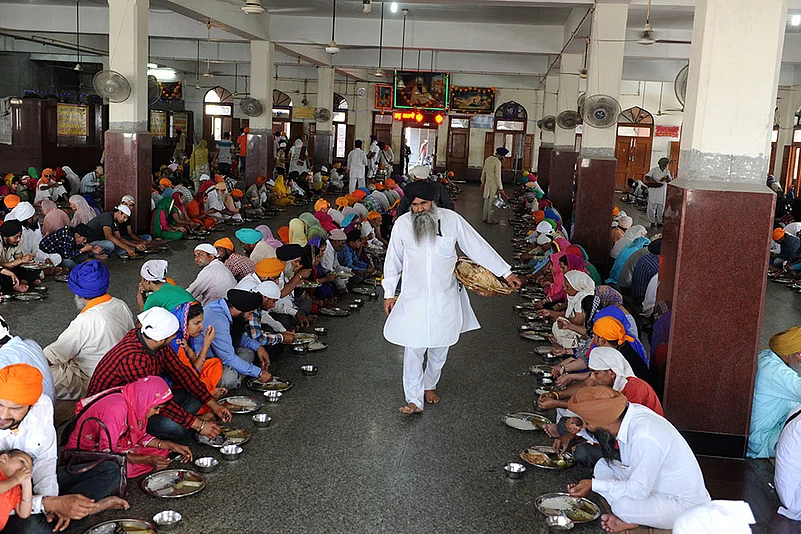
If the SGPC’s initiative signals a change in thinking bigger than the first nine organic acres of its farm, it could trigger a rediscovery of the joys of a meal sans chemical residue from the production process. Meanwhile, the feelers have been good and visitors at the Golden Temple are excited about the reimagined, organic turn to the traditional fare at the langar (community-based gurudwara kitchen offering food to devotees).
So what prompted the most powerful socio-religious organisation in the state to go organic on its farms? Over the years, loss of soil quality due to intensive use of chemical fertiliser has become impossible to ignore and people have also died of cancers caused by overexposure to chemicals on the farm or in their food. In 2013, a World Health Organisation report noted that nitrate levels in 20 per cent of water samples from Punjab were found to be above the 50-mg mark, making it unsafe for drinking.
So, when Eco Sikh approached SGPC two years ago, “the idea of going organic struck us immediately,” says SGPC chief secretary Harcharan Singh. “The gurudwara owns land at several places across the state and we decided to start the initiative in the farms closer to Amritsar.”
That’s how the farms of Satlani Sahib on the outskirts of the city became the first to turn a deep shade of organic green. Here you don’t see farmers carrying pesticide sprayers—a common sight on farms elsewhere—and are instead greeted by the fragrance of fresh-grown tomatoes and fenugreek, and on the periphery, also a hint of apricot and mulberry. The tomatoes look fresher than those from neighbouring non-organic fields and the grains of wheat are bigger though relatively coarser.
“Once you get the knowhow of organic farming, it turns out to be the better option,” says Rajinder Singh, manager of the Satlani Sahib farms. A year of doing organic farming as ‘service’ to the gurudwara has exposed the farmer volunteers to the viability of the idea, and some are considering making the shift in their own fields. Harpag, a farmer who owns 10 acres, says, “We have already gone organic on the land where we produce for our own consumption and are looking at whether it would be profitable to extend it to the rest of our farms.”
The SGPC target is to get complete organic certification within two years—not an easy task given the tough official standards that have to be met. “For the crop to be called fully organic, the soil needs to be rejuvenated for three years. That process is under way,” says Gurjit Singh, an expert helping with the organic transition.
According to the gurudwara administration, the decision to go organic is in sync with the Guru Granth Sahib’s principle of “Pavan Guru, Paani Pita, Maata Dharat” (“the wind is our teacher, water our father and earth our mother”, implying that nature provides us with all we need to live and grow). Religion plays a big role in the lives of the locals and most farmers follow the tradition of dasvandh—contributing 10 per cent of their produce to a religious organisation. Hoping to turn that into a motivation to farmers for going organic, the SGPC has asked farmers to produce in organic ways, on a trial basis, the same percentage of their total crop. This has found many takers as it doesn’t involve drastic overnight changes in their cropping pattern.
Some of those who have tried out organic farming agree that, contrary to their earlier perception, they found it was an economical option. “Growing a portion of the crop organically is quite viable financially,” says Kuldeep Singh, who owns five acres. “I realised this after the Golden Temple initiative.”
“The only expenses involve the cost of procuring seeds initially to start off the process that also yields organic fertilisers,” says Rajbir, the expert. Organic farms usually function on the principle of integrated farming where the farmer not only grows the crops but also provides a complete ecosystem for it. So a part of the land has to be set aside for processing natural fertilisers, sowing of complementary crops to act as natural disinfectants and sometimes even for raising cattle for the manure—all of which are already available to most farmers in the region.
Besides the SGPC, the government too has tried to popularise the concept of going chemical-free among Punjab’s farmers. The Paramparagat Krishi Vikas scheme, introduced in this year’s budget, aims at increasing the area under organic farms to 5 lakh acres over the next three years by subsidising organic seeds and offering loans to farmers who choose to go organic.
Yet, much ground remains to be covered as a walk through the Hoshiarpur mandi on the outskirts of Amritsar makes quite evident. Here you come across farmers who are not sure about the costs and benefits of organic farming, and are, therefore, wary of what they dismiss as a rich man’s fad, too risky for those who depend exclusively on agriculture to make ends meet. This makes the Golden Temple’s initiative all the more significant as it could be just the push Punjab’s farmer needs to get rid of the myths and take the organic route to sustainable farming.