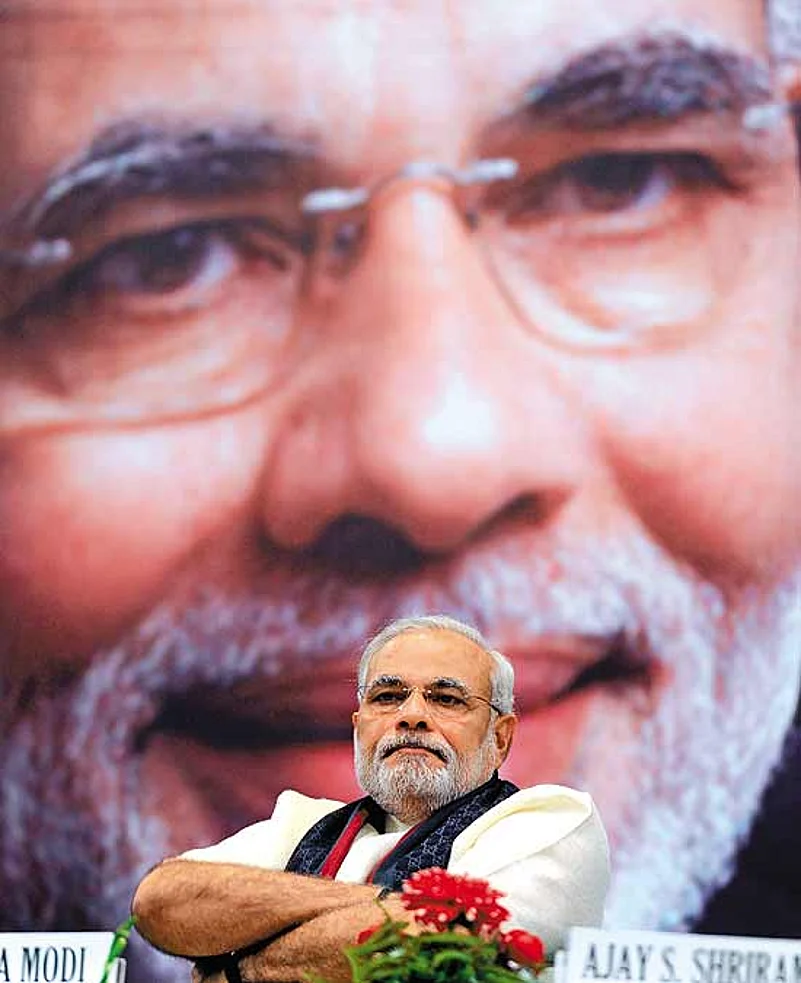

Narendra Modi’s three successive victories in Gujarat, his ability to project himself as the BJP’s possible prime ministerial face, the EU move to lift its 10-year-old boycott of him...there are signs of a growing ‘destigmatisation’ of Modi and a willingness to do business with him. But as the row over his Wharton video lecture shows, an influential section in the United States is still not impressed. If nothing else, the controversy showed that even a decade after the Gujarat riots, many in the US are unwilling to forget his anti-Muslim image.
Some US lawmakers and international rights organisations point out that the accusations about the Modi government’s complicity in the ’02 riots haven’t been adequately investigated. “It’s been 10 years but the very credible allegations of the Gujarat state machinery’s culpability in the riots haven’t been seriously investigated,” says T. Kumar, director of international advocacy at Amnesty International USA. US officials say the Obama administration has no intention of revoking a visa ban imposed on Modi by the Bush administration in ’05. Last November, 25 Congressmen—Democrats as well as Republicans—wrote to then secretary of state Hillary Clinton urging her to keep the ban in place.
That said, the Wharton India Economic Forum’s decision earlier this month to invite and then rescind its invitation to Modi sparked off a firestorm of controversy in the Indian American community here. It all started with the forum, an annual student-run conference hosted by the Wharton School of the University of Pennsylvania, taking flak from some of the university faculty and students for inviting Modi to address its meeting via Skype. When it cancelled last weekend, Modi’s supporters jumped into the fray complaining that his right to free speech had been infringed.
“The reason Modi supporters are turning this into an issue of free speech is that the whole event has coincided with the massive effort to project him as a viable PM candidate. And this shows why he is not,” says Prof Ania Loomba of the university, who helped mobilise the opposition. “We are not opposing his right to free speech. What we are opposed to is the forum—which is an element in a larger institution of which we are a part—granting him a position of honour to increase his personal legitimacy, and thus further a political agenda which we find reprehensible.”
Modi had agreed to address the gathering but had refused a Q&A session with students or faculty members. This, critics like Prof Loomba felt, would only “contribute to the efforts to sanitise his government’s record”. Modi’s supporters, meanwhile, ask why such a song-and-dance was being made when in the past many other controversial figures have been allowed to address students at universities across the US. They also argue that while there is a strong sentiment against Modi, the same is absent against the Congress leaders and the party, which is yet to take action against those involved in the anti-Sikh riots in 1984 or the Mumbai riots in 1992-93.
Indiana University’s Sumit Ganguly blamed it on the forum’s clumsy handling of the issue. “I hold no brief for Modi, but if you’re going to invite someone whom you know is a polarising figure, then it behooves you to think through the likely reactions of your constituents before inviting him,” he says.
Modi’s supporters say the controversy is more than just about freedom of speech. “This is about an elected representative of the people of India, and to snub him is an insult to India,” says Gaurang Vaishnav, a New Jersey-based governing council member of the Vishwa Hindu Parishad of America. “It is not Modi’s loss; it is a loss for the students.”
For Prof Loomba, though, what is most worrying is this shift in the public perception of Modi. “This shift—without any change in practice—is precisely what his supporters have been orchestrating for a while,” she says. “We are firmly opposed to any attempt to delink ‘development’ from ‘human rights’: the kinds of atrocities minority communities suffered and continue to suffer in Gujarat are not neatly separable from ‘economic development’.”
Of course, his supporters dismiss these lingering complaints. “The entire world has moved forward, yet some of these people are stuck in 2002,” says Dinesh Agrawal, professor at Penn State University and ex-president of the Overseas Friends of the BJP.
If the US is anxious about improving ties with Modi, it isn’t saying. The Democrat administration will likely “continue to pay heed to these anti-Modi sentiments” because President Barack Obama is sensitive to human rights, says Ganguly. “If there is continued opposition (to Modi) across the US from key stakeholders, then I do not see the state department overlooking those sentiments,” he says. “If Modi were to become prime minister, it would put the US in a rather awkward position,” he adds.
To Modi’s supporters, the visa ban is of little consequence. “Modi hasn’t asked for a US visa, so how does it matter?” asks Vaishnav. “In today’s world, you don’t need a visa unless you want to go sightseeing, and Modi has no time for that. He is able to communicate with people in the US without coming here.”
The Gujarat CM frequently addresses gatherings of Indian Americans via video link. The Wharton controversy was still raging when the Overseas Friends of the BJP announced, almost as if to make amends, that he would address supporters in the US and Canada from Ahmedabad on March 9. Modi’s backers often pack these events to listen to a man they say has transformed Gujarat into an economic powerhouse.
But even this boom story has its share of doubters. Kamala Visweswaran, of the University of Texas at Austin, says reports of Gujarat’s economic success are mixed at best. “Modi is desperate for FDI, so it’s not surprising that he actively seeks ways to tap into US investment capital,” she says. The Wharton invitation reflected nothing more than Modi’s “narrow base of affluent supporters and hired PR consultants actively seeking to rebrand Moditva as good government. Modi’s critics in the Indian American community may have less money, but they are larger in number”, she adds.
By Ashish Kumar Sen in Washington