At the centre of the debate are the UGC (Promotion of Equity in Higher Education Institutions) Regulations, 2026, framed to replace the 2012 guidelines dealing with caste discrimination in higher education.
The 2012 guidelines were largely advisory. Universities were encouraged to establish grievance redressal mechanisms and equal opportunity structures.
The rules define “caste-based discrimination” as acts of discrimination against students belonging to SCs, STs and OBCs.
The controversy surrounding the University Grants Commission’s (UGC’s) new regulations has revealed far more than a disagreement over administrative procedure. It has exposed how fragile trust has become on Indian campuses, how unresolved the issues of caste remain, and how difficult it is to design laws that both protect and unite a deeply stratified society.
At the centre of the debate are the UGC (Promotion of Equity in Higher Education Institutions) Regulations, 2026, framed to replace the 2012 guidelines dealing with caste discrimination in higher education. On paper, the intent appears straightforward: to strengthen compliance, ensure accountability, and prevent the institutional apathy that has allowed discrimination to persist despite decades of legal safeguards. The difference between the two frameworks, however, is crucial. The 2012 guidelines were largely advisory. Universities were encouraged to establish grievance redressal mechanisms and equal opportunity structures, but there were no real penalties for non-compliance. Institutions that failed to implement them faced little more than moral pressure. Over time, this lack of enforceability came to be seen as a serious weakness.




The 2026 regulations attempt to close that gap. They mandate equal opportunity cells and equity committees, equity squads, a 24-hour helpline, strict timelines for responding to complaints, and crucially, empower the regulator to penalise institutions for non-compliance, including by withholding or denying central grants. This shift from persuasion to enforcement marks a fundamental change in regulatory philosophy.
This tightening did not emerge in a vacuum. It followed a 2019 petition before the Supreme Court by the mothers of student victims who faced caste discrimination in higher education institutions, who argued that institutional inaction had compounded the harm suffered by their children. The Court took serious note of the failure of universities to act decisively and signalled the need for a more robust and enforceable framework. The new regulations were, in many ways, a response to that judicial nudge. Yet, the substance of the regulations quickly became controversial.
The rules define “caste-based discrimination” as acts of discrimination against students belonging to Scheduled Castes, Scheduled Tribes and Other Backward Classes—a move that critics argue inherently dilutes the intent to promote equity. By excluding students from the general category in this definition, the rules presuppose that general category students can, in no case, be victims of caste discrimination. These regulations prescribe equity committees to be represented by women members and members of all other castes, but do not specifically mandate the representation of the general category, leading to allegations of unbalanced composition and perceived bias. Most contentious of all is the absence of protection for general category students in case of any false or malicious complaints, which has fuelled fears of misuse, particularly among general category students and faculty. Protests erupted on several campuses. A few critics described the regulations as a “black law”, arguing that they presume guilt and foster an unequal and discriminative academic environment against the general class.
The need is to create an environment where students learn the harder task of living together with fairness, dignity, and trust. Regulation can set the floor. Harmony has to be built above it.
On January 29, 2026, the Supreme Court of India stayed the implementation of the regulations. The Court did not reject the need to combat caste discrimination. Instead, it signalled caution, acknowledging concerns that the regulations, as drafted, could deepen division and mistrust rather than promote equity. Until further orders, the 2012 advisory guidelines remain in force, and the UGC has indicated that it will revisit the draft.
These facts matter. But they do not explain why the issue has struck such a raw nerve. Caste is not merely a policy matter. It is a civilisational inheritance. It predates the modern Indian state and has shaped our social interactions, access to social services, employment, and dignity for centuries. The Constitution confronted this reality and provided comprehensive structures and provisions to promote equality and equity for all and to outlaw discrimination against anyone for any reason whatsoever. Reservation and caste-based protections were thus conceived not as concessions but as corrective justice, meant to bring historically excluded communities into institutions that had long been closed to them.
Yet the law has often been unable to keep pace with the realities of society. Despite constitutional safeguards, caste conflicts persisted, sometimes through explicit actions and many a time through subtle exclusions and everyday humiliations. Education and urbanisation did blur rigid caste boundaries. Cities enabled anonymity, mobility, and interdependence in ways villages often did not, where caste remains tightly woven into physical spaces and social life. But even in these spaces, caste crept in.
Higher education became one of the most prominent sites of caste-driven schisms. Affirmative action brought students from marginalised castes onto the same platforms as others. Classrooms and hostels became shared spaces of aspiration. This was a remarkable achievement. But it also exposed a difficult truth: caste consciousness does not simply stop at the gates of a university. It travels with people, shaping friendships and interactions. Universities thus became places where legacy prejudices and modern realities intersect daily. In such spaces, friction was inevitable.
This is why the debate around the current UGC regulations is a reminder that India’s engagement with caste remains unfinished. Discrimination on the basis of caste is real and persistent. Denying it erases the lived experiences of many. Thus, regulations that safeguard against discrimination are necessary. At the same time, fears about false accusations, procedural unfairness, and institutional biases are also real. Dismissing these anxieties as reactionary only deepens mistrust. Hence, what is equally important is to ensure that these regulations are free from any biases or imbalances and that all students get equitable access to opportunities for learning, engaging, growing and accessing grievance-redressal mechanisms. The task before policymakers is not to choose between competing fears, but to design systems that deftly assimilate both. The need is to create an environment where students learn the harder task of living together with fairness, dignity, and trust. Regulation can set the floor. Harmony has to be built above it.
(Views expressed are personal)
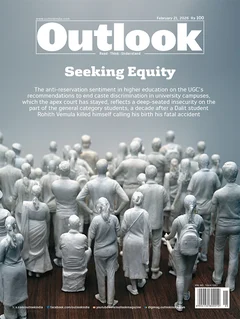
This article appeared in Outlook's February 21 issue titled Seeking Equity which brought together ground reports, analysis and commentary to examine UGC’s recent equity rules and the claims of misuse raised by privileged groups.


Kishore Desai is a public policy and infrastructure sector professional.