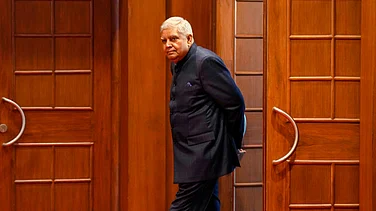
He donned many roles as a historian, educationist and public intellectual.
His studies on colonial India’s intellectual history and the Malabar Rebellion stand out among his major contributions.
As a historian and public intellectual, Panikkar consistently spoke out against the rise of majoritarian politics
“The historian’s history is in danger of being marginalised in popular discourse,” wrote K. N. Panikkar in his introduction to the edited volume “The Concerned Indian Citizen’s Guide to Communalism’.
Published in the aftermath of the Babri Masjid demolition, at a time when Hindutva was steadily percolating through political and academic discourses, the volume stood out as a significant intervention. It attempted to help ordinary readers understand how communalism operates and how it gradually spreads its tentacles across different spheres of public life — from politics and education to culture and everyday social relations.
Panikkar, one of India’s most distinguished historians, wore many hats over the course of a long and prolific career — historian, teacher, educationist and public intellectual. His scholarly work was rooted in the traditions of critical and materialist historiography, and he remained deeply committed to defending the integrity of historical scholarship. Over the years, his writings increasingly addressed the growing attempts to distort history for ideological purposes.
One of his major concerns in recent years was the way myths were being presented as historical facts. In lectures, essays and interviews, he repeatedly cautioned against the dangers of replacing evidence-based history with myth-making. He also warned about the tendency to ignore the complex social and economic forces that shape historical processes. According to him, such distortions not only undermine scholarship but also weaken democratic discourse.




“The challenge of historiography is to reclaim the fundamental principles of historical writing,” he had once remarked in an interview. For Panikkar, historical writing had to remain objective and scientific, firmly grounded in verifiable evidence. But such scholarship, he believed, required a conducive intellectual atmosphere — one that allowed historians to pursue critical inquiry without fear or interference. Any attempt by the state to mould history to suit its ideological agenda, he argued, posed a serious threat to both academic freedom and democratic values.
As a historian and public intellectual, Panikkar consistently spoke out against the rise of majoritarian politics and its implications for Indian society. He viewed the spread of majoritarianism not merely as a political phenomenon but as a broader ideological project that could influence institutions, education systems and cultural narratives.
Through his scholarship, teaching and public interventions, Panikkar remained a steadfast advocate of secular and rational historical inquiry. His work served as a reminder that history is not merely about the past, but also about the values and principles that shape the present.
Rooted in Marxist historiography, K. N. Panikkar consistently foregrounded economic and material conditions in his research. His work on the Malabar Rebellion illustrates the importance he attached to analysing historical events through material realities rather than ideological interpretations.
The rebellion, which took place in the Malabar region of present-day Kerala, was often described by proponents of Hindutva as a purely communal uprising. Panikkar challenged this interpretation in his influential work ‘Against Lord and State: Religion and Peasant Uprisings in Malabar, 1836–1921’. In the book, he argued that the uprising was rooted primarily in agrarian tensions, economic deprivation and the oppressive structure of landlordism under colonial rule.
According to Panikkar, while religious identity played a role in shaping the rebels' mobilisation, the rebellion cannot be reduced to a communal conflict. Instead, it emerged from a complex interplay of economic exploitation, peasant grievances and colonial authority. These factors together created the conditions for a struggle directed both against the landlords and the British colonial state.

By foregrounding these material and social dynamics, Panikkar sought to move the discussion beyond communal interpretations and restore the historical complexity of the rebellion.
‘Culture, Ideology, Hegemony: Intellectuals and Social Consciousness in Colonial India’ is another important work by Dr. Panikker, which examines the methods the British used to exert cultural domination in the early days of colonialism.
Like many scholars rooted in Marxist historiography, K. N. Panikkar often pointed to the link between the rise of neoliberalism and the growth of majoritarianism in contemporary India. He argued that these developments were not isolated phenomena but part of broader structural changes in society.
Panikkar believed that the rise of majoritarianism as a dominant ideology needed to be understood within the broader political, cultural, and economic conjuncture that emerged in post-Independence India. According to him, the interplay of economic transformations, shifts in political power and the reshaping of cultural narratives created conditions in which majoritarian ideas could increasingly gain legitimacy in public life. For him, the battle over history was also a battle over the nature of Indian society itself — whether it would remain anchored in pluralism and rational inquiry or yield to myth, prejudice and majoritarian narratives.