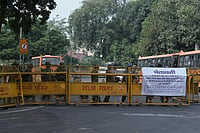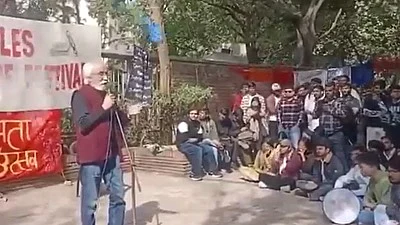
S. Irfan Habib’s speech at Delhi University was disrupted during AISA’s Samta Utsav after water was thrown at the stage.
AISA blames ABVP members, while the administration cites lack of permission and formal complaint.
The episode reflects a broader trend of disrupted lectures and cancelled academic events across Indian campuses.
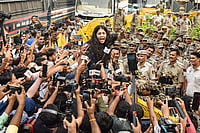
On Thursday, 12 February, historian S. Irfan Habib’s speech at Delhi University’s Arts Faculty was disrupted when unidentified individuals hurled a bucket of water at him during the People’s Literature Festival (PLF), organised by the All India Students’ Association or AISA.
The disruption occurred during a session titled “Caste in Indian Society and Universities,” where the Historian was speaking about the “distortion of history” and “the deliberate attempt by the BJP RSS to rewrite history”.
The student group was organising “Samta Utsav” (Equity Festival), as a grassroots alternative platform to the university’s official literature festival. The primary goal of the event was also to demand the immediate implementation of UGC regulations based on the “Rohith Act”.
“The idea was to organise something parallel to [the official festival] and present the real voices, the real marginal literature that talks about equality and justice in the university,” explained Anjali, AISA DU Secretary.
AISA alleges that members of the Akhil Bharatiya Vidyarthi Parishad (ABVP), the student wing of the Rashtriya Swayamsevak Sangh (RSS), were responsible for the act, describing it as an attempt to derail the event.


Anjali states, “There is a video in which an ABVP Law Faculty activist, has a stone in his hand. He is sitting behind that boundary with a stone.” The video has also been uploaded on the organisation's Instagram handle.
She alleged that the situation escalated as stones were thrown at the gathering. No formal complaint has been lodged so far, with videos of the disruption circulating on social media.
The event drew a good response from students. However, highlighting the venue disparity, Anjali said, “We don't even get a seminar hall or conference hall or rugby ground like the ABVP; we are doing our event on the university streets." She said that many students saw how the water bucket was thrown from behind the stage, leading to brief confusion.
However, Historian Habib, known for his research on Indian history resumed and completed his speech within a few minutes, the incident marks the latest in a series of academic event disruptions across Indian campuses.
The AISA DU secretary expressed concern over the response from university officials and the police.
Despite the heavy presence of CRPF, police, and guards, Anjali alleged that “they were standing there to protect the perpetrators only.” According to Anjali, when students provided video proof and the police initially detained a suspect, “the police released him in front of us.” She added that the Proctor and the SHO demanded video footage showing “the exact moment a stone left a person's hand,” while refusing to check the university's CCTV cameras.
The Administration’s Stance
When questioned about the attack on Habib, DU Proctor Manoj Kumar Singh shifted the focus to the absence of a formal complaint. “I have seen the video but I have not received any complaint,” he stated. He argued that without a written report, he cannot initiate any official action, asking how he could possibly know who was responsible for throwing the water or the bucket.
The Proctor also questioned why the incident was being blamed on the university's security, suggesting that the event itself was unauthorised. He said the organisers had failed to provide a notice to his office or seek the necessary permission to hold the event.
“They didn't take permission," he remarked, implying that the students often bypass university protocols.
Kumar summarised his stance in three parts: the lack of permission for the event, his lack of knowledge regarding the perpetrators, and the absence of any filed complaint. He flatly denied the claim that AISA students gave him video evidence of an ABVP member holding a stone.
“AISA has not shown me anything. No one came to me,” he said. He concluded by asking how it would be possible to take action without knowing exactly “who has thrown the water and who’s thrown the bucket.”
Growing Intolerance in Campuses
According to Scholars at Risk, 395 incidents affecting academic freedom were recorded worldwide between July 2024 and June 2025, with India drawing attention due to concerns over political pressure.
Scholars at Risk is an international network of higher education institutions and individuals founded in 1999 and based at New York University. Its annual Free to Think report, produced by the Academic Freedom Monitoring Project, documents attacks on scholars, students, and universities worldwide and analyses trends in repression of higher education.
In December 2025, Karnataka Central University cancelled a lecture by writer-activist Deepa Bhasthi, citing technical reasons. Critics, however, alleged ideological pressure from right-wing groups.
On October 31, 2025, the Delhi School of Economics cancelled a session of its Friday Sociology Colloquium titled “Land, Property and Democratic Rights.” Convener Nandini Sundar later stepped down, citing administrative interference and raising concerns about academic autonomy.
In August 2025, St Xavier’s College in Mumbai cancelled its annual Stan Swamy Memorial Lecture following protests by ABVP, which objected to the event honouring the late activist priest who had faced anti-terror charges before his death in custody. The lecture was later held online at another venue.
In October 2024, Jawaharlal Nehru University cancelled three seminars featuring ambassadors from Iran, Palestine, and Lebanon. Faculty sources indicated concerns over potential protests.
In April 2024, Delhi University withdrew permission for a pre-approved event titled “Let Us Hear a Palestinian Word,” citing security concerns amid tensions in West Asia.
The same month, the Indian Institute of Science Education and Research (IISER), Pune cancelled talks during its Muktiparv festival after ABVP objected to some speakers, alleging ideological links. Students described the decision as censorship.
On March 12, 2024, a lecture by JNU professor Nivedita Menon at Gangadhar Meher University in Odisha was disrupted by ABVP-affiliated students who raised slogans, forcing her to leave the stage midway.
Reports from organisations like Scholars at Risk indicate these incidents reflect growing tensions around discussions on social justice, democracy, and global conflicts on campuses. While university administrations often cite security concerns or procedural grounds, critics argue that such decisions amount to self-censorship.
The Academic Freedom Index rated India as “completely restricted” in 2024, assigning it a score of 0.16, citing constraints on research, teaching, and campus expression.
In the S. Irfan Habib incident, AISA has demanded action against those involved and urged the university to ensure the protection of open academic spaces. As debates continue, the episode underscores ongoing concerns about the state of academic freedom and dialogue in India's universities.