Event marks Palestinian Prisoners’ Day with focus on rising detentions and new death penalty law
Speakers raise concerns over administrative detention, prison conditions, and international law violations
Exhibition of images and AI visuals highlights loss, restricted access, and shared histories of resistance
You walk in past a photograph of Bhagat Singh. He is looking straight ahead, the way he always does. Fearless, ageless, called Shaheed, the martyr. The image is an insistence that the definition of a terrorist and a freedom fighter has always depended on who holds the pen, who holds the gun, and who holds power…
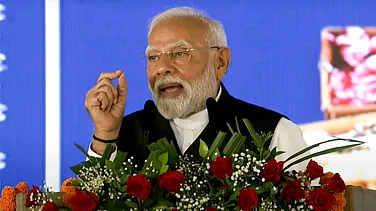
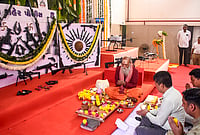
On Monday, the Embassy of the State of Palestine in New Delhi hosted a solidarity meet on the eve of Palestinian Prisoners’ Day. Observed each year on April 17, it is an international day of action for the liberation of Palestinian prisoners, commemorated since 1974. The date was chosen to mark the release of Mahmoud Bakr Hejazi on April 17, 1971, during the first prisoner exchange between Israel and Palestinians.
This year, it carries a particularly heavy weight. The Death Penalty Law, passed just weeks before Prisoners’ Day on March 30, introduces execution by hanging exclusively for Palestinians. Politicians were seen celebrating in the Knesset wearing nooses.
The Death Penalty Law
The most alarming development discussed at the gathering was the passage of the Death Penalty Law. On March 30, the Israeli Knesset passed the Penal Bill (Amendment — Death Penalty for Terrorists), condemning Palestinians convicted of acts of violence to death by hanging. The bill stipulates that those convicted in Israeli military courts of carrying out deadly attacks deemed “acts of terrorism” would be executed within 90 days of conviction, with a possible postponement of up to 180 days. Introduced by Minister Itamar Ben Gvir, the law applies exclusively to Palestinians and is set to take effect at the end of April 2026.


On the day the law passed, Israeli politicians were seen wearing hangman’s nooses on their lapels, celebrating in the Knesset. The law targets up to 117 prisoners currently serving life sentences, though legal experts note it would not be applied retroactively to those presently held.
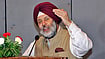
Palestinian ambassador to India Abdullah Abu Shawesh argued that such measures raise serious legal and moral questions under international law. “These discriminatory legislations fuel racism and extremism and a world that overlooks them contributes neither to peace nor to stability in the region.”
Who Are the Palestinian Prisoners?
They are not, the gathering was reminded, merely numbers. They are names and stories.
As of April 2026, the total number of Palestinian prisoners and detainees has exceeded 9,600. Among them are 84 female prisoners, many facing medical neglect and isolation, according to the Palestinian embassy. Approximately 350 children are currently detained, primarily in Megiddo and Ofer prisons, where they are often denied rights guaranteed under international law. The number held under administrative detention, imprisoned without charge or trial, has reached 3,532, the largest category among all detainees.
The ambassador placed these figures in a longer historical arc. Since 1967, nearly three-quarters of a million Palestinians have been arrested and detained. Since October 7, 2023, approximately 22,000 more have been arrested in the occupied West Bank, including East Jerusalem. Among them, the embassy stated, are 1,760 children, over 731 women, and 240 journalists. Administrative detention orders in this period number more than 19,954, accounting for around 91 per cent of all arrests cited.
A senior Palestinian official described what is unfolding inside these prisons as a “silent genocide,” running alongside the live-streamed one in Gaza. Severe torture, deliberate medical neglect, and starvation have led to the deaths of at least 89 Palestinian prisoners inside Israeli jails since October 2023, described as a record toll. The embassy’s figures cite 326 prisoners who have died in custody since 1967, with the bodies of 97 still being withheld.
Inside Detention Walls
The embassy cited a report released in April 2026 by the Euro-Mediterranean Human Rights Monitor, titled Another Genocide Behind Walls. It alleges that Israeli detention centres have become a systematic structure of abuse, operating with institutional support and impunity, and warns that these practices may constitute war crimes and crimes against humanity requiring urgent accountability.
Documented conditions include prisoners suffering from chronic illnesses without adequate treatment, delays in care leading to complications and death, prolonged isolation causing psychological harm, physical abuse, stress positions, sleep deprivation, and verbal humiliation. Families face permit denials and travel restrictions that prevent visits. The embassy further alleged that some detainees from Gaza remain subjected to enforced disappearance, leaving families without knowledge of their fate.
Voices in the Room
Ambassador of the Kingdom of Morocco to India Mohamed Maliki spoke about obligations under the Geneva Conventions, the denial of adequate medical services, the practice of torture, and what it means when a signatory state violates them in full public view.
Particular condemnation was reserved for administrative detention. Such detention echoe colonial-era laws like the Rowlatt Act, once used by the British in India to imprison people without trial. The mechanisms change, but the logic of silencing dissent remains.
The venue held grief and rage with quiet dignity, with photographs of Palestinian journalists killed in Gaza. On display were photographs of journalists killed in Gaza and the occupied West Bank, including Shireen Abu Akleh and Ismail al-Ghoul. Abu Akleh was shot dead in 2022 while covering a raid in Jenin; al-Ghoul was killed in Gaza in 2024 when his clearly marked vehicle was struck. The conflict has been described as the deadliest ever for journalists, with more reporters killed in Gaza than in multiple past wars combined.
Also on display were haunting AI-generated visuals of “what no camera has been permitted to show.” “Since we don’t have access to them,” the ambassador said, “this is what we have created using AI, to remember those lying in prisons.”
The photograph of Bhagat Singh, who was hanged at 23 by a colonial power that called him a terrorist, at the entrance felt like a testament to India’s connection to Palestine. “Our relationship runs through the anti-colonial imagination, through the understanding that occupied peoples recognise each other across distance and time,” the ambassador said.