






UN Secretary-General Antonio Guterres described India as a "very successful" emerging economy and the “right place” to host the India–AI Impact Summit 2026.
He stressed that AI must benefit all nations, especially the Global South.
Guterres also voiced “frustration” over the UN Security Council’s inability to act effectively, calling for urgent reforms to reflect today’s global realities.
India is a "very successful" emerging economy with growing influence in global affairs and is the “right place” to host the AI summit, UN Secretary-General Antonio Guterres has said.
In an exclusive interview with PTI at the UN Headquarters ahead of the India–AI Impact Summit 2026, Guterres stressed that Artificial Intelligence must serve the entire world rather than remain the preserve of developed nations or two superpowers.
“I strongly congratulate India for organising this Summit. It's absolutely essential that AI develops itself to the benefit of everybody, everywhere and that countries in the Global South are part of the benefits of AI,” he said.
The summit, scheduled from 16 to 20 February, will be the first AI gathering of its kind hosted in the Global South and will be guided by the principles of ‘People, Planet and Progress’.
Guterres, who is set to travel to India for the event, said “it would be totally unacceptable that AI would be just a privilege of the most developed countries or a division only between two superpowers”, in an apparent reference to the United States and China.


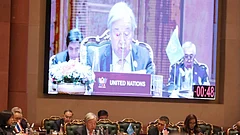
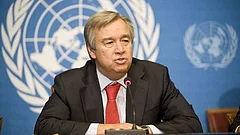
“It is absolutely essential that AI becomes a universal instrument for the benefit of humankind,” Guterres said.

“The role of India, (which) is today a very successful emerging economy that is having a bigger and bigger role in not only the global economy but in its influence in global affairs, India is the right place to have this Summit and to make sure that AI (is) being discussed in depth, in all its enormous potential and also in all its risks, but that AI belongs to the whole world and not only to a few,” he said.
The summit will bring together world leaders such as French President Emmanuel Macron and Brazilian President Luiz Inacio Lula da Silva, as well as technology executives including Google and Alphabet CEO Sundar Pichai, Adobe CEO Shantanu Narayen and Anthropic CEO Dario Amodei, for discussions on the future of AI.
Guterres met Prime Minister Narendra Modi on the sidelines of the G20 Summit in Johannesburg last year and also held talks with External Affairs Minister S Jaishankar in New York.
Reaffirming his strong support for multipolarity, Guterres highlighted India’s role in shaping a more balanced global order and said he looked forward to discussing this further with Indian leaders during his visit to New Delhi.
"There are two things we need to avoid in the world. We need to avoid the system in which there is total hegemony by only one power or a system in which the world is divided between two superpowers,” he said.
Guterres described himself as a “very strong advocate” of genuine multipolarity. He argued that such a system requires emerging economies to assume a “higher and higher” role and to build a “stronger and stronger” network of trade, technological cooperation and international partnerships.

In that context, he described the recent trade agreement between India and the European Union as a “good example” and added, “India is one of the most relevant emerging economies.”
"We are seeing across the world, more and more, the creation of a network of, I would say, all developed countries but also, and very importantly, emerging economies creating a true multipolarity without any hegemony, and allowing, then, multilateral organisations to be effective,” he said.
Emphasising the need for multipolarity, Guterres also expressed his “frustration” at the UN Security Council’s inability to address conflicts and maintain global peace and security.
"When one looks at the UN, you can imagine my frustration when I see the Security Council unable to take decisions, and it is clear that we need a fundamental reform of the Security Council, first of all, to represent the world as it is today and not after the Second World War. And second, to be able to take effective decisions for peace and security around the world,” he said.
He added that for a "fair" multilateral system — both within the UN and in international financial institutions — emerging economies must have a stronger voice and occupy a central role in global cooperation networks.
"I see India in the centre of those emerging economies, and this is something I would be delighted to discuss with Prime Minister Modi because I have a lot of hope for the role that India can play in shaping this multipolar world,” he said.
At the summit, Guterres will be joined by senior UN officials, including UN High Commissioner for Human Rights Volker Turk and Under-Secretary-General and the UN Secretary-General’s Envoy on Technology Amandeep Singh Gill.
Guterres further said that “it is always fantastic” to visit India, describing it as “a democracy with an enormous diversity and extraordinary civilisation and culture.” He noted that he is currently reading about India’s historic role in shaping global developments, “starting hundreds of years before Christ and going on for centuries, with an enormous influence of Indian culture, of Indian civilisation that we can see in China, Southeast Asia, the Indian Ocean." "Even in the time of the Roman Empire, there were very strong connections with India and a very important influence of Indian culture in what is today the Mediterranean area.
“So it is always an enormous pleasure to visit India,” Guterres said.
(with PTI inputs)
















