Outlook traced dust from stone crushers, encroachments and constant demolitions across Faridabad and the Aravalli fringe, where illegal and semi-legal operations continue openly.
Despite bans, distance rules and GRAP restrictions, crusher zones, roadside storage and rapid-fire construction all feed the steady plume that drifts towards rest of NCR.
These once-green patches, now barren and shifting, create a relentless dust cycle — build, break, rebuild — pushing particulate levels that help turn NCR air “severe”
When Delhi’s air quality improved to ‘severe’ from ‘hazardous’, people rejoiced. Now we only have an itchy throat; the burning eyes finally have some relief, hoorah!
While AQI discussions obsess over the usual suspects — stubble burning, Diwali pollution, vehicular emissions — some equally important culprits often get left behind. Like dust.
Those tiny, innocent motes twirling beautifully in a slant of sunlight may make for cinematic shots meant to evoke emptiness and sadness, but the same dust can choke us with near-fatal outcomes. From roads, construction, demolitions, mining and stone crushing, these near-microscopic particles greatly help push us to ‘severe’ 400 AQI. Studies place dust at 30–40 per cent of the AQI villains; one CEEW study suggests road dust alone can account for up to 65 per cent of PM10 pollution in some cases.
Meanwhile, the centuries-old silent sentinels of the Aravalli hills have guarded Delhi for eons, acting as a natural barrier to obstruct dust and sand from the Thar desert. Despite this mighty protector, the lands around Aravalli are oddly ‘dusty’.


So Outlook followed the journey of dust emerging from the leeward side of the Aravallis — from benign liquor store businesses to massive mining and stone crushing networks. We tracked the vital question: where is all this dust coming from?
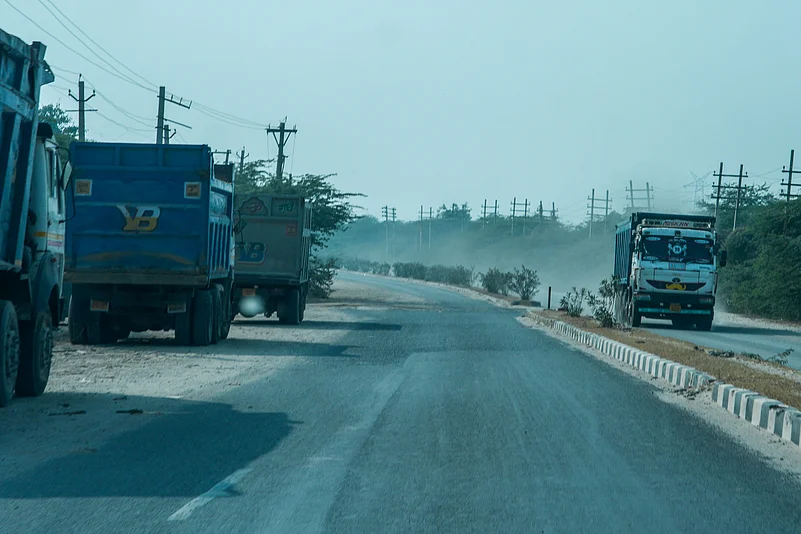
A little outside of Faridabad, Outlook followed a truck filled to the brim with very large stones. The journey led to dusty, broken roads near Pali Village. Soon more such trucks followed, all seemingly headed to the same location; so Outlook did the same. Google Maps soon informed us we were on “Stone Crusher Road”, and the visuals made the name painfully obvious. Dust coats everything. A single minute spent on the road leads to blurry car windows and thick, unbreathable air. Children can be spotted playing in an area that looks straight out of a post-apocalyptic dystopian movie, completely unbothered by poison settling in their lungs.

Under GRAP III, activities like stone crushing are explicitly banned. However, when Outlook visited “Stone Crusher Road”, several units were happily operational. On that day, Delhi’s AQI stood at 395 (very poor), while dust explosions from this temporarily illegal activity continued to exacerbate it. The dust, however — along with Outlook — still had a long way to go. Though in the past, this journey used to be longer. In 2016, stone crushing units had to be at least 1–3 kilometres away from highways and structures like schools. But in September 2025, the Nayab Singh Saini government slashed most of these distances by half. Now a stone crushing unit can sit 500 metres away from a highway or a school — and that much closer to the lungs of our children.

This is the dust’s haven. More than a dozen structures dot the road as far as the eye can see, each almost a replica of the next. There are 97 “authorised” stone crushers in Faridabad. While exact data on their land usage wasn’t available, all of this land was once fertile with thick green cover.
In the Aravalli region of Faridabad, stone crushing is legal while mining remains strictly illegal. And while stones can come from demolition sites, in Outlook’s dust-chasing journey at least twenty trucks were spotted within fifteen minutes — each carrying a few tons of stones — heading straight toward the crusher zone. So without mining, where is all this stone coming from?
As mentioned, stone cutting is illegal. Stone crushing is legal. And illegal transportation of illegal cut stone? The scene here in Faridabad — just a few kilometres from “modern” Gurgaon and the national capital — resembles a Mad Max franchise set . While it is obvious that crushing heavy stones creates dust pollution, the near-erasure of greenery around crusher units is another tragedy.
In 2015, the National Green Tribunal fined a few hundred crushers Rs 20 lakh each (totalling around Rs 65 crore) for failing to maintain a green belt. The principle was “polluters pay”. But in 2019, the Supreme Court ordered that no “coercive” action be taken, citing flaws in the tribunal’s processes. The fine was meant to restore greenery, but now, our dust friends rejoice — they have full freedom to exist here and travel further. So we travel with them once more.

After boulders and stone blocks are crushed, our mighty dust sits out in these areas until a truck picks it up for distribution. And if one assumes these particulate friends are only formed by mining and quarrying, one would be mistaken. A local resident recalls how a man renovating his newly purchased property was not allowed to keep his own rubble; the local strongman forced him to “gift” it away. The strongman then sold that rubble to be crushed, and the crushers sold the fine grey result to builders — letting some of it drift across borders and, ultimately, into our lungs.

Even though the BJP-led Haryana government recently reduced the minimum distance a stone crushing unit must be from habitation, places like this have existed for decades. Our dust friends from nearby crushers also gather right here on the sides of Surajkund–Pali Road, between houses and shops. The actual crushing plants may be elsewhere, but on the Faridabad–Surajkund Road, transport and storage happen almost right on the roadside.
This is another zone where fast-moving cars easily accelerate dust movement from these illegal or semi-legal spaces straight into our lungs.


Like many residents, Haryana authorities have had enough — at least on paper. They claimed last year that “no illegal mining” occured here but illegal contruction was a different story. PTI reported in September that nearly 780 acres of Aravalli land had been encroached upon, with more than 6,500 structures: farmhouses, banquet halls, shops, homes — and even a dozen long-running government offices. A demolition drive was ordered, sparing the government buildings, but a short drive through the area shows how uneven these demolitions are.
Residents remain sceptical. “Look at how these are broken — they’ll spring up again in no time. Those who paid bribes were left untouched,” says Minakshi Sharma from a group trying to save the Aravalli. It has been this way since 2009: court-ordered demolitions that tear down a few farmhouses while others remain standing. The “broken” ones rise again within weeks. “They once smashed the security guard room of this banquet hall and used the photo as proof of action, while weddings carried on inside,” she says.

In our quest to track the mighty dust, like all great journeys, we must halt for rest stops. Here at the recently constructed, then more recently demolished, then most recently reconstructed liquor store, dust from stone crushers meets its brethren from demolition and construction — a continuous cycle. Only weeks ago, a two-storey structure stood next to this liquor shop; tales vary on whether it was demolished or simply changed ownership.


The dust here has more reincarnations than a 70s Bollywood hero. These once-green patches — even if not officially “forests” — were strong traps for dust. Dr Paul explains that whether we call them forest or not, the trees maintained groundwater balance and air moisture. The barren patches are drier than crackers and allow loose dust to fly effortlessly.
One reason for these barren pockets: liquor stores along the highway constantly change ownership as well as illegal banquet halls which are made and broken too frequently to keep track
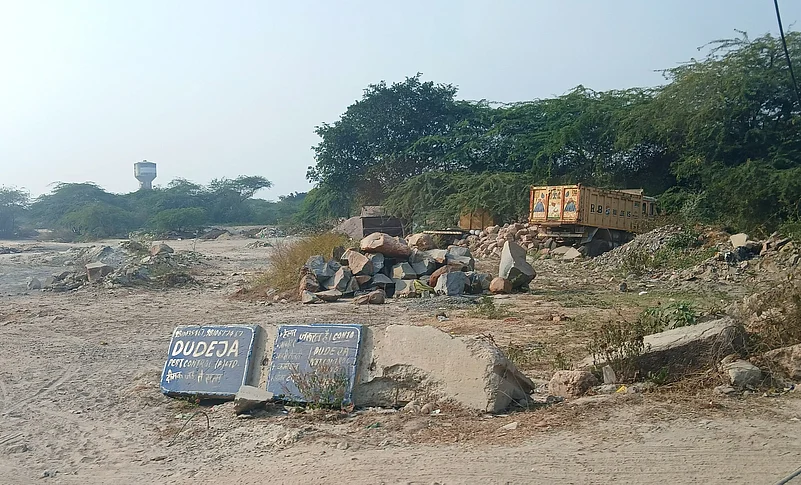
Outlook, along with the mighty dust, finally reaches the Delhi–Haryana border. Even a few metres away from the police check post, a man stands with a beer in hand under a lone tree as a light breeze creates a swirl of dust around him.
Under CAQM rules, all NCR projects on plots of 500 sq m or more must register on state-specific portals and self-monitor compliance with clean construction rules. Video-fencing and PM2.5/PM10 monitoring are required to reduce dust. But pop-up shops, illegal halls, constantly shifting restaurants and seasonal constructions fall outside this ambit. So they build, demolish, rebuild and demolish again, depending on the loophole of the month.
All the while, the mighty dust flies higher and travels farther—until it settles as a film on our cars, our park benches, our roads. And until it forms a beautiful mosaic coat inside our lungs.