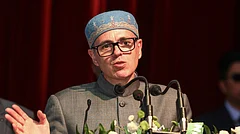
Jammu Kashmir Chief Minister Omar Abdullah has faced criticism over his remarks that the Central government has not left his government starved of funds.
The Union Territory is currently facing a grave economic crisis, with a recent government order putting a freeze on the creation of new posts. At the same time, liabilities have remained piled up under the flagship job programme of the Mahatma Gandhi National Rural Employment Guarantee Scheme.
The government's spending on the creation of public infrastructure has been inadequate, with key sectors such as education and health facing both a shortage of infrastructure and workforce.
The Union Territory (UT) of Jammu and Kashmir is facing a severe economic crisis that has forced the authorities to order a freeze on the creation of new jobs. At the same time, a large workforce of over 1 lakh daily wagers and casual labourers remains employed on meagre monthly wages of a few thousand rupees.
Chief Minister Omar Abdullah has, however, faced a backlash after he said that the Central government has not resorted to arm-twisting in providing money to the UT to meet its developmental expenses.
Omar told a media organisation that the Central government could have brought Jammu and Kashmir “to its knees” by cutting off funds, but praised New Delhi for increasing them.
People’s Democratic Party (PDP) leader Iltija Mufti lashed out at CM, saying he exhibited duplicity. “We know which political party Omar Abdullah is supporting these days. In Kashmir, he says that he can’t deliver on his manifesto because the BJP has tied his hands. But in Delhi, he says, funds are flowing, and the treasury is full,” she said. Former Srinagar Mayor, Junaid Azim Mattu, responded by saying, “Every Kashmiri feels ashamed today. What an absolutely unbecoming and shocking capitulation.”



Omar’s remarks have come at a time when Jammu and Kashmir is reeling under a deep economic crisis. UT’s Finance Department has ordered a cap on vacancies, noting that “no new post shall be created,” as part of austerity measures to cut down government expenses. Employees have earlier taken to the streets seeking fair wages for over 1.1 lakh daily wagers and casual workers. At the same time, the infrastructure and workforce in vital sectors such as education and health remain inadequate.
‘Central devolutions no favour.’
The devolutions from the Central government to Jammu and Kashmir are mainly used to pay employees' salaries and pensions, and any reductions would mean the UT has to cut down its existing staff. In his budget speech last year in the Legislative Assembly, CM Omar said that the government's “fiscal stress stems from high committed expenditures with salaries and pensions alone accounting for nearly 60% of revenue expenditure.” For the ongoing fiscal year, revenue expenditure has been estimated at Rs 79,703 crore, while capital expenditure is only Rs 32,607 crore. The UT has depended on borrowings to meet its financial needs, with the budgetary estimates for ways and means advances and overdrafts in the current financial year pegged at Rs 28,000 crore.
Economic expert, Professor Nisar Ali, says that there was a statutory liability on the Central government to provide funds to the states to meet developmental expenses, and the case of Jammu and Kashmir cannot be treated differently when the share of Central government taxes is provided.
“The Central government doesn’t extend any favour by providing the funds to Jammu and Kashmir as an entitlement in the share of taxes. In fact, the UT should seek compensation for the use of our water resources for the generation of hydel power by the companies of the Central government,” he says.

Freeze on Jobs, Spending Cuts
On 30 October, the Jammu and Kashmir Finance Department issued an order directing departments to reduce expenses during the current financial year as part of austerity measures. The authorities imposed a 10 per cent cut in budget allocations across several financial segments, while also seeking that departments refrain from filling vacancies by creating posts. “Posts that have remained vacant for more than two years should be identified for surrender. Such posts should not be revived except under rare and unavoidable circumstances and after seeking clearance from the Finance Department,” the order said.
The Finance department further directed that video conferencing for official purposes should be given priority and travel should be restricted to the economy class, irrespective of an officer’s cadre.
The holding of exhibitions, fairs, seminars, and conferences outside J&K is strongly discouraged. There shall be a complete ban on holding meetings and conferences at private hotels. Purchase of new vehicles shall be restricted. Video conferencing should be used effectively, and travel to attend meetings should be avoided. No furniture shall be procured except in case of newly established offices with the concurrence of the Finance Department,” the Finance Department order added.
Nisar Ali says the job freeze meant the Union Territory's financial condition was poor.
“Orders to ensure austerity in the spending of funds have also been issued in the past. But it is rare that there is an order that the vacancies shouldn’t be created or posts are ordered to be surrendered or abolished,” he says.
However, Deputy Director of the Budget Finance Department, Shahnawaz Ahmed, who issued the order, says that the departments “can go ahead with the recruitment in case of emergency and that the order barring the creation of posts was issued as part of the larger austerity measures to control the expenses in the government.” “The 10% economic cut is part of the wider austerity measures of the government,” he adds.
The order prohibiting the creation of new posts has come even as Jammu and Kashmir faces a chronic unemployment problem. UT’s unemployment rate is estimated to be over six per cent, and government jobs seem to be the only viable means of employment, given the lack of opportunities in the private sector. In the hill states like Jammu and Kashmir, government jobs are the only source of employment. There are 70,000 vacancies in different government departments which the government should have filled,” adds Ali.
Delay in the regularisation of daily wagers, casual workers
Jammu and Kashmir has a strength of over 1.1 lakh daily wagers, casual labourers, and seasonal workers employed in various government departments, including the Jal Shakti Department, the Power Development Department, and the Forest and Public Works Departments. The majority of engagements have been made in the Jal Shakti department. Employees have taken to the streets earlier seeking the regularisation of their services and an increase in wages from the nearly Rs 300 they get each day. President of the Employees Joint Action Committee (EJAC), Wajahat Durrani, says the issue of the regularisation of daily wagers and casual labourers has been hanging fire for several years.
He notes that during their meetings with the authorities, they were informed that they are facing a shortage of funds to fulfil their demand. “The number of daily wagers and seasonal workers engaged in different government departments, including in the clerical side, was 62,000. They were employed several years back, and the government has also taken their biometric data. But the number has now increased, and we have sought that they should be paid at least as per the Minimum Wage Act before they get benefits like those of any regular employee,” he says.
Liabilities under MGNREGS
Jammu and Kashmir faced whopping liabilities in both the payment of wages and the material cost under the flagship job programme of the Mahatma Gandhi National Rural Employment Guarantee scheme, which is now proposed to be named by the Central government as Viksit Bharat — Guarantee for Rozgar and Ajeevika Mission (Gramin) (VB-G Ram G). On December 9, Union Rural Development Minister, while giving details about the pending liabilities under the MGNREGS, told Lok Sabha that Jammu and Kashmir has a liability of Rs 192 crore under the material component of the scheme and over Rs 6 crore for the wage component.
However, Director Rural Development Department Kashmir, Shabir Bhat, says the UT doesn’t face many liabilities under the labour component. “The material component also includes the skilled labour besides the construction cost of the developmental works. The scheme is funded 90 per cent by the Central government, while the respective state governments bear 10 per cent of the cost; however, the Centre fully funds it for our UT. Sixty per cent of the funds of the scheme are spent on the labour cost, while another 40 per cent is spent on the material component for the creation of assets,” he says. “The scheme has been very effective, and we have been able to generate several crore man-days in Kashmir, ” he adds.