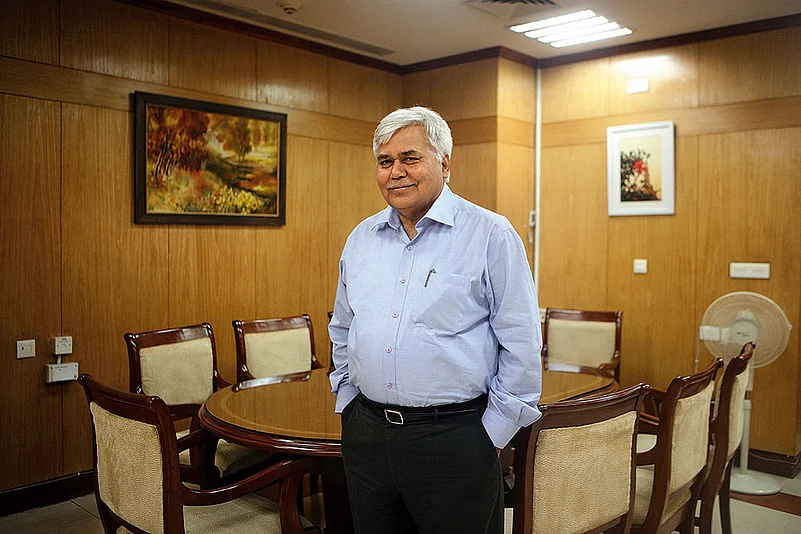

TRAI chairman Ram Sevak Sharma feels that India needs to explore other possibilities to improve internet experience. In an exclusive interview, he tells Arindam Mukherjee that the government should allow Cable TV operators to provide high-speed internet, bringing 100 million cable TV homes into the internet fold.
Why is internet so slow in India and the service so bad?
Internet is different in India from what it is in the US, where 60 per cent have fixed lines, all converted into ADSL, DSL and FTTH (fibre-to-the-home) so they give very fast internet speeds. Besides, 50-60 per cent homes use the cable TV network, which is also used to deliver broadband. And wired broadband is always a better option. In India, only 20 million have fixed telephone lines and that too is going away slowly. Also, its quality is quite bad and it is copper and cannot take high speeds.
Why haven’t we allowed cable internet?
We have not been able to leverage the 100 million cable TV homes in India to deliver broadband, which would have given us very fast internet. TRAI has made recommendations to the government to enable internet on cable TV network. It has not been enabled because for providing broadband you have to take an Internet Service Provider (ISP) licence and there is a seven per cent Adjusted Gross Revenue (AGR) share with the government. The cable TV sector today does not share any revenue with the government. The government is worried that loss in revenue realisation will take place as the cable TV sector will not report broadband revenues.



Where exactly is the hitch?
Twice we have recommended allowing cable TV internet and asked the government to resolve the revenue issues. If the government forgoes the revenue share, it can make up from service- and other taxes. We have asked the government to treat wireless and wired internet differently.
Why has the government not promoted wired internet if that can give fast speed?
TRAI has been recommending the promotion of wired internet because it does not burden the spectrum. But, unfortunately, there is no fixed line and cable is not allowed in India. We have low internet penetration—350 million internet users with 512 kbps. If we increase speed to 1 mbps, the numbers will drop. Wireless cannot provide robust bandwidth.
What problems does wireless internet face?
There are too many rules and a lot of pressure on spectrum. And there are also issues with the towers.
So what should the government do?
The government should treat wired and wireless differently, and FTTH should be the ultimate policy for providing broadband in India. We have also asked for the promotion of wifi hotspots connected to wired broadband. The last mile is not using licensed spectrum and that is a big solution.
What about satellite internet?
Satellite internet has high infrastructure costs and high recurring costs. And even then the bandwidth you get is not much. It is only good for difficult-to-access areas and is not a solution elsewhere.
(Disclosure: Outlook’s promoters have interests in the cable TV business)