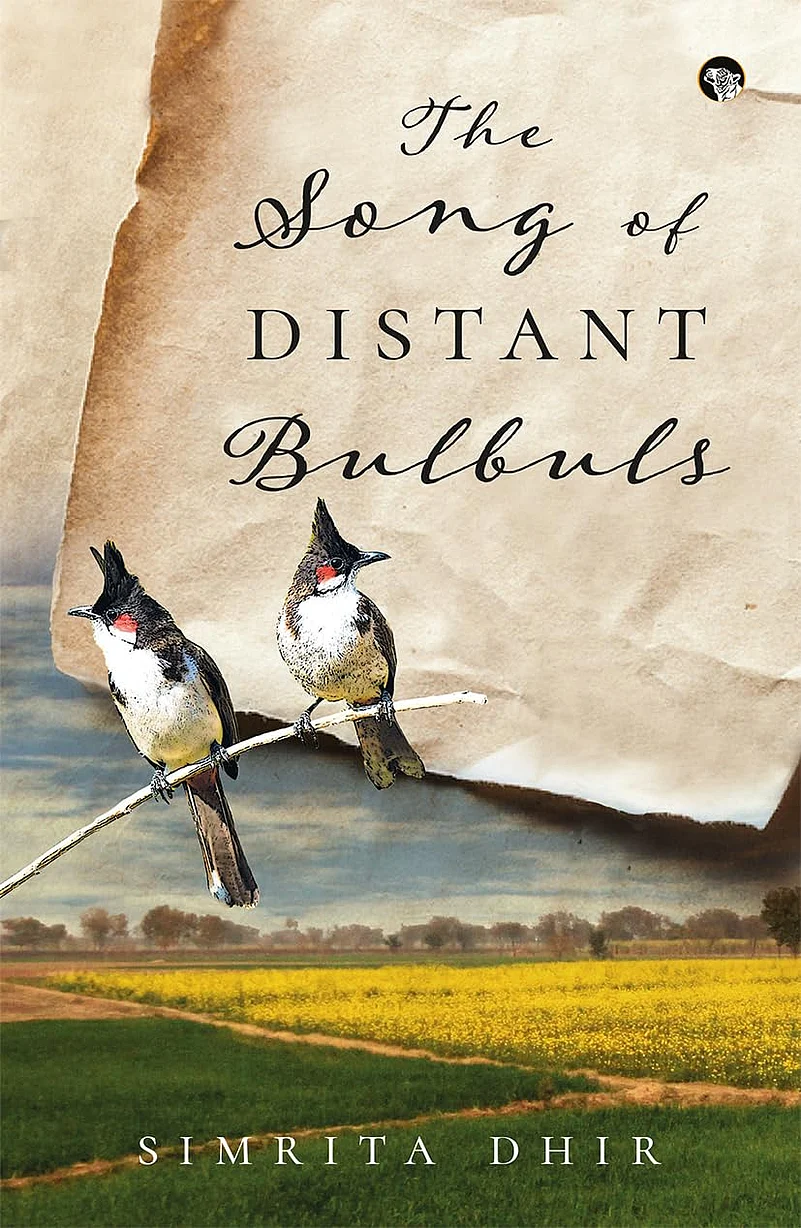
The Song of Distant Bulbuls sits in conversation with classics like Amrita Pritam’s Pinjar and Bapsi Sidhwa’s Ice‑Candy‑Man.
What makes the book feel both genuine and engaging is its refusal of neat resolutions.
Women’s desires and decisions are not incidental to the story of Punjab and Partition, but central to understanding both.
Simrita Dhir’s The Song of Distant Bulbuls is a contemporary novel that uses the story of one Punjabi family to illuminate the historical violence, silences, and defiances that have shaped women’s lives in pre- and post‑Partition Punjab. The book deserves to be read as an important work in the growing body of Partition literature that recentres women as its moral and emotional core.
The book is divided into four sections, namely Winter, Spring, Summer, and Monsoon. The novel is set across the turbulent decades of late colonial India, the Second World War, the run‑up to Independence, and the trauma of Partition. The narrative orbits around the farming family of Aliwala, a syncretic village with Sufi bearings. The protagonist, Sammi is married at seventeen to Hari Singh, an British Indian Army officer, whose brief presence and long absence define her adult life. The novel’s structure moves between village, cantonment, and the city, braiding the trajectories of Sammi, her brothers Jasjit and Kirpal, her mother, and friends like Zulfi and Preeto. Dhir filters major historical events through letters, hearsay, radio announcements and small talk, so that the reader experiences history as it impinges on the bodies and choices of ordinary women and men. The seasons, therefore, become a kind of counter‑structure, marking what changes and what refuses to change in women’s lives despite political upheavals.


Partition, community, and the gendered nation
One of the novel’s great strengths is the way it reconstructs women’s lives in rural Punjab before Partition, without romanticising either the village or the “tradition” that circumscribes them. Through Bibi, Jeeti Bhua, Sammi, Preeto, and even passing figures like the helper Madani, the book shows an entire spectrum of constraint: early marriage, the expectation of self‑effacing devotion, the casual erasure of female choice in matters of love, land,and labour.
Sammi’s marriage to Hari Singh is emblematic. It is decided between her father and eldest brother Jasjit who prize the glamour of an officer groom and the symbolic prestige of the khaki uniform over the everyday security of a local match. Kirpal’s dissent, rooted in a clear‑eyed understanding of soldiering as a life lived on the edge of death, is brushed aside. The girl’s own voice is barely considered. Yet Dhir lets us into Sammi’s interiority which includes the nervous ecstasy of her wedding night, the erotic charge of Hari’s gaze, the way twenty‑one days of marriage can anchor a lifetime of loyalty, thus insisting that what patriarchy writes off as a “fleeting chapter” is, for the woman, a cosmos.
Preeto’s trajectory demonstrates how even affection cannot protect a woman from gendered disenfranchisement. Widowed when her soldier husband Pratap Singh is killed in Burma, she is denied the right even to mourn him in the way she chooses. Her father forbids the very mention of Pratap Singh’s name and hurriedly arranges a second marriage with an older widower. That decision is justified as “practical” and “lucky” for a young widow, laying bare a society in which a woman’s grief, desire, and consent are all negotiable commodities.
The novel is not structured around the usual set‑pieces of Partition such as massacres, trains of corpses, refugee camps. However, Partition is everywhere, as a slow, encroaching catastrophe that reconfigures the meanings of neighbour, friend, and stranger. Dhir’s Aliwala is a village where Sikhs and Muslims have long lived in entangled intimacy: the village itself is named after its first Muslim settler and it is the “village tradition” to have a Muslim brother carry a Sikh girl’s doli.
In this world, Zulfi, the orphaned Muslim blacksmith who is Jasjit’s closest friend, is not an exception but an embodiment of a composite culture. When Kirpal sneers at Zulfi’s caste, poverty, and religion, Bapuji’s rebuke is unequivocal, reminding him that Sikh history is incomplete without Muslim saints and comrades. This insistence on an ethical, everyday syncretism gives the subsequent political break its full tragic weight.
Love, autonomy, and resistance
Sammi’s refusal to accept her family’s insistence that Hari Singh is dead, and her determination never to remarry without her own consent, is not treated as youthful stubbornness but as a politics of love and autonomy. She guards his letters like talismans, refuses to let her brother burn them, and insists on the sanctity of the marriage solemnised in the presence of the Guru Granth Sahib.
Her eventual decision to leave home clandestinely, armed only with a cloth bag of letters, and her own conviction, is among the most haunting acts in the book. In the letter she writes to Bapuji before fleeing, she links a life “worth living” to the courage to live one’s truth, even if it means shattering the patriarchal fantasy of filial obedience and ideal daughterhood. That letter, trembling between love and defiance, may be one of the novel’s most memorable interventions in the tradition of Partition narratives, where women so often disappear into statistics of abduction and honour killings rather than reappear as agents of their own fates.
In Jeeti Bhua’s life, Dhir offers another model of female strength. Jeeti’s contentment, her commitment to beauty in everyday domestic acts, and her refusal to harbour resentment become a quiet counter to the corrosive bitterness that eats away at Bibi heart. Together, they sketch two different answers to the question that the novel keeps asking: how does a woman live with what is done to her?
Style, language, and the “bulbuls”
Dhir’s extended metaphors such as Jat farmers as men who “beat rocks into fertile soil,” Sammi as “a bird caught in a storm,” love as a shifting river, are grounded in an intimate knowledge of land, crops, and weather. The recurring image of the bulbul’s song, “rising into the air before sliding down the purple skies,” becomes the novel’s central trope for longing, endurance, and return.
In the climactic monsoon scene, when the news about Hari Singh finally arrives, the “song of a million bulbuls” seems to tear open the sky itself, fusing natural and emotional weather in a kind of secular epiphany. The closing pages, in which Sammi steps into the rain, arms outstretched, reclaiming both her beloved and her own story, feel earned precisely because the novel has not spared her (or us) any of the intervening years of dust storms, failing health, dying parents, and family feuds.
Place in Partition and feminist writing
The Song of Distant Bulbuls sits in conversation with classics like Amrita Pritam’s Pinjar and Bapsi Sidhwa’s Ice‑Candy‑Man, but it does something slightly different. It anchors Partition not in a single cataclysmic rupture but in a continuum of smaller violences that women have always navigated.
What makes the book feel both genuine and engaging is its refusal of neat resolutions. Bibi dies coughing up blood in the middle of a dust storm; Preeto is pushed into a remarriage whose outcome we never fully see; Kirpal’s dreams of land and status remain morally compromised; Jasjit’s success in examinations does not automatically translate into moral clarity. Against this, Sammi’s hard‑won assertion of self, and the stubborn, circling song of the bulbuls, stand as a fragile but luminous counter‑history—a reminder that women’s desires and decisions are not incidental to the story of Punjab and Partition, but central to understanding both.
Disha Dahiya is an Assistant Professor of English at GGDSD College, Chandigarh. Her research spans translation studies, critical theory, and South Asian literature, with several academic and book publications. She is also an enthusiastic reader and book reviewer.