Recent Indian OTT narratives have seen women characters exploring morally ambiguous or criminal routes.
These characters expose cultural anxieties about women who desire autonomy and control.
On screen, female perpetrators are granted psychological density where their acts of violence often require justifications, trauma and a morally upright motive.
Recent Indian OTT narratives—Saas, Bahu Aur Flamingo (2023), Dabba Cartel (2025), Mrs Deshpande (2025), Aarya (2020) and Delhi Crime Season 3 (2023)—share a striking thematic convergence: women navigating, negotiating and singlehandedly commanding traditionally masculine spaces—often through morally ambiguous or criminal routes. In Saas, Bahu Aur Flamingo, Rani Ba and her daughters-in-law manage a family business that doubles as a drug cartel, merging domesticity with ruthless power. Speaking of cartels—in Dabba Cartel, the women led by Sheila Jagtap (Shabana Azmi) enter organised crime through the ordinary circuitry of dabba delivery.
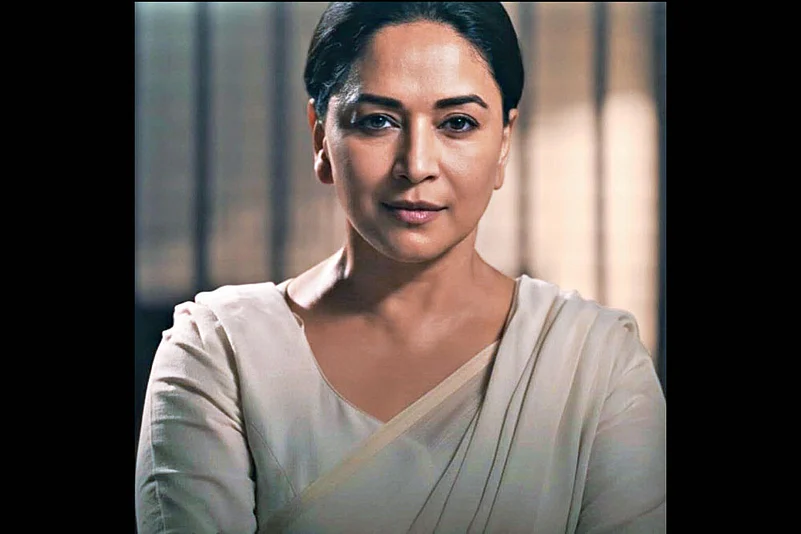
What begins as domestic labour gradually acquires criminal velocity, transforming into a narcotics distribution network. The setup of crime becomes a tool to reclaim authorship over their lives. Aarya traces a similar arc: Sushmita Sen’s protagonist evolves from a grieving mother to the head of a drug syndicate, compelled by circumstance yet exercising agency in a world of betrayal and violence. Mrs Deshpande literalises this inversion of expectation—a female serial killer whose vigilante justice challenges conventional morality, reminding viewers that gender does not prescribe ethics or violence. Delhi Crime Season 3 though, shifts the crime narrative entirely: the entire crime operates in a narrative dominated by women, including victims, criminals and cops alike. Here, the series interrogates systemic pressures—social, financial, and psychological—that shape women’s choices and, in Meena’s (Huma Qureshi) case, push them into criminality.




Across these narratives, maternity, occupation and social expectations intersect with survival and power. Each of these examples foreground women as both architects and enforcers of their worlds—refusing passive roles while exposing the moral and structural impediments they navigate. Collectively, these shows reflect a shift in Indian streaming content: women aren’t merely victims or side characters in crime and power dramas. They are complex, self-sufficient forces—capable of empathy, strategy and ruthlessness—whose narratives demand both recognition and reckoning.
Crime as a genre often functions as a language of survival. Women, in particular, engage with these narratives to decipher how violence frequently arrives disguised in ordinariness, masked in the familiar. Audiences are perhaps not watching a single femme fatale archetype anymore, but are possibly exposed to a wider spectrum of female antagonists who operate across different narrative logics: chaos, intellect, vengeance, repression and survival. This diversity mirrors the complexity of women’s real emotional and social negotiations. Fictional female killers destabilise the genre by forcing a confrontation with gendered assumptions about violence. However, these characters mostly aren’t tunnel-visioned killers—they expose cultural anxieties about women who desire autonomy and control.
***


In the depiction of criminal figures, in the case of men—agency flows outward into violence. The criminal act becomes an instrument to expand systemic power already possessed or desired. In the latest spy thriller Dhurandhar (2025), Hamza (Ranveer Singh) paves his way into Lyari’s underworld by shapeshifting into a local goon—adopting its spoken language, mannerisms and political codes. This assimilation demands no deviation from the masculine power structure that governs the space. His rise depends on earning recognition from other men, reinforcing a hierarchy where authority circulates through mutual validation. Similarly, in Gangs of Wasseypur (2012), Faizal Khan (Nawazuddin Siddiqui) inherits vengeance from Sardar Khan (Manoj Bajpayee)—crime operates as lineage sustaining memory and preserving masculine continuity through bloodshed. Although, it is a considerable rarity to witness men being allowed a duality. In Anurag Kashyap’s Nishaanchi (2025) franchise, Babloo and Dabloo (Aaishvary Thackeray) depict two masculinities—one complying and one deflecting their generational history of violence.
In women, contrarily, the external act precedes recognition of agency. Female perpetrators are granted psychological density, yet their acts of violence often require justifications, trauma and a morally upright motive. Male perpetrators seldom require such scaffolding and their actions are permitted autonomy, even when morally vacant. In Dahaad (2023), Anand Swarnakar (Vijay Varma) murders women to assert power and control. The series examines Swarnakar’s violence entitlement and misogyny through investigation, yet withholds redemption or justification. In a rare instance, Andhadhun (2018) features Tabu as Simi Sinha who commits multiple murders to safeguard the life she has carefully constructed. Her ruthlessness remains undiluted and is allowed to exist without apology or narrative correction.

Crime and its subgenres, especially in their OTT incarnation, have become a cultural language through which these narratives organise fear, power and justice in ways the real world rarely does.
Although motherhood remains one of the few frameworks that allows for female violence to be culturally intelligible. Often equated with goddesses Kali and Durga, these figures become the duality of the fierce and the nurturing. Vidya Bagchi (Vidya Balan) in Kahaani (2012), despite donning a baby bump, came to the city of Kolkata with a larger mission—to avenge her husband’s death. In Kahaani (2012), Sujoy Ghosh positions his protagonist as an instrument of deferred justice, as she acquires an almost spectral authority. Set against the sacred temporality of Durga Pujo, Vidya emerges as both witness and reckoning, reclaiming justice long denied to her. Similarly, in Mom (2017), Devki Sabarwal (Sridevi) orchestrates the killing of her daughter’s rapists after multiple institutional failures. Her violence is aimed at restoring moral equilibrium within a system incapable of protecting the vulnerable. The narrative grants legitimacy because maternal care precedes criminal action. Women also function as rehabilitators of the larger structure of justice—often vigilantes who operate maternally, yet, also protect their communities.
Violence often becomes a metaphor for reclaiming the self, the body, and the way it is perceived. What captivates you is the tension between tenderness and violence—the image of a woman retaliating against those who have harmed her, wielding compassion alongside calculated lethality. In Tripti Dimri’s Bulbbul (2020), Chhoti Bahu’s transformation into a supernatural avenger is explicitly tied to reclaiming herself from patriarchal violence and sexual abuse. The targets of her vengeance include abusive men within a patriarchal feudal household. After enduring years of trauma, she becomes a spectral force, reframing her violence as mythic correction embodying female rage. In Karan Kandhari’s Sister Midnight (2024), Uma (Radhika Apte) experiences domestic life as suffocation. Her eventual acts of supernatural deviance and madness dismantle the expectations imposed upon her body and labour. Crime thus becomes an exit from prescribed stillness. Similarly, in Haseen Dilruba (2021), Rani Kashyap (Taapsee Pannu) orchestrates the murder of her husband to escape her loveless marriage. Her violence emerges from repressed desire shaped by neglect and resentment.
The seductress-killer archetype binds violence to desirability, leveraging attraction into tactical advantage. Monica Machado (Huma Qureshi) in Monica, O My Darling (2022) understands the mechanics of male fantasy. She fashions herself as an object of aspiration, calibrated to the vulnerabilities of corporate masculinity. Her criminality here cannot be separated from her performance of femininity. The men desire her as possession and reward within their hierarchy. She, however, remains the only author in the room, directing their downfall while appearing peripheral to it. These narratives are about imagining justice in a world where legal and social systems routinely fail women. Fiction allows space for a morally ambiguous thrill and the pleasure of watching the downfall of abusers in the most satisfying way possible.
Crime and its subgenres, especially in their OTT incarnation, have become a cultural language through which these narratives organise fear, power and justice in ways the real world rarely does. Fictional narratives around crime also mirror how women are taught to move through the world: trust your instincts, carry tasers, notice any shadows or suspicious vehicles. Women have turned into literal detectives protecting their mere existence in public and private. Many women approach these stories with a complicated curiosity. Pleasure and fascination coexist uneasily with guilt, since the engagement is both vicarious and ethically fraught. The genre illuminates the tension of finding intrigue in harm, while simultaneously offering a framework to confront a world defined by unpredictability and danger. It allows viewers to process anxieties that are personal, social and structural.
In doing so, crime narratives reveal not only the mechanics of transgression but also the conditions—gendered, cultural and systemic—that make such stories feel both necessary and enduring. In the real world, violence against women is often met with social disbelief, bureaucratic delay or outright erasure. On screen—despite the setbacks—evidence is gathered, someone listens and hopefully, justice is served. Even when narrative closure is denied, the uncertainty itself is respected as an outcome. Justice may be incomplete but the attempt itself emerges as cathartic.

MORE FROM THIS ISSUE

This article is part of Outlook's March 11 issue Femme Fatale which looks at how popular media has shaped narratives of violence against women over the years and rewrites the language of male gaze in media which commodifies and condemns the women who make headlines.