



Kaouther Ben Hania's The Voice of Hind Rajab had its world premiere at the Venice Film Festival 2025.
The docudrama reconstructs the final few hours of a five-year-old Palestinian girl killed by Israeli forces.
The film's India release has been blocked due to a recently strengthened India-Israel relationship.
Kaouther Ben Hania’s The Voice of Hind Rajab launches a full-blown anxiety attack. It shoots straight into shameless lies and misinformation spewed by Israeli propaganda machine, ripping off all masks. A child’s plea for help mottles the film with bracing immediacy and searing impact. Hind Rajab, a five-year-old Palestinian girl, was killed in 2024 by Israeli Defence Forces (IDF). She was trapped along with six deceased family members in a car that was a mere eight minutes away from the nearest Red Crescent ambulance. Ben Hania’s film recreates her failed rescue down to its harrowing minutiae.
There’s relentless coordination, falling through, yet hoping against hope. It’s a cycle of having our hearts shattered again and again, without reprieve or rescue. Everyone in Red Crescent is doing their best, yet they are up against structures that don’t see them as human, worthy of survival. There’s endless protocol to weave through, mines to skirt. Ben Hania flings us into the middle of the Palestine Red Crescent Society hustle. Amidst frantic scrambles to connect trapped Palestinians with ambulances, the film situates one of the biggest barbarities of our times with emphatic fragility.

The central audio recording knitting the film, an on-off call between Hind and Crescent volunteers, is a polarising choice. Questions of cinematic ethics are bound to be evoked in a project like this. Is Ben Hania rerouting unspeakable suffering into uneasy capital? Dramatising such a crisis in real time instantly provokes anxieties around limits of representation. How far can a filmmaker go to re-stage such abuse, such grief? What’s the thin line between sincere intent and dangerous trespassing? Nevertheless, she digs somewhere piercingly human.


Ben Hania reconfigures the optics of urgency to its most primal. Each time Hind’s voice crackles through, hope stirs. Yet the relief is momentary, undercut by its erratic nature. The audio recording—the film’s moral backbone and its forbidding conscience—writes a rocky journey. Her desperate insistence on help shades into resignation, defeat, tentative faith, only to be smashed in a sudden swoop right when things seem to look up.
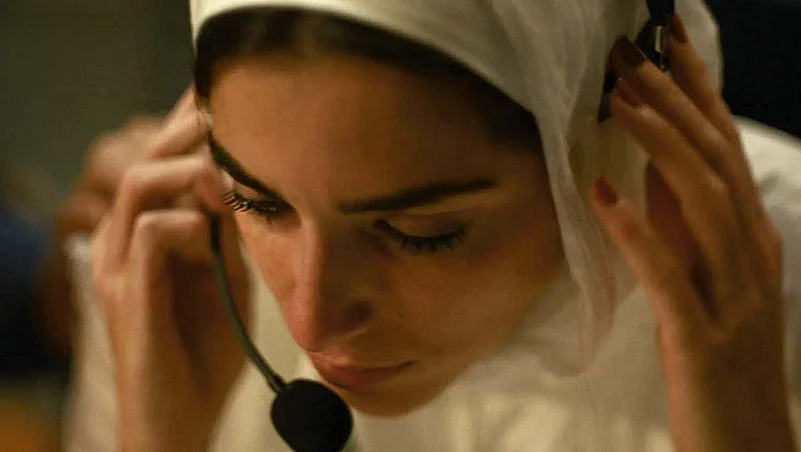
We witness how the rescue operations weigh and wean away at the volunteers. Maintaining any emotional anchor becomes not only tenuous but impossible. Oman (Motaz Malhees) and Rana (Saja Kilani), two primary volunteers, bear the fatigue, helplessness and rage of being stuck in an impossible situation. Their powers are severely limited, despite the illusion that Red Crescent can achieve some release. The entire Red Crescent wing is at the mercy of the Israeli defence force. A bureaucratic web of complex orders and signals has to be bypassed. Neither have maps been updated to reflect the current state of shelled Palestinian streets. The tract of territory might appear small and navigable. But each step is a delicate negotiation between on-ground soldiers, volunteers and ministries on opposing sides. Every Palestinian ambulance has to wait for a go-ahead that percolates down through layers and layers of Israeli personnel. This protracted wait puts Red Crescent through utter emotional fatigue.
Ben Hania depicts vulnerability across rungs of Palestinian rescue efforts. Oman and Rana lash at their supervisor, Mahdi (Amer Hlehel), for stalling, not doing enough, not stepping up when just a bit of speed can save Hind. Minutes roll into hours, yet extraction appears out of reach. It’s a race against time, spiked with anxiety and thwarted hope. There are several channels to secure permission from. Mahdi rails about the many volunteers he’s lost. He doesn’t want to be reckless. The number of on-ground evacuating drivers is rapidly dropping. If those continue, who will remain to take frontline recovery forward?

The Voice of Hind Rajab makes no bones of its immense fury, squarely attacking how Israel has steamrolled Palestine while projecting fairness in rescue operations. Volunteers are perched on breakdown, stretching their resources. But this isn’t a place where miracles happen, Ben Hania strongly asserts. Every progression is increasingly undone by greater blockade. Israel’s systemic genocide of Palestinians makes a mockery of all that we regard human and sane. The Voice of Hind Rajab reclaims truth from twisted facts, while posing no reassurance. Its guttural exigency runs smack into the monstrosity that is Israel.















