India has had several successful franchises of unscripted content.
The new seasons of Lock Upp and India's Got Latent have brought in massive streaming revenue.
India has yet to export its own original franchise.
As India's streaming platforms double down on reality television, it's faced with a crisis. Lesser scripted drama series are being commissioned and mounted. Similarly, there's a tightening of purses regarding acquiring and licensing movies. The meteoric success of Lock Upp and India's Got Latent signals a rush to drum up reality television.
What's The Appeal Of Reality TV?
Indian viewing habits have veered toward engaging, conversational and social-media-friendly unscripted formats. Platforms are designing shows that trigger active online discourse and community viewing. Indian television has a long history of linear reality hits like Bigg Boss and Kaun Banega Crorepati that streaming platforms are now modernising for digital-first audiences. The original promise of reality TV lay in its digital democratisation. Participants’ willing submission to being monitored was reframed as a manner of self-expression, a form of participation that was eventually harnessed, commodified and sold to viewers as reality. The artifice is replete with contestants performing for us viewers who bring stakes in the daily dealings. Over the years, reality TV became all about cultivation of a practised self, perfectly culled and designed for a viewer's engagement. The voyeurism dovetails into a play between the spectacle and the ravenous viewer.
Then, there's the equal import reality TV fans as regards community discourse. From social media chatter to group text threads, reality shows allow a channel for reflecting on our actions, attitudes, particular kinds of behaviour we may either condone or condemn. Conversations turn revelatory. These shows also offer a chance at social and economic mobility. A single unscripted format can be adapted across territories, languages, and markets. This scalability is infinitely attractive to global streamers looking to maximize ROI. Social media traffic gives an impetus to renewed seasons and continuing new offshoots of the same.



Why Are Streaming Platforms Investing In Unscripted Content?
This is very much a global phenomenon. Unscripted content props up several advantages for the platforms. It is usually cheaper and faster to produce than scripted drama, travels well internationally and often spin out well-oiled social media engagement. Reality shows don't use expensive actors, scripts, unions and writers, unless they are of the celebrity crop. The shows are more malleable to advertisers who are pushing harder to integrate their brands directly into shows
Platforms leverage shorter production cycles and flexible, repeatable formats to scale content quickly. Unscripted shows offer lucrative brand integration and sponsorship opportunities directly within the content. Product placement is much easier to incorporate in reality television. This practice, which churns out advertising revenue for both the show and the network by strategically adding brand name products within the aegis of the program, isn't as acceptable in scripted TV shows. Pam Glennon, an award-winning producer, told INC in a 2022 interview, “Something that you see, which is particularly appealing to unscripted is this idea of having brands come in at an early stage… to really come in as a co-producer on a show and help alleviate costs.” A symbiotic equation begins.
Netflix has often stressed that unscripted formats are critical to building reliable viewing patterns that buttress its advertising strategy. Some buzzy scripted series may crank up initial energetic conversation but struggle to sustain the viewership. Unscripted content has the allure of longevity in keeping viewers riveted. Of course, the lines between orchestrated and improvised are increasingly blurry. Cabals of producers are overseeing how to engineer momentum, twist exchanges and dynamics in a certain way for riling up emotions. Netflix's slate of original reality shows rose by as much as 700 per cent over two years between 2018 and 2020. Netflix is dominated by non-fiction content, ranging from documentaries to reality TV. Many of the OTT's biggest hits are reality TV outings, like Love is Blind, Too Hot To Handle.
Is Unscripted Content Clicking For OTTs In India?
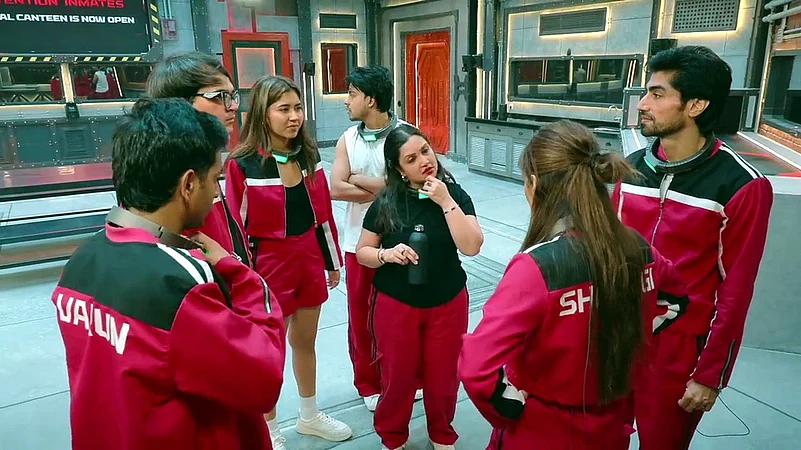
The numbers are impressive for Indian-origin shows as well. Lock Upp ranks No 8 on Netflix's Global Top 10 Non-English Shows, clocking 1.9 million views. India's Got Latent Season 2 follows at number 9 with 1.5 million views. "Non-fiction has many advantages — its authenticity, the way it connects with younger audiences— but it also allows us to respond much faster than a fiction series," Tanya Bami, Series Head at Netflix India, told Moneycontrol in a 2026 interview.
"It has a strong recall value, which means the gap between seasons can often be much shorter. Those nuances make it an incredibly important part of our overall slate", she added. Netflix is roping in digital creators. It has announced projects with Bhuvan Bam and Zakir Khan. The platform is intent on eagling beyond just viewership, angling for encore value and franchise scope.
The roots of this juggernaut go back to the aughts. In a 2024 interview with Variety, Sameer Nair, the then CEO of Applause Entertainment, underlined, ”With KBC in 2000, the celebrity-powered version of officially licensed unscripted television took root in India." The original format and localised iterations have often melded winningly as in the thriving case of Bigg Boss now heading into its twentieth season and raging new hits like Shark Tank India. A healthy pipeline can be maintained as well as subscribers retained. But unscripted content exists primarily to cushion the gaps between the prestige dramas, keeping up the viewing hours.

Can India Be A Global Exporter Of Reality TV Formats?
India has tended to adapt international shows rather than introduce its own ilk that has mushroomed in foreign markets. Indian showbiz has long been governed by formula. If this impulse of importing seems to be delivering the numbers, executives and decision-makers would rather keep it going than try a new, indigenously harnessed concept. The British hit, Pop Idol floated into India via American Idol as Indian Idol. The celebrity dance contest, Jhalak Dikhhla Jaa, rehashed its format from Dancing with the Stars, which was modelled on the globally popular British TV series, Strictly Come Dancing, distributed by BBC Worldwide. KBC itself was merely a desi version of Who Wants To Be A Millionaire?, a British quiz show adapted in over 20 countries. Most of these shows also pivot on the attraction of a celebrity anchor. The glitz of having Salman Khan to steer Bigg Boss is indispensable to its success. For India to make the leap, it must have solid international distribution partnerships, legal protection for a brand-new concept to traverse diverse cultures.