Miya poetry emerged as a reclamation of identity, turning a slur into a form of resistance, but poets now hesitate to publish openly due to FIRs, arrests, and threats of prosecution.
Activists and poets link the decline of Miya expression to evictions, delimitation, and rhetoric by the state leadership that frames the community as outsiders.
While public poetry has receded, Miya expression is finding new outlets in songs, films, and digital content—even as the sense of precarity persists.
Write
Write Down
I am a Miya
My serial number in the NRC is 200543
I have two children
Another is coming
Next summer.
Will you hate him
As you hate me?
Write
I am a Miya
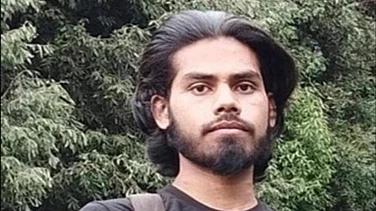
When Hafiz Ahmad, a Bengal-origin Assamese scholar, wrote this in 2016 and posted it on his Facebook page, it created quite a stir, reviving the tradition of Miya poetry. The erasure of Miya culture and identity is a constant theme in the poetry by Ahmad, who is president of the Miya community’s literary society (Char Chapori Sahitya Parishad).
As Assam goes to the polls on April 9, Ahmad says the theme of erasure is back in the limelight as he is campaigning against the incumbent chief minister, Himanta Biswa Sarma, who was “instrumental” in the erasure of Miya identity from public spaces of Assam. Ahmad is part of Ahom Nagrik Sammelan, which is a joint body of intellectuals from all groups of Assamese society that is going to crucial assembly constituencies and canvassing for the Opposition-led alliance.



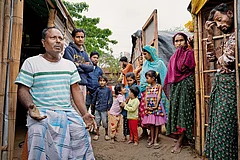
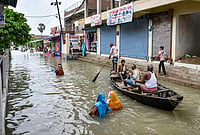
Miya poetry as a tool of expression became so popular also because it turned “Miya” – a slur for Bengal-origin illegal immigrant – on its head. The Miya community resides in the chars, an Assamese word for sandy landmasses or sandbars that emerge from riverbeds, particularly in the Brahmaputra River. These areas are often used for farming but are impermanent due to erosion and flooding.
The Miya community is largely composed of peasants brought over by the British Raj from what was then united Bengal. The majority of these peasants came from the Mymensingh region of northeast Bengal, now in Bangladesh. The residents of the chars are among the poorest and least educated populations in Assam. The first Miya poem, A Charuwa's Proposition, was published in 1985 in the aftermath of the Nellie Massacre by Maulana Bande Ali. Miya Muslims are also referred to as Char-Chapori people in Assamese.
Ahmad says that BJP rule is quite harmful for Miya Muslims in particular, as Sarma is always attacking Miya Muslims. He had popularly said that he shall break the backbone of the Miya community by ruining them politically and economically. He has evicted fifty thousand Miya Muslims who were living and cultivating one lakh bighas of land, and he has promised that after he comes back to power, he will dispossess several lakh more Miyas of the land where they are living and farming.
Cultivation is the only profession for the Miya community. Once you take the land away from them, they are dispossessed and reduced to daily wage laborers, Ahmad says, while adding that Sarma has already reduced the political clout of Miya Muslims through the delimitation exercise.
“Before the delimitation, Muslim voters were in the majority in 32 seats, but after delimitation, the Muslim-majority seats came down to 21. This is similar to breaking the backbone of Miya Muslims politically by making them politically irrelevant,” he says.
Ahmad refers to Sarma’s statement in which he had urged people to pay 4 rupees instead of 5 rupees to Miya rickshaw pullers, suggesting this economic pressure would lead them to leave the state. “He declares us as enemies because he wants to polarize the voters of Assam for electoral gains. What he doesn’t want to accept is that we are as much a part of Assam as some other ethnic groups, and that a large section of Assamese people have accepted the Miya community as part of Assamese culture.
BJP desperately wants to counter this unity by polarizing the voters,” says Ahmad.
“Like any other ethnic group, Miyas have our unique identity, but that identity is part of the larger Assamese identity. And that is bad for Sarma’s politics. To survive and thrive as a politician, Sarma’s goal is to keep projecting us as the ‘other’ who are separate from Assamese culture. So he has persecuted every Miya Muslim who tried to publicly express Miya culture,” he adds.
He rues that a decade after Miya poetry gained national and international spotlight, the poetry form has largely disappeared from the public space. Ahmad blames it on constant targeting of Miya identity by the government. Ahmad says that the first setback to Miya poetry happened in 2019 when the state police filed an FIR against Miya poets, including him.
For writing poetry, the Assam Police filed a case under sections of the Indian Penal Code that pertain to criminal conspiracy, promoting social enmity, and insulting religion. The police complaint accused them of “depicting a picture of Assamese people as xenophobic in the eyes of the whole world, which is a serious threat to the Assamese people, as well as towards national security and a harmonious social atmosphere.”
“Miya poetry movement is weakened due to these reasons—pressure from the government, threat of prosecution. We are out on bail, so there is constant pressure. They want to keep the pressure up. That is why they have not yet filed the chargesheet or the closure report,” he adds.
Abdul Kalam Azad, a Miya poet and a faculty member at Jindal University who is one of the ten booked by the police, says that poetry writing by Miya Muslims has come down substantially, and when they do, Miya poets do not circulate poems on public platforms anymore due to threats of persecution.
The FIR was not the only thing.
Miya poetry provoked anger and major trolling from Assamese speakers and intellectuals not only for the fact that they draw attention to the oppression Bengal-origin Muslims face in Assam but also because they are written in the native Miya dialect, rather than standard Assamese. In a state where language, identity and politics are intricately linked as historic faultiness, this switch from Assamese to Miya dialect in literature immediately produced a backlash at an unimaginable scale. After they were cornered by almost everyone in Assam, Ahmad who had revived the poetry form, had to apologize, and reiterate his loyalty and allegiance to Assamese.
“What was heartbreaking was that people from secular and progressive circles massively criticized and delegitimized us. We were trolled at an unimaginable scale by a large section of the Assamese speaking society. We received death threats. But there were also those who helped us in that distressing time,” Kalam adds.
In the aftermath of the FIR, the poets went underground. When Miya Muslims started writing poetry to express their angst, Kalam and Shalim Hussain, another Miya poet, started a Facebook page called Itamugur, a term which refers to a tool used by farmers on the chars, sandbars where the majority of the Miya poets grew up. Hussain shared poems of Miya poets on Itamugur.
That Facebook page doesn’t exist anymore.
“We were lucky. Look at what happened to the guy who established the Miya Museum. He was immediately arrested and charged under draconian laws. The museum was sealed. The state, media, and every institution of Assam pounced on him,” Kalam added. In 2022, Mohar Ali, a local political leader, was arrested after he opened a small museum in his house in a village in Goalpara district. The museum, which was dedicated to the culture of ‘Miyas’, had some agricultural tools and garments like lungis on display.
Kalam also refers to the arrest in 2024 of Altaf Hussain, a Miya Muslim singer who had released a song in Assamese which asked: “Does Assam belong to your father that you want to chase them out?” Through the song, Hussain had sought to highlight the targeting of Bengali-origin Muslims in the context of a campaign by Assamese groups to drive Miya Muslims out of Upper Assam. The lyrics of his song are similar to a Bangladeshi protest song called “Desh ta tomar baaper naki”, which translates to “Does the country belong to your father?”
“But if you approach Miya poetry as a social movement, then it has taken a different form. Now the focus has shifted to films, songs on Miya culture, and other creative forms of expression. Lots of YouTubers and content creators with massive followings are creating content in the Miya language,” Kalam says, adding that NRC was the context in which the entire Miya community was quite anxious, and that is when the poetry form was revived.
Ahmad says that if the BJP government comes back to power, the hatred against Miya Muslims will reach epic proportions. “There is constant erasure of Miya culture and identity. And if this government comes back to power, it will persecute more Miyas for expressing their unique identity. When they keep pushing us against the wall, we have to stand up.”
Abhimanyu Singh, a poet who runs a poetry blog, The Sunflower Collective, which ran a series on Miya poetry in 2016, says, “I know it is quite difficult to write Miya poetry on public platforms due to fear of state persecution. It is quite sad and equally infuriating the manner in which the state has effectively criminalized every public expression of the angst Miya Muslims go through. As we have seen, every time someone has expressed Miya identity in public, it was brutally crushed. But I hope that Miya poets continue to write in whatever form possible.”
In 2024, Shalim Hussain, another Miya poet, collected poetry and songs from Miya poets and translated them into English, which was published by Tilted Axis Press as an anthology titled Again I Hear These Waters.
Kalam concludes by quoting one of the first Miya poems, “I beg to State That” (1985) by Khabir Ahmed: I beg to state that/I am a settler, a hated Miyah/Whatever be the case, my name is/Ismail Sheikh, Ramzan Ali or Majid Miyah/Subject – I am an Assamese Asomiya/I have many things to say/Stories older than Assam’s folktales/Stories older than the blood/Flowing through your veins…Besides, you haven’t yet decided what to call me/Am I Miyah, Asomiya or Neo-Asomiya?