



I visited Andaman and Nicobar Islands twice over the past few months. The first, as part of a two-member team, along with Adivasi Congress chairman Vikrant Bhuria, to study the proposed Great Nicobar Project. The second was as part of an advance team preparing for the visit of Leader of Opposition Rahul Gandhi to the islands. A helicopter from Port Blair took us to the island in three hours with a refuelling stop at Car Nicobar before landing at the Indian Naval Air Station INS Baaz, the southernmost airport of India located in the Campbell Bay area of Great Nicobar. The purpose of our visit was to gain first-hand knowledge about the proposed Rs. 72,000 crore Great Nicobar Project and its impact on environment, ecology and humans. We met members of the Nicobarese community and their leaders, settlers who had been brought to the island beginning in 1969, social workers, activists and officials. We also travelled to Galathea Bay, the proposed site for the transhipment port that forms the project’s centrepiece.
The project, touted as a ‘holistic development of Great Nicobar Island’ is planned as a package comprising a large transhipment port, international airport, power plant, an eco-tourism hub and a greenfield township with a gaming and entertainment zone that will include casinos. It will cover 166 sq km, including 130 sq km of primary forest and 84.10 sq km of tribal reserve. As per official count, it will involve felling of 10 lakh trees but experts believe the number could go up by ten times or even more. The project has come under scrutiny for its procedural and legal lapses as also for being violative of ecological, environmental safeguards and of the rights of tribal and indigenous groups in the island. It has also been pointed out that many factual misrepresentations were made to facilitate an unduly accelerated approval for it.


On August 16, 2022, the chairman of the Tribal Council of Little and Great Nicobar, Barnabas Manju, signed a no objection certificate (NoC), a mandatory requirement as per various laws, including the Forest Rights Act (FRA) 2006. However, within three months, the tribal council, in a letter addressed to the Ministry of Environment, Forest and Climate Change, withdrew the previously issued NoC citing that consent had been obtained through a rushed and non-transparent process and that the administration withheld crucial information. The withdrawal letter had Manju himself as one of the signatories along with the council deputy chairman and captains (traditional Nicobarese village heads).
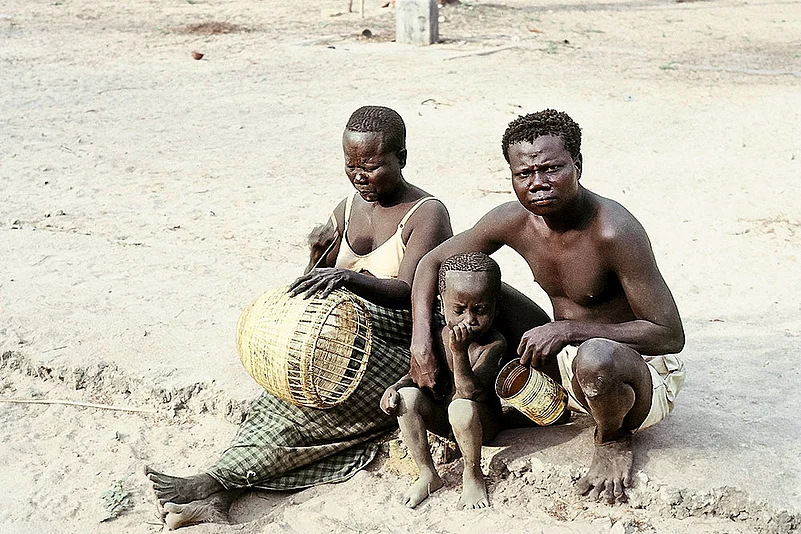
We met Manju and other captains at Rajiv Nagar and New Chingen, the two ‘temporary’ settlements in Campbell Bay where the Nicobarese were provided makeshift structures after the 2004 tsunami wrecked their villages. They continue to live in sub-human conditions in the temporary structures allotted to them. Even while they yearn to return to their ancestral villages, those areas were shown as unoccupied and included in the areas to be diverted for the project.

While the Nicobarese are a tribal community, the Shompens are classified as a particularly vulnerable tribal group (PVTG) and lead a nomadic life. Project maps and feasibility documents did not adequately show their settlements and foraging areas. The maps only reflect their present, temporary settlements and fail to mark their potential footprints in the foraging areas.
It is a mindless plan which will prove to be a colossal disaster for the island’s ecology.
Great Nicobar is also home to many settler communities who were allotted land to cultivate. These communities are primarily from Punjab, Tamil Nadu and Andhra Pradesh. There are also other non-tribals from the Chota Nagpur region who came as workers to clear forests and build infrastructure and stayed on. Around 250 such families will be directly affected by the project, raising concerns over loss of land and livelihoods. The affected land supports agricultural activity, residential settlements, community infrastructure and plantations. Our interactions with these groups revealed that they only have vague ideas about what the promised ‘development’ implies in tangible terms. Most believe that the compensation will be based on a circle rate of Rs. 113–118 per sq m which is ridiculously low as opposed to Rs. 1,000 per sq m in a comparable place like Hut Bay.
Environmental Disaster
The large-scale felling of trees will adversely impact the climate and lead to risk of rapid soil erosion. Great Nicobar hosts a United Nations Educational, Scientific and Cultural Organization biosphere reserve and is home to about 1,767 faunal and 811 floral species, including endemic species like the Nicobar Megapode. All of these may face extinction as the project takes shape.
Galathea Bay, the site for the proposed port, is the nesting site for the critically endangered Leatherback Turtle. The project will not only impact the nesting sites but will also destroy the coral reefs and the marine life supported by it. Interestingly, a revised government map of 2021 inexplicably removed the extensive reefs that were marked in the previous documents and maps. Also, until 2020, nearly the entire island was classified as CRZ-IA, a zone where construction of ports is strictly prohibited. However, in 2021, Galathea Bay was removed from this category. It is obvious that the alterations were done to facilitate the clearance for the project.
National Security
The national-security angle is put forward when arguing in favour of the project. National security is paramount. But it is not as if the region is currently vulnerable from the point of national security. INS Baaz, the Indian naval air station under the joint-services Andaman and Nicobar Command (ANC) of the Indian Armed Forces, guards our frontiers and overlooks the Strait of Malacca as well as the Six-Degree channel between Great Nicobar and the Indonesian island of Sumatra. If defence requirements were primary, the INS Baaz airfield could have been expanded instead of pursuing a project involving an airport and a township with a planned inflow of about 4,00,000 people. The population of Great Nicobar Island is about 8,000. Adding four lakh people will amount to an increase by 5000 per cent. Besides severely straining the island’s freshwater resources, the cultural disruption and habitat loss from a mega project will be tantamount to a ‘death sentence’ for the indigenous people.

The project site is located along a major tectonic fault and studies have shown that the islands have experienced nearly 444 earthquakes in the past 10 years. A project involving heavy construction and land-use change in such a fragile zone makes the plan highly questionable. It will prove to be a colossal disaster for the island’s history, culture and ecology. It is a hasty plan more to do with benefitting large corporate houses through another instance of organised plunder while causing irreversible destruction of our shared heritage.
(Views expressed are personal)

MORE FROM THIS ISSUE


Munish Tamang is a Congress leader who was part of the party’s fact-finding team tasked with assessing the impact of the Great Nicobar Project















