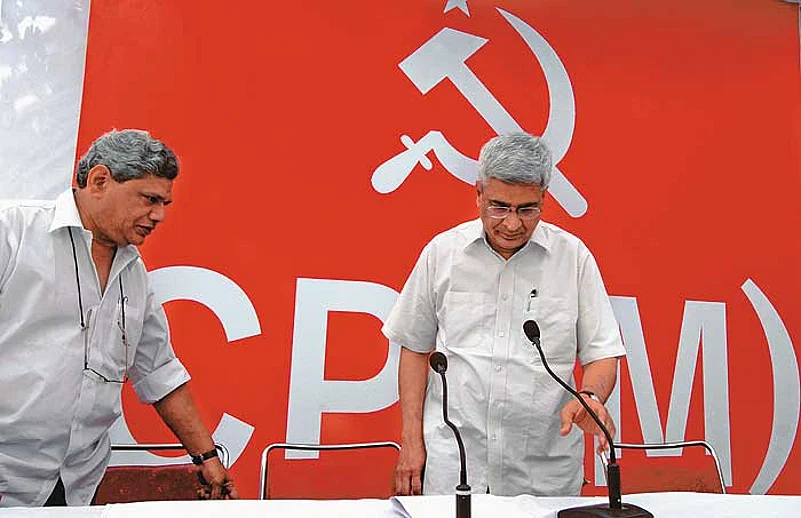

The underlying tension between the CPI(M)’s central committee and its Bengal unit had come to the fore when the results of the 2009 parliamentary elections were announced. Each blamed the other for the party’s poor performance. Now it is emerging that of the two top central committee leaders—Sitaram Yechury and general secretary Prakash Karat—it is the latter the state CPI(M) dislikes more.
“Karat is a hardliner who made a number of wrong decisions and thrust it down the throat of the party,” a state leader told Outlook. “He engineered the Third Front concept which proved so detrimental to us in the election. He withdrew support to the first UPA government, paving the way for a Congress-Trinamool alliance. He had veteran Bengal leader Somnath Chatterjee expelled, and only because he wanted to discharge his duties as Speaker of the Lok Sabha. And then he had the gall to put the blame on the West Bengal unit for the drubbing that we got.”
Pointing out that “Yechury is a moderate” and a much more “savvy politician who wouldn’t make the kind of blunders that Karat has been making”, the CPI(M) leader said that many in the state unit would like to see Yechury as a leader more than Karat.
But are Bengal CPI(M) leaders openly admitting their preference? Not surprisingly, there is a steely adherence to status quo officially. Top leaders of the Bengal unit, including Left Front chairman Biman Bose and industry minister Nirupam Sen, voiced the standard party line that all is well and under control.
Explaining the curious phenomenon of tacit dissent, a CPI(M) insider says, “One simply cannot be in the party and openly criticise the leadership.” However, he did reveal to Outlook that the Bengal CPI(M)’s preference for Yechury over Karat must have been “leaked” because “whenever party members feel that something needs to be out in the open, this is the strategy they resort to”.
Confirming the pro-pragmatist line in the West Bengal CPI(M), political analysts attribute it to Karat’s failure to understand both the Bengal unit’s individual strength as well as its significance at the national level. Explaining it in detail, veteran Bengal political analyst Tarun Ganguly says, “Karat lacks the political acumen of someone like Namboodiripad, who understood that without Bengal the CPI(M) would be reduced to nothing.” As for Yechury being respected more in Bengal, Ganguly says it is “because he appears concerned about the issues facing Bengal, including Nandigram, Singur or Lalgarh. Unlike Karat, he hasn’t publicly washed his hands of these matters as a problem of the Bengal state”.
Karat and Yechury themselves have differences, insiders say. While issuing a caveat that “getting the opinion from an expelled party member may not be appropriate”, Somnath Chatterjee told Outlook “there were indications that the two (Karat and Yechury) did not see eye to eye” during the time he was still a party member. Somnath’s unceremonious expulsion was one big grouse the Bengal unit had against Karat and Somnath admits “some Bengal party leaders and members do meet me, but secretly, because it is not going to do them any good if they are caught doing so”.
This state of affairs also reflects the fact that the Bengal CPI(M) finds itself in desperate straits and its vote for someone to steer the ship at this dire hour—if it’s allowed to choose—would go to Yechury, not Karat.