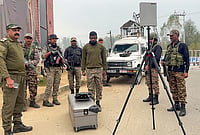
Khan Sir has challenged the FIR linked to the alleged firing incident outside his Patna coaching institute.
The Bihar Police says a valid arms licence does not permit unrestricted firing in a public place.
The Patna High Court will decide whether the FIR should be quashed while the investigation continues.
The FIR against educator and YouTuber Faisal Khan, popularly known as Khan Sir, has raised legal questions that extend beyond the violence outside his coaching institute in Patna. At the centre of the case is whether holding a valid arms licence, by itself, justifies the alleged use of a firearm in a public place, whether criminal liability can extend to an employer for the alleged actions of armed security guards, and whether a court should quash an FIR while a police investigation is still underway.
Those questions are now before the Patna High Court, where Khan has challenged the FIR registered against him following the June 2 incident outside Khan Global Studies (KGS). According to The Indian Express, Khan has argued that no firearm or ammunition was recovered from him and has sought quashing of the FIR. The Bihar Police has opposed the plea, arguing that the recovery of a firearm alone does not determine criminal liability and that the investigation must examine the role of every person allegedly involved. Here is what happened, what the State has argued, and what the High Court will have to decide.






What happened outside Khan Sir's coaching institute?
The case relates to violence outside Khan Global Studies in Patna's Musallahpur Haat area on the night of June 2. According to The Indian Express, police said a group allegedly linked to a rival coaching institute vandalised the premises and assaulted a security guard. Khan later claimed that "eight to 10 rounds of gunfire" were fired outside the institute during the violence.
Police later registered a separate FIR after verifying videos purportedly showing two KGS security guards firing outside the coaching institute after the violence had ended. Based on those videos and other material collected during the probe, the FIR named Khan, the two security guards and other unidentified persons under Section 109 (attempt to murder) of the Bharatiya Nyaya Sanhita (BNS) and provisions of the Arms Act.
As The Indian Express reported earlier, the two security guards allegedly told investigators that Khan instructed them to open fire, saying, "Fire, I'll handle what happens." Police have relied on that allegation, along with other evidence collected during the investigation, to book Khan under the BNS and the Arms Act. Khan has challenged the FIR before the High Court.
Court records cited by The Indian Express show that Khan moved the High Court on June 9 seeking quashing of the FIR and protection from coercive action, including arrest. A Patna court later granted anticipatory bail to Khan and three members of his staff, while the two arrested security guards were granted regular bail. The grant of bail, however, does not determine whether the FIR should be quashed, an issue that remains before the High Court.
Why has the Bihar Police opposed quashing the FIR?
In its counter-affidavit, the Bihar Police has argued that the FIR was registered after receiving "credible information" regarding cognisable offences and not on the basis of "mere conjectures or surmises".
The State has rejected Khan's argument that no firearm or ammunition was recovered from him. According to the affidavit, "The scope of investigation is not confined merely to the person from whose possession the weapon is recovered." It further states, "Whether any person has instigated, abetted, facilitated or otherwise participated in the commission of the alleged offence is a matter to be determined during investigation on the basis of the entire evidence collected and not merely on the basis of physical recovery from a particular accused."


The State has said the investigation is based on multiple materials, including the viral video, statements of independent witnesses, seizure of firearms and ammunition, verification of the security guards' arms licences and other surrounding circumstances, and not solely on the statements of the two arrested security guards.
The Bihar Police has also argued that the alleged firing constituted "an independent occurrence attracting separate criminal liability", making the registration of a separate FIR "legally justified and necessary". On that basis, it has urged the High Court not to quash the FIR while the investigation is ongoing.
What does the Arms Act say about licensed firearms?
A central issue before the High Court is not whether the two security guards possessed valid arms licences, but whether the alleged use of those firearms complied with the law. As The Indian Express reported from the State's counter-affidavit, the Bihar Police has argued that the existence of a valid licence does not, by itself, make every use of a firearm lawful.
The affidavit states that "the existence of valid arms licences in favour of the two security guards does not, by itself, justify the alleged firing in a public place." According to the State, investigators must examine whether the firearms were used in accordance with the law and the conditions attached to the licences.
The FIR invokes Sections 25(9), 27 and 35 of the Arms Act, 1959. Broadly, Section 25(9) deals with the unlawful or negligent use of a firearm that endangers public safety, Section 27 prescribes punishment for the unlawful use of arms in specified circumstances, and Section 35 deals with criminal liability in certain cases involving premises under the joint occupation or control of more than one person. The State has relied on these provisions to argue that a valid arms licence does not end the inquiry and that investigators must determine whether the firearms were used lawfully and whether anyone else bears criminal responsibility.
The Bihar Police has also rejected Khan's reliance on the right of private defence at this stage, arguing that it raises disputed questions of fact that can only be decided after evidence is examined and not in writ proceedings while the investigation is underway.

Can employers be held liable for the actions of their security guards?
The case has also raised the question of whether criminal liability can extend beyond the security guards who allegedly fired the shots, including to those accused of directing or facilitating the act. The Bihar Police argues that investigators must examine whether anyone else, including those who allegedly directed, instigated, abetted or facilitated the act, can be held responsible.
According to the State, that is why the investigation is not confined to identifying the individual from whose possession a firearm is recovered. Whether the evidence ultimately supports those allegations will be determined during the investigation. For now, the State's position is that the probe should continue before any conclusion is drawn on criminal liability.
What will the Patna High Court decide?
At this stage, the Patna High Court is not deciding whether the allegations against Khan are true. Instead, it must decide whether this is a fit case to quash the FIR while the investigation is still underway.
As The Indian Express reported, after Khan filed his petition on June 9, Justice Chandra Shekhar Jha issued notice to the Bihar government, directed it to file a counter-affidavit within four weeks and permitted Khan to file a rejoinder. The court also directed that the "position be retained" in the meantime.
In opposing Khan's plea, the State has relied on Supreme Court decisions, including State of Haryana v Bhajan Lal and Dineshbhai Chandubhai Patel, to argue that this case does not warrant interference at the investigation stage. Responding to the counter-affidavit, Khan's counsel, Abhishek Kumar, told The Indian Express, "Since the matter is sub judice and the investigation is admittedly at a preliminary stage, we do not propose to argue the merits outside the courtroom. We are examining the averments made in the counter affidavit, and all submissions in response will be made by way of the appropriate pleadings before the Hon'ble Court."
The High Court must now decide whether the FIR deserves to be quashed or whether the Bihar Police should be allowed to complete its investigation. It is not deciding the merits of the allegations at this stage.