mWith the controversy over power-sharing unlikely to subside immediately, attention is now set to shift to the upcoming seat-sharing
Summary of this article
DMK president and Chief Minister M.K. Stalin categorically ruled out the possibility of a coalition government in Tamil Nadu.
Congress has been pushing for cabinet accommodation lately, a section still unconvinced about the DMK stand
DMK to start seat-sharing negotiations next week
“It will not work in Tamil Nadu, we know that, they also understand that well.” With this categorical assertion, Chief Minister M.K. Stalin attempted to decisively shut down the debate on power-sharing with alliance partners. Instead, his remarks have reopened a deeper political question: whether Tamil Nadu’s Dravidian model can accommodate coalition-era demands without diluting its core structure.
Stalin’s clarification, which came soon after he publicly acknowledged his familial relationship with Congress leader Rahul Gandhi, was widely read as a message to both allies and cadres. While the DMK leads a broad alliance, it has historically resisted the idea of sharing executive power, preferring electoral partnerships without cabinet accommodation. This reflects a long-standing Dravidian political culture centred on single-party dominance, even within alliances.
For the Congress, however, the demand for a share in governance signals an attempt to move beyond its junior-partner status in the state. Reports that Rahul Gandhi had raised the issue with the DMK leadership suggest an effort to renegotiate the terms of engagement within the alliance.
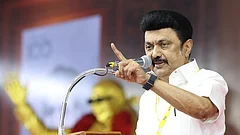


Stalin’s rejection thus underscores more than a tactical disagreement — it reveals the structural tension between national parties seeking relevance in Tamil Nadu and regional Dravidian formations determined to retain undisputed Stalin’s rejection, therefore, goes beyond immediate electoral arithmetic. The DMK maintains that its position is rooted in ideological consistency rather than political expediency. “Self-government at the state level and coalition at the Centre is our principle,” a senior party leader said, reiterating the Dravidian formulation that prioritises strong, undiluted state leadership while advocating federal coalitions in New Delhi.
Yet, the Congress response reveals lingering unease within the alliance. Soon after Stalin’s remarks, Congress MP Manickam Tagore took to social media to voice his disappointment. He argued that the question of a coalition government should ultimately be decided by the people. Tagore also blamed his own party’s past leadership for failing to insist on cabinet accommodation in 2006, when the DMK depended on Congress support to form the government. “The failure to implement the people’s verdict in 2006 was a mistake of our Congress,” he wrote on X.
The reference is significant. In the 2006 Assembly election, the DMK secured 96 seats — short of a majority — while the Congress won 34, placing the latter in a position of leverage. Despite this, the Congress extended support without entering the cabinet. Tagore’s remarks revisit that moment as a missed opportunity to redefine the balance of power within the alliance.
Earlier reports had indicated that Rahul Gandhi himself had raised the issue of power-sharing with the DMK leadership during a meeting, suggesting that the demand may not be confined to state-level leaders. Tagore, who is considered close to the AICC leadership, is seen by some within the party as reflecting at least a section of the national leadership’s thinking.
The DMK, however, appears unfazed. Responding to Tagore’s comments, party spokesperson Salem Dharanidharan downplayed any rift, asserting that the Congress high command alone determines its political stance. “Our relationship has evolved over time. Chief Minister Stalin and Rahul Gandhi share good camaraderie,” he said, signalling that the alliance remains intact despite public sparring.
For the DMK, conceding cabinet space would not merely be a tactical adjustment but a structural shift in Tamil Nadu’s Dravidian political tradition, which has historically resisted shared executive authority. At the same time, the Congress’ renewed assertion reflects its attempt to regain political relevance in a state where it has long operated as a junior partner.
Complicating matters further are ideological divergences. While the DMK foregrounds federalism and strongly defends its two-language policy as a marker of regional autonomy, its framing of state-centred governance does not always sit comfortably with the Congress’s national outlook.
In effect, the debate over coalition in Tamil Nadu is not just about cabinet berths. It exposes the evolving negotiation between a dominant regional party determined to preserve its authority and a national party seeking a more meaningful role within a long-standing alliance.
With the controversy over power-sharing unlikely to subside immediately, attention is now set to shift to the upcoming seat-sharing negotiations, scheduled to begin next week. A Congress leader admitted that the party would press for a larger share this time, signalling that the unease within the alliance may translate into harder bargaining at the table.
Several Congress leaders told Outlook that they are uncomfortable with what they describe as the DMK’s increasingly unilateral approach within the alliance. They point to a steady decline in the number of seats allotted to the Congress in successive Assembly elections as evidence of shrinking space. In 2006, the Congress contested 48 seats; this rose to 63 in 2011. However, the trend reversed thereafter — the party contested 41 seats in 2016 and just 25 in the last election.
By contrast, the DMK has progressively expanded its own contesting footprint. It fielded candidates in 128 seats in 2006, and by the last Assembly election, that number had risen to 173. “The DMK has consistently increased the number of seats it contests. This reflects its effort to secure a simple majority on its own rather than depend on allies,” a Congress leader said.
Observers believe that the recent public sparring over cabinet accommodation could also cast a shadow over the seat-sharing talks. The DMK is expected to retain roughly the 173 seats it contested in the previous election, leaving limited room for expansion by allies. However, adjustments may become necessary if new or returning partners are accommodated.
One such factor is the Desiya Murpokku Dravida Kazhagam (DMDK), founded by the late actor Vijayakanth and now led by Premalatha Vijayakanth, which has kept its options open. If the DMDK aligns with the DMK-led front, the ruling party may have to carve out additional seats — potentially tightening the space available for the Congress, the left parties and VCK.
In 2021, the Viduthalai Chiruthaigal Katchi (VCK), which has been steadily consolidating its influence among Dalit voters, contested six seats. Both Left parties — the Communist Party of India (CPI) and the Communist Party of India (Marxist) — were also allotted six seats each.
If these parties, seek a larger share this time, the arithmetic could become even more complex. Any upward revision for smaller allies would inevitably squeeze the Congress further, unless the DMK is willing to reduce its own contesting footprint — a move it has shown little inclination to make in recent years.
Thus, seat-sharing negotiations are shaping up to be more intricate than usual. . The coming talks will reveal whether the DMK-led front can accommodate competing ambitions without disturbing its carefully managed balance of power.
In a wider sense, the coalition debate is not merely ideological or symbolic; it is likely to play out in the hard arithmetic of seat distribution, where political hierarchy within the alliance becomes most visible.