Southern states risk losing relative Lok Sabha seats due to lower population growth; western states like Maharashtra seek to safeguard influence.
Sule’s conditional support for 50% seat increase is pragmatic strategy, not a policy shift.
The move tests NCP (SP) unity in Maharashtra and could shape future alliances or electoral positioning.
In a strong show of unity, NCP (SP) working president and Lok Sabha MP Supriya Sule addressed the media in Mumbai on Wednesday. Sule positioned herself as a key decision-maker during a period when the party was navigating sensitive national and regional pressures.
“All 8 MPs of NCP SP and all our MLAs, we stick together... The NCP is a party where Sharad Pawar not only leads it, he invests in everybody, and he listens,” she noted, as reported by ANI.
What did Supriya Sule say on the Delimitation Bill?
Sule stated that her party has not taken an official stand on the proposed Delimitation Bill yet. She made it clear that the Sharad Pawar-led faction would support the legislation only if the Union government amends it to include a 50 per cent increase in Lok Sabha seats across all states on a pro-rata basis.
“If the Union government amends the delimitation Bill by bringing a 50 per cent increase in seats, then we will support it. This is not something new,” Sule said, adding that the party and the INDIA bloc would deliberate the matter thoroughly once a formal proposal is tabled in Parliament.

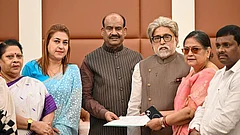


Her comments provide much-needed clarity amid confusing reports. Sule has repeatedly emphasised that no decision has been finalised, and the party will not commit without seeing the exact provisions of the bill.
Why has the statement come amid NDA speculation?
Sule’s remarks surfaced against a backdrop of intense speculation about NCP (SP)’s political future. Reports of late-night meetings between leaders of the ruling NCP (Ajit Pawar faction) and the opposition NCP (SP) have fuelled rumours of backchannel talks or potential realignments with the NDA. With the NDA looking to build support for key legislative items in the upcoming Monsoon Session, the eight Lok Sabha MPs of NCP (SP) have become strategically significant. Sule, however, firmly dismissed any possibility of switching sides.
This timing is not coincidental. The delimitation issue has gained urgency as Parliament prepares for important sessions, and NCP (SP)’s position could influence the numbers game for constitutional amendments. By speaking out, Sule aims to control the narrative and reassure both party workers and alliance partners.
What conditions has the NCP (SP) set?
The party’s primary condition is a uniform 50 per cent increase in Lok Sabha seats for all states, along with clear written assurances and implementation details. Senior leader Jayant Patil echoed the cautious approach, stating that any major increase in the number of legislators would ultimately depend on the views of Supriya Sule, the other MPs, and Sharad Pawar. The party has stressed that it will take a final decision only after seeing the formal bill and consulting within the INDIA alliance.
This conditional framework reflects a mature political approach. It allows the NCP (SP) to support reform in principle while protecting the interests of states that have performed well on population control and development parameters. Patil’s deference to Sule further highlights her growing stature as the public face steering the party’s national positioning.

How does delimitation affect southern and western states?
Delimitation involves readjusting parliamentary constituencies based on population data, potentially using the 2011 census or figures from the upcoming 2026 census. Southern states like Tamil Nadu, Kerala, Karnataka, and Andhra Pradesh, which have successfully controlled population growth, fear a relative decline in their Lok Sabha representation if the exercise is not balanced carefully. Northern states with higher population growth are expected to gain a larger share of seats.
Western states such as Maharashtra occupy an intermediate position. While they may see absolute gains due to urbanisation and migration, there is concern about maintaining their overall political and economic influence in the federal structure. A significant overall increase in seats, such as the 50 per cent pro-rata expansion demanded by NCP (SP), is seen as a way to preserve balance and prevent any region from being penalised for development achievements.
Experts point out that without such an expansion, southern and western states could lose relative power despite their economic contributions to the national GDP. The government, on the other hand, argues that a well-designed delimitation will actually increase representation for all regions in absolute terms while maintaining fairness.
Is this a shift in policy or parliamentary strategy?
This appears to be more of a pragmatic parliamentary strategy than a fundamental policy shift. NCP (SP) has consistently called for fair delimitation and has previously supported related reforms, including aspects of the Women’s Reservation Bill. Sule’s conditional support allows the party to engage constructively on a national issue while safeguarding regional interests and maintaining some distance from full opposition confrontation. It reflects the faction’s effort to position itself as flexible yet principled amid Maharashtra’s complex politics.
In the post-split era, NCP (SP) has had to carve out a distinct identity. By taking a nuanced stand on delimitation, the party is demonstrating that it can rise above pure opposition politics when larger national interests and federal balance are at stake. This approach could help it appeal to a broader electorate that values practical governance over ideological rigidity.
What could it mean for Maharashtra politics?
In the high-stakes arena of Maharashtra politics, this episode serves as a fresh test of NCP (SP)’s cohesion and relevance. By emphasising collective leadership involving Sule, Pawar, and the MPs, and with Sule herself projecting strong internal unity, the party is projecting stability while keeping its options open.
A successful extraction of concessions on delimitation could enhance its bargaining power and image as a serious regional player. Conversely, any perceived softening could accelerate speculation about further splits or alliances. Ultimately, how NCP (SP) navigates this issue, with Sule playing a pivotal role, may significantly influence its trajectory in state and national politics in the coming months.
Maharashtra has long been a battleground where national issues intersect with local ambitions. The delimitation debate adds another dimension to existing tensions between the ruling alliance and the opposition. For NCP (SP), successfully managing this could strengthen its position ahead of future elections, particularly if it can showcase results on issues that matter to both urban and rural voters in the state.
This latest development underscores the intricate interplay between national constitutional debates and regional power struggles. With Supriya Sule emerging as a confident and articulate voice, her stand on delimitation is not just about one bill. It is a litmus test of NCP (SP)’s ability to balance loyalty to its core ideology, federal concerns of states like Maharashtra, and the practical demands of coalition-era politics.
As the Monsoon Session of Parliament approaches, all eyes remain on how this influential leader and her party translate words into concrete political outcomes.