After failing to win any seats, Kishor has launched the Bihar Navnirman Abhiyan to rebuild Jan Suraaj’s grassroots organisation and restore worker morale.
By raising governance issues and pressuring the Nitish Kumar government on pensions, welfare, and jobs, Kishor is positioning Jan Suraaj—not traditional parties—as Bihar’s most active opposition voice.
With years before the next election, Kishor is betting on sustained village-level mobilisation to convert Jan Suraaj from an electoral experiment into a durable political alternative.
On a winter morning in west Champaran, Prashant Kishor stood before a modest crowd and spoke less like a defeated politician and more like a man beginning anew. Barely three months after his Jan Suraaj Party (JSP) failed to win a single seat in the Bihar assembly elections, Kishor was back on the road—walking village to village, invoking promises unmet and futures deferred. Electoral defeat had not ended his political project.
What Kishor is attempting now is not merely a political comeback, but a structural reinvention. Having failed to enter the legislature, he is trying to turn Jan Suraaj into something that may, in time, matter just as much: Bihar’s primary opposition force outside the assembly.
Reinventing After Collapse
The scale of the electoral setback was stark. Despite months of mobilisation and contesting nearly all constituencies, the Jan Suraaj Party drew only a small share of the vote and failed to open its account. For many parties, such an outcome would have meant organisational disintegration. But several party functionaries told Outlook, Kishor appears to have interpreted the defeat less as rejection and more as diagnosis.

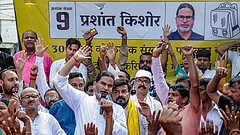


“Privately and publicly, his assessment has been consistent: the party’s weakness lay not in its message but in its machinery. Jan Suraaj had visibility but not penetration,” said Yaseen Hussain a party worker in Magadh region where the JSP has considerable following.
The Bihar Navnirman Abhiyan, the new statewide yatra Kishor launched in its aftermath, is therefore less an electoral campaign and more an organisational repair exercise.
“The objective is to rebuild morale among workers, recruit new cadres, and embed the party within Bihar’s dense social and political networks. Every village meeting, every roadside address, is part of a slower project—to transform Jan Suraaj from a campaign vehicle into a permanent political presence,” Hussain said.
“The election was only one step. This is about building something that lasts.”
Occupying the Opposition Space
But rebuilding the organisation is only one half of Kishor’s strategy. The other is more ambitious: positioning Jan Suraaj as the state’s most credible opposition voice.
In recent weeks, Kishor has repeatedly raised issues ranging from pension adequacy to women’s financial assistance schemes, arguing that the Nitish Kumar government has failed to deliver on its commitments. He has claimed that his party’s pressure contributed to the government’s decision to increase social security pensions—a claim that underscores his broader political messaging: that Jan Suraaj can influence governance even without legislative representation.
Nirnimesh Kumar, a senior journalist who extensively reported on the last Bihar elections, told Outlook, “This is not accidental positioning. It reflects Kishor’s reading of Bihar’s current political vacuum. The Rashtriya Janata Dal (RJD), despite being the principal opposition party in formal terms, has struggled to sustain visible grassroots agitation outside election cycles. The Congress remains organisationally weak. Smaller parties lack statewide reach.”
By maintaining continuous contact with voters and raising concrete governance issues, he is trying to cultivate a perception that Jan Suraaj—not the established opposition—is the most active challenger to the ruling dispensation.
This shift marks a deeper strategic evolution. Kishor’s earlier political efforts were centred on electoral entry—converting his extensive padyatra and public outreach into votes. The failure of that conversion has now pushed him toward a longer horizon. His current approach resembles movement-building more than conventional party politics. The emphasis is on sustained mobilisation rather than episodic campaigning.
The Consultant Turns Politician
“This strategy,” said Kumar, “also acknowledges a structural reality of Bihar politics: durable political parties are built not in months but in years. The Rashtriya Janata Dal and the Janata Dal (United) emerged from long social movements and caste-based mobilisations. Even the Bharatiya Janata Party’s eventual dominance required decades of cadre-building. Kishor appears to be attempting a similar long game—constructing a political organisation that can endure beyond individual elections.”
Kishor’s current efforts suggest he is no longer on immediate electoral breakthroughs but on gradual accumulation of political capital. At village meetings, his rhetoric has also shifted. He speaks less about winning elections and more about accountability, governance, and citizen empowerment. The message is calibrated to present Jan Suraaj not merely as another party, but as a corrective force within Bihar’s political system.
Betting on Time
With the next assembly elections still years away, Kishor has space to experiment. Time, in fact, may be his most valuable political asset. Without the pressure of imminent polls, he can focus on organisational consolidation and public engagement.
The risks remain considerable. Bihar’s political loyalties are deeply entrenched, shaped by caste alignments, historical affiliations, and patronage networks. Breaking into this ecosystem requires not only persistence but structural breakthroughs. For now, Kishor’s yatra is less about victory than visibility. Prashant Kishor’s Jan Suraaj, born in electoral defeat, is attempting to follow a slower, harder path—recasting itself not just as a contender, but as Bihar’s opposition-in-waiting.