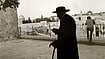
A Trishul given to him as a weapon of “self-defence” makes him reflect on his Kashmiri Pandit childhood, where survival came from family, ritual, neighbours and shared culture, not arms.
His memories and his visit to the Ajmer Sharif Dargah reveal a lifelong, intimate syncretism between Hindu and Muslim faith and friendships.
He concludes that what truly protects a home is love, trust and humanity, not symbols of fear.
Last month in Delhi, an elderly man gave me a gift.
“To defend yourself and to protect your home,” he said and handed me a cardboard box.
I opened the box. Inside was a Trishul, Shiva’s trident, made of brass.
The Trishul was the length of my forearm. I touched its tips. They were sharp.
I slipped it back into the cardboard box.
Kashmiri Pandits are Shiva devotees. For the community in Kashmir, Shivratri was the most important festival; the sacred night when Shiva married Parvati. In Kashmir, on that wintry day, with thick snow blanketing the garden, I would hunt for traces of early flowers. Sometimes a tiny yellow virkin. Or, if I was lucky, a white nargis with a heart of gold. Other than these, we needed bel patra, fragrant Trishul-shaped leaves of a shrub that grew on the meadowy slopes of Khilanmarg. We never had a Trishul at home.




We looked forward to Shivratri, although it involved rigorous house cleaning and scrubbing of dishes with icy water. Food on Shivratri meant reet food, which meant that year after year, the same food would be cooked, nothing else. My father was wise and practical. He knew that the only road to Kashmir from the rest of India could close down because of mudslides or just bury under snow. When this happened, meat disappeared from the shops, as did green vegetables. So, for us, that sacred night of Shivratri meant a spicy red dumaloo, green moong dal, and fried mujj chutney. Potatoes, lentils and local radishes could be sourced every winter. Sometimes, my eldest uncle would visit us with his book of hymns, written in large nastaliq fonts. We hummed along, waiting impatiently for the puja to end, and for the dinner to be laid out. Every Shivratri my mother would say, “Shivratri reet food tastes so special, doesn’t it?” This made us eat more rice, take another dumaloo, and relish the radish chutney, sitting on the floor and eating with our fingers.
I did not know that this phrase was my mother’s defence against the harshness and scarcity of those days.
We have no problems with food in England, and snow does not block roads. But we still eat dumaloo, moong dal and mujj chutney on a mound of hot rice. We eat it in steel thalis, like we used to. On Shivratri, I am transported to those snowy nights. And I say to our children. “The reet food is simple, but it tastes so special, doesn’t it?”

We pray and celebrate the wedding of Shiva and Parvati, as my parents used to. After 3 days, we float the flowers in a river nearby. The walnuts that we soak in water are taken out and eaten. In Kashmir we used to give them to all neighbours, Pandits and Muslims. I still get a message from friends in Kashmir; they miss those wet walnuts.
The cardboard box sat on my lap in the taxi. Did the elderly man know something that I did not? Or did I know something that he did not?
In those days, a battery-operated radio was our lifeline because electricity was as rare as the winter sun. We woke up to Radio Kashmir playing Kashmiri songs in the freezing mornings. Around Shivratri, this prayer would play often:
Bel tai madal vyen golab pamposh dastai
Poozai lagas parm shivas shivnathas tai
Wood apple, datura, wild basil, rose and lotus bouquets.
I offer these to you, Shiva.
The prayer was written by a 19th century mystic Pandit poet, Krishan Joo Razdan and sung by a Sufi Muslim singer, Mohammed Abdullah Tibet Baqal. He had a unique soulful voice. The voice still rings in my ears, on the days leading up to Shivratri.
As the taxi bumped over speed breakers on Delhi roads, I looked at the weapon on my lap. My thoughts returned to those crippling attacks in the winter months.
As the frost in December advanced, my fingers swelled like carrots. My toes turned flaming red and glistened. On some nights my fingers and toes hurt so much that I cried. My father tried everything to cure the chilblains; from rubbing kerosene on my toes to magnesium salt baths. The piles of frozen snow made it impossible to step out. Running came with the risk of slipping and breaking a limb. The enemy was on a mission.
After spending a week in Delhi, my wife, our children and I went to Ajmer and visited the dargah of the 13th century Sufi saint Khwaja Moin-ud-din Chishti, who had travelled from Iran.

I remembered the river behind our house in Kashmir. It dried up in winters to a stream. We could almost walk across to Janbazpora, the village where a 16th century Sufi saint, Syed Janbaz Wali, lived. He too had travelled from Iran to Kashmir. While it was exciting to walk on the pebbly riverbed, it also meant no electricity from the hydel projects. It meant solving algebra problems and chemistry equations under a kerosene lantern. It meant reading about the free lives of the Hardy Boys and Nancy Drew in America, under dim candlelight. A single wood bukhari kept a room warm, while the rest of the house froze.
It was a long, crowded street leading to the Ajmer dargah. We looked for help to enter the shrine.
A young khadim approached us. “I will guide you through the dargah.”
In the dargah compound, devotees were offering chadars and baskets of fragrant red roses. Others were singing prayers.
In the tight space of the shrine, through its small entrance, under its marble dome, we huddled together, with scores of other men and women, praying. Here, one forgot if one was a Hindu or a Muslim, man or woman, rich or poor. All one felt was humanity, its helplessness and its hope.

Outside, the young khadim said, “Two months ago, my father, the old khadim, died. Please pass on the sad news to his old friend in Delhi.”
We found out that the elderly man we had met in Delhi had been a good friend of the old khadim who was no more. It was the elderly man who had arranged for our easy entry into the shrine.
In that moment, the true meaning of the gift of the Trishul unfolded. Satyam Shivam Sundaram, the three words rang in my ears, beating gently like the damru on Shiva’s Trishul. That truth is divinity, and divinity is beautiful. I could see the two friends in their young days together in the dargah, talking, smiling, exchanging gifts, walking down the streets, buying at the shops, and welcoming devotees.
I bought a gift for Rafiq, my friend in Kashmir; a glass bead tasbih, and a cotton namaz rug for Khurram, my friend in England. The young khadim gave us a box of sweet sohan halwa. Later, my wife gifted it to her friend, Tabassum, in London.
I am again thinking of the frightful Kashmiri winters. Our only defence in those days were the salt baths, candles, logs of wood, a few books and prayers. And to protect our home, all we needed was the love of our family, friends and neighbours.