The performance brings figures like Rantas and the Braid-Chopper to life, making folklore a method to preserve unrecorded stories and collective trauma.
Spoken in Kashmiri, the verses draw the audience, turning passive spectators into witnesses to fear and resilience.
The show saw artistic freedom and self-censorship, asserting cultural survival and nuanced social commentary.
The lights dimmed, and the young performers, boys and girls, moved into the space with deliberate calm. From that moment, folklore entered the room, fear emerged as the quiet protagonist.
Their voices, speaking in Kashmiri, filled the room with a steady, trembling resonance.
For those in the audience unfamiliar with the language, the words demanded more than comprehension. They required a surrender to tone rather than understanding the literal meaning. And for those who knew, they knew.
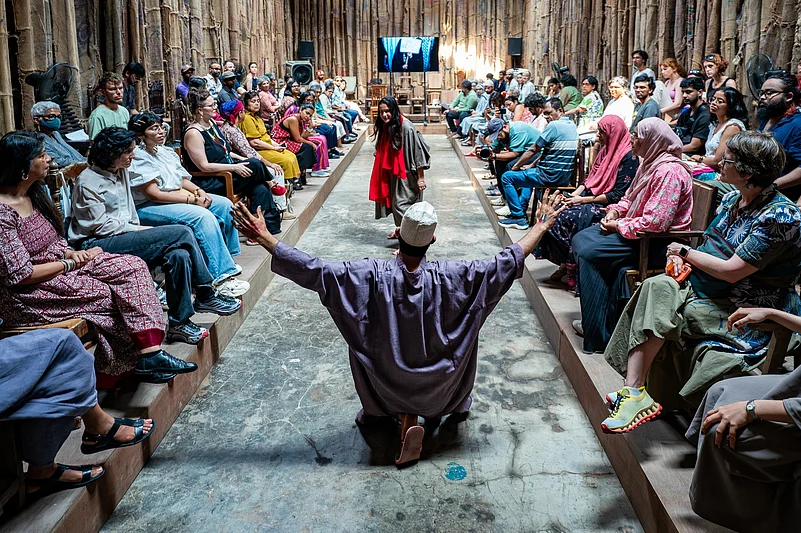
The verses, half memory and half incantation, lingered in the air. Be moyas (I died), and tem gie aabas (they drowned) were more than simple statement of facts.
It was an acknowledgment of loss suggested, evoking how trauma becomes part of the ordinary texture of life. The audience felt implicated almost immediately. Who drowned?
The question lingered in the silence. Was it about the discovery of two young women’s bodies in a river near their village, the Asiya and Neelofer incident that then had shaken the Valley?
The performers did not name any cases directly. Their pauses were deliberate and their silences dense with implication. The murmurs rose into chants, and fractured back into whispers. At moments, performers froze, eyes fixed somewhere beyond the audience, as though witnessing events invisible to everyone else.


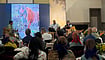
After its initial presentation at the Kochi-Muziris Biennale, The Conference of Anti-Apocryphal arrived at Method Delhi carrying with the folklore tremors of memory and survival.
Conceived by artists Salman B Baba of the Yusmarg Collective and Khursheed Ahmad of the Shikargah Collective, and realised by young performers from the Institute of Music & Fine Arts, University of Kashmir, the work presented fear as something inherited, and passed down through stories, carried in the rhythm of language, and held in the stillness of a gaze.
Creatures of Memory
The figures drawn from Kashmir’s folklore like Rantas, Dyev, Yachh, and the contemporary Braid-Chopper hovered as “misremembered presences that travel through mountains and checkpoints”.
Rantas is often described as a winter demon haunting snowbound village, and this time became something more complex on stage. She stood carrying on her back women’s unrecorded histories. The labour performed in silence, endurance mistaken for invisibility.
The Dyev occupied an unstable terrain between deity and demon, sacred and profane. The Yachh evoked forests and older ecological knowledge systems carry knowledge that has been erased or muted. Its presence suggested that conflict reshapes landscapes as much as it does memory.
Then there was the recent addition. The Braid-Chopper, who unlike the others, did not originate in distant folklore but was born from “panic, gossip and fractured political reality”.
In 2017, reports spread across the Valley of women whose hair had been mysteriously cut. Accusations circulated, rumours multiplied, protests erupted, and internet services were suspended to contain unrest. The incidents were never conclusively explained, but the fear it brought along persisted.
The show wove these beings together without hierarchy, allowing audiences to trace their own connections to drowning women remembered in whispers, to protest movements, to unresolved cases that linger in public consciousness.
Through gesture and silence rather than declaration, the performers transformed these figures into living testimony.
Witnessing the Unspeakable
What made the performance striking was its opacity or the refusal to explain itself. The script moved elliptically, circling trauma without naming it outright. Myth carried what direct reportage often cannot. The texture of living under surveillance, political uncertainty, and accumulated historical grief.
Khursheed agrees the ambiguity was deliberate. “The artists are unabashed in presenting what they want,” he noted. “But there is a line we chose to draw as we don’t want to lose whatever space we have got for expression.”
The restraint is visible in the choreography of speech, silences and in the pauses that feel as charged as dialogue. It mirrors the real calibration required to create art where expression can be politicised or curtailed, he said.
Through face-to-face whispers, repeated questions, and moments of proximity, spectators become witnesses. When the performers ask: “Does the tongue flutter?”, the question lingers as an invitation and a test, probing the space between knowing and not knowing, between consent and compliance.
Where the Body Speaks
Salman describes the show as a response to the “living present”. To him, meaning emerges less from explicit dialogue than from posture, gestures and distance, and the performers’ bodies carry what remains unsaid.
Rantas, he explains, is traditionally a folkloric female figure, which appears not as a passive spectre but as an unruly and defiant woman, who resists containment, asserting agency, and a figure that refused erasure.
“Through her, folklore becomes less about superstition and more about endurance. The opacity is intentional, and leaving parts untranslated respects both the integrity of performance and the diversity of audiences. The performance trusts that bodies and space can hold meaning where words might falter,” he said.
The Yusmarg Collective itself emerged after the abrogation of Article 370 and the Covid-19 lockdowns, years marked by communication blackouts and uncertainty.
Khursheed, who comes from a family of traditional Bhand performers, also speaks of how the form has lately often been mostly confined to state functions. Through his Shikargah Collective, he seeks to reclaim performance as independent heritage practice, rooted in lived memory rather than official narratives. “We want to be a voice for cultural preservation speaking of socio-political issues while staying relevant an art form,” he said.
Artist Inder Salim reflected on the density of the performance, imagining how it might expand in full costume while acknowledging the power already present in its raw form by young performers. “Even in simplicity, the layering is palpable,” he said.
The show concludes with: “Me chond panun paan nevis saazs te naven baharan manz…” (I am finding myself in a new tune and a new bloom). It is spoken as a woman’s body lies out in the open, while life around her continues, uninterrupted.
The image captures the precariousness of life in Kashmir.
Here tragedy and normalcy coexist.