Donald Trump met his national security team to discuss Iran’s proposal to reopen the Strait of Hormuz, a key global oil route.
Marco Rubio said Iran is “serious” about a deal but seeking time, with internal divisions complicating negotiations.
The US said Iran’s terms fall short of its red lines, even as blockade pressure continues on Tehran.
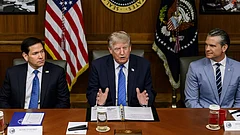
In a meeting with his national security team on Monday, US President Donald Trump discussed Iran's most recent proposal to open the Hormuz Strait, a vital waterway that transports one-fifth of the world's oil supplies.
At a news conference today, White House spokesperson Karoline Leavitt stated that while Trump was talking about Iran's most recent proposal, she did not want to "get ahead" of the President or his security team regarding the meeting's conclusion.
“I would just say that there was a discussion this morning that I don't want to get ahead of. And you'll hear directly from the president, I'm sure, on this topic very soon,” Leavitt told reporters at the White House.
Earlier, Secretary of State Marco Rubio told Fox News that Iranian negotiators were “serious” about reaching a deal with the US, but were looking to buy themselves more time.
"I think they are serious about getting themselves out of the mess that they're in; there are all the problems Iran had,” he said.
Rubio said Iranian negotiators often are in disagreement with other factions within the Iranian regime, severely limiting the scope of peace talks.
The US administration's positive assessment of the effects of its continuous naval blockade of Iran's ports coincided with Trump's meeting with the national security team.
Iran has offered new terms for an agreement to more permanently end the confrontation between the two countries over the weekend, but those concessions still seem to fall well short of the administration's red lines, according to an official quoted by ABC News.



In the Fox News interview, Rubio said the fact that Iran is run by radical Shia clerics is a pretty big impediment.
“The other is that they're deeply fractured internally, and I think that's always been the case, but I think it's far more pronounced now,” he said.
Rubio said the best way to understand Iran is "you have a political class now who understand they have to run a country and an economy".
“People talk about moderates and hardliners. They're all hardliners in Iran. But there are hardliners who understand they have to run a country and an economy, and there are hardliners that are completely motivated by theology," he said.
"The hardliners that are motivated by theology are not just the IRGC (Islamic Revolutionary Guard Corps) officials, but obviously the supreme leader and the council that surrounds him, Rubio said.
"And then you've got the political class, the foreign minister, the president, the speaker of the moguls. These guys, they're hardliners, too, but they also understand the country has to have an economy,” he said.
Unfortunately, the hardliners with an apocalyptic vision of the future have the ultimate power in that country, Rubio said.
"So as much as anything else, one of the impediments here is that our negotiators aren't just negotiating with Iranians. Those Iranians then have to negotiate with other Iranians to figure out what they can agree to, what they can offer, what they're willing to do, even who they're willing to meet with," he said.