Bab el-Mandeb is a strategic Red Sea chokepoint connecting Asian, European and Middle Eastern trade routes.
The narrow strait has shaped migration, imperial competition, energy security and global shipping for centuries.
Threats to Bab el-Mandeb could disrupt oil supplies, shipping routes and international supply chains.
The Bab el-Mandeb Strait is barely wide enough to appear significant on a world map, yet its waters sit at the centre of a trade route that connects some of the world’s largest economies. A conflict involving a few miles of sea between Yemen and the Horn of Africa can affect oil markets, shipping schedules, food supplies and industrial production thousands of miles away.
As tensions rise across the Middle East, attention has moved beyond the Strait of Hormuz to Bab el-Mandeb, another maritime chokepoint that could become a pressure point in any wider regional confrontation. While Iran has the geography and military presence to threaten Hormuz directly, pressure on Bab el-Mandeb would depend largely on its regional partners, especially Yemen’s Houthi movement.
The strait’s importance is not only a result of today’s conflicts. For centuries, Bab el-Mandeb has shaped migration, trade routes, imperial competition and naval strategy. Its position at the southern entrance of the Red Sea makes it one of the key passages linking the Indian Ocean with the Mediterranean Sea through the Suez Canal.


What is the Bab el-Mandeb Strait and why has it mattered throughout history?
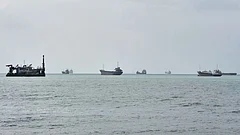
The Bab el-Mandeb is a maritime passage between Yemen on the Arabian Peninsula and Djibouti and Eritrea in the Horn of Africa. It is around 18 to 20 miles wide at its narrowest point and connects the Red Sea with the Gulf of Aden and the Arabian Sea.
The island of Perim, also known as Mayyun, sits near the narrowest section of the strait on the Yemeni side. The Seven Brothers Islands extend from Djibouti further south. These geographical features have historically made the passage both valuable and difficult to navigate.
The name Bab el-Mandeb means “Gate of Tears” or “Gate of Grief” in Arabic. The name refers to the dangers faced by sailors because of strong currents, unpredictable winds, reefs and shallow waters. The passage has long been associated with maritime risks, including shipwrecks and navigation challenges.
The strait has also featured in debates over early human migration. Scientists have studied whether Homo sapiens crossed from Africa into the Arabian Peninsula through this region, although research has found no permanent land bridge existed. Some studies suggest the narrow distance may still have allowed early movement between the two regions.
Bab el-Mandeb gained greater global importance after the opening of the Suez Canal in Egypt in 1869. The canal connected the Red Sea with the Mediterranean, creating a shorter maritime route between Europe and Asia. Shipping that once relied on longer journeys around Africa increasingly moved through the Red Sea, making Bab el-Mandeb a crucial link in international commerce.
The strait became an area of imperial competition after Britain seized Perim island during the Napoleonic Wars and later occupied it fully in 1856. Britain used the island as a support point for ships travelling between Europe and its naval base at Aden. British influence continued until the late 1960s, when Perim was transferred to southern Yemen.
The strait’s role in energy security became clear during the 1973 Yom Kippur War. Arab members of the Oil Producing Economic Community imposed a blockade on oil tankers heading towards Israel from Iran, which was then governed by the pro-Western Shah. Egyptian ships enforced the blockade at Bab el-Mandeb and turned back several oil tankers before the passage was reopened months later. The episode highlighted how events around the strait could influence global energy supplies.
Today, Bab el-Mandeb remains a focus of military competition, with powers including the United States and China maintaining facilities in Djibouti because of its location near a major global shipping route.
Why has Bab el-Mandeb become a geopolitical flashpoint?
The modern importance of Bab el-Mandeb comes from the volume and variety of goods that pass through it. The route carries crude oil, petroleum products, LNG, grain, metals, consumer goods and industrial materials moving between Asia, Europe and global markets.
The International Maritime Organization estimates that up to a quarter of global shipping passes through the wider Red Sea-Suez route. The U.S. Energy Information Administration estimates that millions of barrels of oil and petroleum liquids move through Bab el-Mandeb each day.
According to the EIA, crude oil exports and petroleum liquids transiting the strait increased from 5.7 million barrels per day in 2020 to 9.3 million barrels per day in 2023. After Houthi attacks disrupted shipping, the figure fell to 4.1 million barrels per day in 2024.
However, Bab el-Mandeb gained importance as tensions around Hormuz pushed companies to seek alternatives. Unlike Hormuz, where Iran has direct military access, pressure on Bab el-Mandeb would depend largely on regional partners such as the Houthis.
Crude oil and condensate moving through Bab el-Mandeb increased from 3.7 million barrels per day in the first quarter of 2025 to 5.4 million barrels per day in the first quarter of 2026. LNG flows, which had stopped in the second quarter of 2025, returned to 2.9 billion cubic feet per day in the first quarter of 2026.
The latest crisis began in late 2023 when Yemen’s Houthi movement started targeting commercial vessels in the Red Sea after the outbreak of the Israel-Hamas war. The Houthis said the attacks were linked to their support for Palestinians.
The attacks disrupted shipping, but experts caution against viewing the Houthis as simply an Iranian proxy. The group has its own locally defined interests while often aligning with Tehran.
The International Institute for Strategic Studies has described the Iran-Houthi relationship as a partnership rather than a direct command structure. Both sides cooperate on some political and military objectives while maintaining their own independence.
Iran’s ability to directly restrict Bab el-Mandeb is also limited. Unlike Hormuz, where Iran has military forces located along the coastline, Tehran does not have the same direct geographical advantage near Bab el-Mandeb.
“The reason Iran can threaten to disrupt ships in the Strait of Hormuz is that Iran has military forces directly located on the coast of the Strait. Iran has no military forces near the Bab el-Mandeb,” said Gholz, adding that Iran would instead have to assert its influence via regional proxies.
Iran’s parliament speaker Mohammad Bagher Ghalibaf highlighted the strait’s importance. “What share of global oil, LNG, wheat, rice, and fertilizer shipments transits the Bab-el-Mandeb Strait?” he queried on April 3. “Which countries and companies account for the highest transit volumes through the Strait?”
The Houthis have also issued warnings over possible disruption.
“If the current situation aggravates, the Bab el-Mandeb Strait and the Strait of Hormuz will be closed in an operational alliance. Oil prices would then skyrocket to $200 a barrel in a dreadful shock,” a senior Houthi official warned, according to a report by Iran's Press TV.
What would happen if Bab el-Mandeb was disrupted?
A prolonged closure or serious disruption of Bab el-Mandeb would affect more than energy markets. Oil tankers, LNG carriers, bulk carriers and container ships rely on the route to move fuel, food, raw materials and consumer products.
Noam Raydan, a senior fellow at The Washington Institute for Near East Policy, says the strait has become more important because shipping patterns have changed during regional crises.
“Saudi Arabia managed to re-route some of the volumes that used to cross via the Strait of Hormuz and go mostly to Asia and other markets. They started using a pipeline that runs to the Red Sea and exporting out of the Red Sea via the Bab el-Mandeb,” says Raydan.
“Fuel, oil, gasoline, and other products pass through Bab el-Mandeb. So oil tankers in general carrying liquids, we [also] have bulk carriers. These can carry, for instance, grains, they can carry steel. We have container ships. Container ships are the ones that can carry commodities like clothes, like toys, and other stuff. And then you have, of course, the gas carriers, and specifically here, I'm referring to liquefied natural gas (LNG) and liquefied petroleum gas, which is used for cooking and heating,” she says.
If Bab el-Mandeb became unusable, vessels travelling between Asia and Europe would have to take a longer route around the Cape of Good Hope at the southern tip of Africa.
“If a ship wants to come to the Red Sea and Bab el-Mandeb is closed, and if it wants to get to Europe, the only way for it to do that, is to go around the Cape of Good Hope. There's no other way,” says Raydan.
Such a diversion would increase fuel consumption, insurance costs and delivery times. Previous disruptions around the Strait of Hormuz showed how quickly chokepoint crises can tighten energy markets and raise concerns over essential goods. Iran has never directly blocked Bab el-Mandeb, but continued threats show why narrow maritime passages remain central to global trade and security.
Bab el-Mandeb matters because modern trade depends on a small number of strategic waterways. Its history, from ancient migration routes and imperial competition to present-day energy security and military rivalry, shows how control of a narrow passage can influence economies far beyond its shores. A disruption there would not remain a regional problem; it would become a global shipping and energy issue.
(With inputs from National Geographic and TIME)