






The book recounts India’s May 2025 punitive strikes on Pahalgam terror camps, which escalated into a four-day full-scale air war after Pakistan retaliated.
It highlights the IAF’s bravery, precision, and moral restraint, like avoiding civilian aircraft, amid advanced enemy weaponry.
Beyond tactics, it reveals insider perspectives, split-second decisions, and the emotional reality of using cutting-edge systems in real combat.
The Sky Warriors: Operation Sindoor Unveiled is a timely book. May 7-10 will be the first anniversary of the 88-hour mini- war that India fought in 2025 to teach terrorists and the military generals in Pakistan a punitive lesson. Launched in the wee hours of May 7, 2025, Operation Sindoor’s initial objective was simply to destroy the terror camps across the border that had sent masked gunmen to Pahalgam, to kill innocent tourists in a gruesome attack on April 22, 2025. But the operation escalated into one of the most intensely-fought battles when Pakistan retaliated with an all-out military offensive against India. Written by Vishnu Som, The Sky Warriors… tells the inspiring story of the Indian Air Force’s role in the four-day battle between two countries using the most advanced methods of warfare.
Som narrates how fifteen days after 26 men were gunned down on the beautiful meadows of Baisaran Valley, Pahalgam, the IAF blasted the terrorist hideouts of Lashkar-e-Taiba (LeT), Jaish-e-Mohammad (JeM) and Sialkot Hizbul Mujahideen (HM) with surgical precision. Thereafter, India officially informed Pakistan that it had no intention of attacking Pakistan’s military bases. But, instead of letting the embers at the above camps die out, Pakistan fanned them into a full-fledged war by unleashing a large number of fighter planes, including the US-made F-16s, to target both, civilian areas and military bases in India. India was left with no option but to counter the rogue country with similar fire.


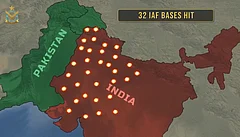

Having covered defence, since the Kargil War, Som, Senior Managing Editor at NDTV news channel, has the advantage of knowing many of the IAF’s top bosses from their younger days. Responsible reporting over the decades has earned Som their trust, and so he was privy to an insider’s view of Operation Sindoor; limited, of course, to information that would not risk national security. The Sky Warriors…, therefore, contains a wealth of information.
Sitting in our comfort zones, far away from the scene of action, most of us are unaware of what a war entails. Som’s book gives a gripping account of the bravery, determination and combat skills of our men in blue as they faced Pakistan’s arsenal of new- generation weaponry supplied by China, the US, Turkey and other countries. Flying into a storm of drones, being mapped on enemy radars, facing the most advanced air-to-air missiles required nerves of steel and coordinated support from those on the ground firing surface-to-air missiles at enemy aircraft. Our air warriors rose to the occasion, taking split-second decisions, making calm, calculated moves, hitting with precision and returning to base, unscathed.
Som recounts crucial details of the four-day war, such as India’s destruction, on May 8, of Pakistan’s surface-to-air missile unit near Lahore, a critical defence network; and how, caught on the back foot, Pakistan’s pilots, unscrupulously, resorted to positioning themselves in the radar shadow of commercial airliners—planes filled with families, business travellers, students…
Indian commanders, however, Som emphasises, held their fire when civilian aircraft were in the picture. “It was a test of systems, of doctrine, of national will—and of the moral lines nations would or wouldn’t cross in pursuit of victory,” he observes, with justified admiration for our pilots.
The same mature restraint was shown by our Armed Forces when they graciously accepted Pakistan’s request for a ceasefire after four days of intense fighting, a restraint rarely seen in global warfare. A case in contrast being the war in West Asia which is going nowhere and yet its players are continuing to self-destruct. Our sharply-focused military chiefs, on the other hand, knew when to suspend their retaliatory action, uninfluenced by those who criticised the decision to stop the war despite our winning position. Being the ones who send their men into the thick of fire, the military chiefs’ decision to accept the enemy’s request for a ceasefire was a pragmatic one. Having achieved what they had set out to do, was there any sense in prolonging the conflict?
Operation Sindoor achieved its goal by combining impeccable preparation, synchronised orchestration and flawless execution. Kept under wraps, very few people knew what our defence chiefs were strategizing. But the rank and file of our armed forces had sensed that the killings in Pahalgam would call for action and many of them cut short their holidays and returned to their bases without waiting for orders from the top. Knowing it was not a question of whether it would happen but when, they were eager and rearing to go, to give the terrorists a befitting reply.
Senior officers in the know pretended that everything was routine, with some of them even attending a junior officer’s birthday party, a few hours before action started. “We didn’t want anybody to know that the day of the attack is today,” explained a Node Commander of the Integrated Air Command and Control System to Som. Fuelled by caffeine pills, this Node Commander spent 64 hours at a stretch on duty inside the underground IACCS.
Above ground, braving severe weather conditions, Group Captain Kunal Kalra, in a Sukhoi-30, and his squadron were in the air, to target the terror camps. At exactly 1.05 a. m., on May 7, Kalra sent the first missile into the heart of Pakistan’s terror camp. The others in his squadron also fired. They eliminated nine major terror launch-pads and killed 100 terrorists, including many high-profile ones. But the operation was not as simple as it sounds, as the squadron had exposed itself to the risk of being detected on enemy radar while in action. It was a very close call! Fortunately, Kalra and his team streaked away, just in time, beyond the firing range of Pakistani aircraft.
“This was an absolutely flawlessly-executed strike,” Air Marshal Bharti told Som. Sitting in the IAF Command and Control Centre in New Delhi, Bharti had seen a real-time feed of the air battle as it commenced.
If Air Marshal Bharti was seeing a real-time feed and taking split-second decisions, his Pakistani counterpart was doing just the same. Som points out, “The air war between India and Pakistan was the most sophisticated air battle fought between near-peers in decades. Both sides deployed advanced fourth-generation fighter jets, game-changing ultra-long-range air-to-air and surface-to –air missiles and integrated command and control networks that guided the conduct of war on both sides.”
Apart from delineating the nuances of modern warfare, Som says his intention in writing the book was to tell the human story of Operation Sindoor. A human story that describes, for instance, the nervous apprehension of officers who were using highly advanced systems for the first time in real warfare, not simulated ones. Som narrates how Group Captain Animesh Patni at Adampur Airbase, waited with bated breath after his Wing Commander pressed the button to launch an S-400 missile at an enemy aircraft. “It felt like an eternity,” recalled Patni later, although it was a matter of seconds before he heard the boom. The earth shook under his feet as the missile—25 feet tall—soared into the night sky. And made a successful hit, 200 km away. The boom was followed by another huge sound. The sound of Bharat Mata Ki Jai!
The Sky Warriors…is an engrossing, informative read, though the sub-editing could have been better.
















