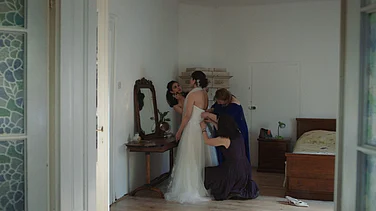
Marijana Jankovic’s Home had its World Premiere at the International Film Festival Rotterdam.
The film opens in 1991 Yugoslavia and follows Marko, who decides to migrate with his wife Vera and five-year-old daughter Maja to Denmark when civil war looms.
He is forced to leave behind his two older sons, Milos and Ivan with their grandmother, a decision born of desperation, but one that becomes a lifelong wound.
Human history is one of migration. Following rivers and seasons in search of survival, humans travelled from one part of the world to another. Birds still do it. Wildebeest still do it. Entire ecosystems depend on cyclical departure and return. But it is only ever seen as a crime when humans do it. In order to build a home elsewhere, a migrant has to essentially destroy the very idea of home and the pain that causes is unlike another. Marijana Jankovic understands and tries to explore that very sense of self-destruction in her debut feature Home that had its world premiere at the recently concluded International Film Festival Rotterdam.
Migration is an act born of violence, of rupture. It promises the reward of an ever-elusive “better” life but brings with it the demand of endless sacrifice. It also brings with it the condition that you can no longer find a sense of belonging in one place.

Janković’s Home opens in 1991 Yugoslavia, in a world that is abundantly green and idyllic, where we meet Marko (Dejan Čukić), a family man of integrity who believes hard work should earn him a life of dignity. Marko would rather cling to principle than bend to circumstance, even when bowing down might save him.


As civil war looms, Denmark appears as a lifeline. Encouraged by his uncle Laza (Zlatko Burić), he decides to migrate with his wife Vera (Nada Šargin) and five-year-old daughter Maja (Tara Čubrilo). But there is no space in his sister Sanja’s (Dubravka Drakić) Copenhagen apartment for his two older sons, Milos (Sergej Bulatović) and Ivan (Viktor Janković). They are left behind with their grandmother, a decision born of desperation, but one that becomes a lifelong wound.

Home is not interested in spectacle or melodrama. Instead, it charts what might be called the Ulysses Syndrome—the chronic, multiple stressors experienced by migrants facing isolation, fear, economic and social precarity and prolonged uncertainty. Named after the wandering Greek hero, it describes a prolonged grief response to displacement.
Janković visualises this stress through an eventual kind of plateauing. The boisterous Balkan temperament that relies on community and being emotionally expansive is gradually battered out of Marko and Vera by Denmark’s quieter, more restrained social rhythms. They eventually conform, but never integrate. The camera (courtesy of Manuel Claro) frequently frames them in shallow focus, dwarfed by clean Danish interiors or caught in vast Nordic landscapes that feel emotionally airless. Yugoslavia was green and warm; Denmark is muted, orderly and clean, but can knock the air out of your lungs when you come unprepared.

The film explores this in Marko’s transformation. In Yugoslavia, he is a competent, respected man—a beloved son, father, neighbour. In Denmark, he becomes linguistically and culturally diminished. His lack of language skills and inability to decode social cues reduce him to “the immigrant”, whose sparkle and intelligence has dimmed by simply crossing a border. His pride curdles into dishonesty in trying to secure his family’s economic survival. The way Janković approaches this decline feels like it comes from a lived experience.
The film resists the easy mythology of migration as uncomplicated bravery. It strips away the triumphal arc and instead lingers on the awkward, often humiliating labour of starting over. It poses a disquieting question: where does the burden of adjustment truly lie? With the migrant, expected to assimilate by decoding an entirely new social grammar? Or with the host nation, which prides itself on tolerance, yet rarely shifts its own terms of belonging?

Though Marko dominates the emotional arc, the film ultimately belongs to Maja. She is the only one Marko listens to when even Vera cannot get through.
We meet Maja at five and leave her as a successful adult artist in Denmark. Tara Čubrilo puts in a disarmingly heartbreaking performance as she carries Maja from her days of innocence to the heaviness of adulthood that overshadows her within the span of a year living abroad. Maja’s life appears, on the surface, to vindicate her father’s gamble. But beneath that success lies a persistent fracture. For those who migrated young (or grew up in families that led to one’s early parentification), Maja’s experience will resonate sharply. Maja assimilates better than her parents because of her age. But she grows up too fast as her parents’ burdens become hers. She translates everywhere for her parents, from helping them navigate ideas of trade unions to the realities of abortion. She becomes a bridge between her parents and the world.
But we only see a part of the burden placed on children of migration through Maja because Milos and Ivan’s perspectives are never explored. We feel the weight of their separation but we never see how it scars them. What becomes of the children left behind? The film gestures toward their sense of abandonment but leaves them behind just like Marko and Vera had to.
The widescreen compositions and realistic performances give Home a cinema verite sensibility. Cameos from Danish stalwarts like Claes Bang, Trine Dyrholm, and Croatian-Danish Zlatko Burić add heft, but do not alter the film’s fundamentally subdued tone. The emotional register of the story remains steady with its sadness accumulating gradually.
For migrants, the film will feel painfully recognisable. You leave in search of stability, sometimes prosperity, only to discover that everything comes at a persistent cost. You gain opportunity but lose coherence. You gain a future but forever get to linger in futures that could have been. Home is an emotionally astute debut that is comfortable observing rather than being incendiary or confrontational. And that is quite alright because the quiet sorrow of displacement first and foremost needs nothing else but remembrance.