Amma, Do Giraffes Cry? premiered at Visions du Reel Film 2026.
The short film centering a zoo visit is directed by Kartikeya Saxena.
It weaves memory and imagination to push beyond the folds of encountering captive animals.
Premiering in Opening Scenes at Visions du Réel Film Festival 2026, Kartikeya Saxena’s short film, Amma, Do Giraffes Cry?, is limited to a zoo, but opens out within thoughtful, gracefully posed reckonings. Interlacing wonder, curiosity and private memory, Saxena has created a work of enigma, intuition and supple emotional burrowing. Filmed at the Prague Zoo, the film searches for something the enclosures can’t contain or diminish. There’s an elemental urge Saxena reaches for—a kindred connection with the animals he believes in. Yet, he doubts himself, “For a zoologist’s son, I don’t think I’m good with animals.”
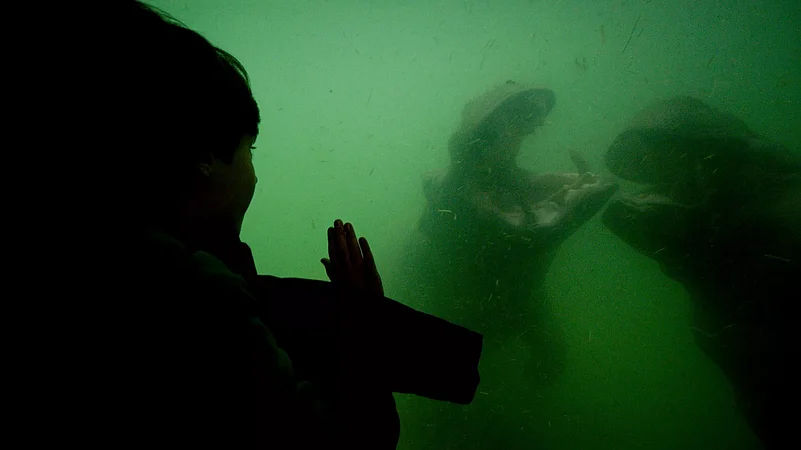
First, the shadows of giraffes’ necks stretch out, teasing. Then, the elegant creatures trundle out, rendering the frame ill-disposed to clasp their magnificence. Saxena zeroes in on the interstices between man and beast, wherein he activates a rich space of reflection and projection. The film lingers at the dividing glass boundary, before gradually chipping away at it. It warns of what can eventually spark zoochosis in animals splayed apart from natural ecosystems. What does this artificial habitation, being displayed as museum exhibits, do to creatures, their habits and sense of surroundings? How does it shift their natural processes and disrupt perception? Aptly, Saxena envisages the glass barrier as a theatrical site. The onlooker and the beheld animal form a dynamic that’s knottier than it initially lets on.


There’s a seamless back-and-forth between his zoologist mother’s scientific assessments and his indulgent musings that swan into deep imagination. A call between the two lends the film its discursive plank. He infuses few of the creatures with a story, like an anaconda who’s privy to a visitor’s whispered secret, penguins groping for their shadows even at night. Saxena gently pushes beyond discourse. He’s seeking that limber feeling hidden somewhere between rational assertions. His questions are wandering, “Do captive creatives dream more than wild ones?” She rebuts his scattered, straying thesis with precision. When he says he saw a baby giraffe cry, she reminds that they don’t have tear ducts. But her responses never come off as rude course-corrections or dismissive.

Rather, the film arrives, persisting and hopeful, as a synthesis between emotion and intelligence, imagined thought and sharp factual outlines. Saxena’s gaze isn’t fitful; instead, it embraces an equanimity. It’s rare to encounter a film that feels so immediate and attentive, suffused with both intimacy and ambiguity. It parses the creatures’ temperament and impulses while drawing a personal line. Devraj Bhaumik’s sound design catches every delicate beat. Long sweeps of the film are wordless, circling majestic hippos or an anaconda slinking around at times. Bhaumik’s soundscape critically evokes mood and undercurrents. Just when the film wanders too probingly among them, it turns back to the correspondence.
She brings up memories of safari rides taken when he was a child, how the tiger returned in his dreams. She talks of her childhood ache of losing her pet rabbits. The tension between his adult suppositions and her insight animates how the animals and their behaviour are framed. Ya Ching Yang’s camera constantly calculates the distance, negotiating between regard and intrusion. Saxena is convinced that a camera-averse gorilla, Kisumu, recognises him. There’s a cautious testing of how close the gorilla permits cameras to hover. These scenes are fraught, unsettling. How the animals reciprocate, shuttling between acceptance and lashing, feeds a taut vector of uncertainties. It’s this biding of time that adds a slight nervous energy.
I watched this film utterly rapt. Minute by minute, Saxena softly constructs an almost sanctified space. However, the zoo isn’t some neutral arena. The act of observing the animals isn’t just passive. It can be intense if one allows such engagement. It is spiked with racing thoughts, aches, trepidations and expectations we bring to the moment. Lit by Saxena’s inquisitive gaze, the enclosures don’t only remain as a neatly sectioned-off realm. They pulse with their own drama. Shawrya Kumar’s edit is sensitively alert to the central dialogue among three players—Saxena, his mother, the animals. Kumar hones the sheer expansiveness propping up the film, smoothly cutting between animals and personal reflections. He locates the bated breath charging a moment, tentativeness ascending in intensity. Along with Kumar, Saxena whets volatility underlying scrutiny.
Amma, Do Giraffes Cry? is buoyed by humility. Its gift is in its ability to deepen and extend the complex inner life of the cloistered animals as inscrutable yet inviting. It concedes no absolute knowledge, cognisant of what it cannot cross. We may try to foist an emotional geometry on them. However, as Saxena’s mother underlines, they are instinct-driven and will move by their own set of rules. I could have gladly watched hours of this entrancing film.