The England vs Argentina rivalry spans decades of World Cup drama, political history and iconic moments, making it one of football's fiercest contests
England lead the overall head-to-head 6-3 and the World Cup record 3-2
The rivals meet again in the 2026 World Cup semi-final for a place in the final against Spain
England and Argentina share one of the most captivating rivalries in international football. Unlike most football feuds, which are born out of geography, this one stretches across continents and generations, fuelled by unforgettable FIFA World Cup encounters, controversial refereeing decisions, iconic goals and the lingering shadow of the 1982 Falklands War.
While players and coaches on both sides have repeatedly insisted that football should remain separate from politics, every meeting between England and Argentina inevitably revives memories of some of the sport's greatest moments, from Diego Maradona's infamous 'Hand of God' to David Beckham's red card and redemption.
The two nations renew acquaintances in the FIFA World Cup 2026 semi-final at Atlanta Stadium (Mercedes-Benz Stadium), with a place in the final against Spain on the line. Here's everything you need to know about football's most storied international rivalry.
Who Has Won More Matches Between England And Argentina?
England enjoy the superior overall record in official meetings.
England vs Argentina Head-to-Head
Matches played: 14
England wins: 6
Argentina wins: 3
Draws: 5



The Three Lions also have the edge in World Cup meetings, winning three of their five previous encounters (1962, 1966 and 2002). Argentina emerged victorious in the iconic 1986 quarter-final and eliminated England on penalties after a 2-2 draw in the 1998 Round of 16.
How Many World Cup Matches Have England And Argentina Played?
Before the 2026 FIFA World Cup semi-final, England and Argentina had faced each other five times on football's biggest stage.
1962 (Group Stage): England beat Argentina 3-1.
1966 (Quarter-final): England won 1-0 in a controversial encounter marked by Antonio Rattin's dismissal.
1986 (Quarter-final): Argentina defeated England 2-1, with Diego Maradona scoring both the infamous Hand of God goal and the iconic Goal of the Century.
1998 (Round of 16): The teams drew 2-2, before Argentina advanced 4-3 on penalties after David Beckham's red card.
2002 (Group Stage): England secured a 1-0 victory thanks to David Beckham's winning penalty.
How Did The England Vs Argentina Rivalry Begin?
Although football itself arrived in Argentina through British immigrants during the late 19th century, the rivalry truly began at the 1966 FIFA World Cup.
The quarter-final at Wembley descended into controversy after Argentina captain Antonio Rattin was sent off by German referee Rudolf Kreitlein despite the two men being unable to communicate due to the language barrier. Rattin refused to leave the pitch for several minutes, insisting he wanted a translator and accusing the referee of favouring England.
England eventually won 1-0 through Geoff Hurst before manager Alf Ramsey further inflamed tensions by refusing to let his players swap shirts with Argentina and later describing the visitors as "animals."
The rivalry intensified after the 1982 Falklands War, ensuring future meetings carried emotional significance far beyond football.
What Was The Hand Of God Goal?
The defining image of the rivalry came during the 1986 FIFA World Cup quarter-final at Mexico City's Estadio Azteca.
Early in the second half, Diego Maradona challenged England goalkeeper Peter Shilton for a high ball and punched it into the net with his left hand. Referee Ali Bin Nasser failed to spot the infringement and awarded the goal.
Maradona later famously described it as being scored "a little with the head of Maradona and a little with the hand of God," giving football one of its most enduring phrases.
Why Is Diego Maradona's Hand Of God So Controversial?
The Hand of God remains controversial because it was an obvious handball that directly changed the course of a World Cup knockout match.
Without VAR or goal-line technology, England's protests went unheard and Argentina took the lead.
For England, it remains one of football's greatest injustices. In Argentina, many viewed the victory as symbolic after the Falklands War, although Maradona later described the conflict itself as a tragedy and insisted it should not define relations between the two nations.
What Is The Goal Of The Century?
Only four minutes after the Hand of God, Maradona produced perhaps the greatest goal football has ever seen.
Receiving possession inside his own half, he dribbled past Peter Beardsley, Peter Reid, Terry Butcher (twice), Terry Fenwick and Peter Shilton before calmly finishing into the net.
The breathtaking 60-yard solo run was later voted FIFA's "Goal of the Century."
The extraordinary sequence means the 1986 quarter-final remains the only match to feature arguably football's most controversial goal and its greatest goal within the span of four minutes.
What Happened In The England Vs Argentina 1998 World Cup Match?
The 1998 Round of 16 in Saint-Étienne produced another unforgettable chapter.
Gabriel Batistuta and Alan Shearer exchanged early penalties before teenage Michael Owen scored one of England's finest World Cup goals with a brilliant solo run.
The turning point came when David Beckham reacted to a foul from Diego Simeone by flicking his leg towards the Argentine midfielder while lying on the ground. Simeone theatrically went down, the referee spotted the incident and Beckham was shown a straight red card.
Despite playing with ten men, England forced extra time and even thought they had won when Sol Campbell headed home, only for the goal to be ruled out. Argentina eventually prevailed 4-3 in the penalty shootout after a 2-2 draw.
Beckham became the villain in England before redeeming himself four years later by scoring the winning penalty in England's 1-0 victory over Argentina at the 2002 World Cup.
Who Are The Key Players In England Vs Argentina?
The 2026 World Cup semi-final features several of the tournament's standout performers.
England
Jude Bellingham
The Real Madrid midfielder has once again established himself as England's driving force. Bellingham has scored six goals and provided one assist in the tournament, including braces against Mexico in the Round of 16 and Norway in the quarter-finals. Those performances made him the first player since Diego Maradona in 1986 to score twice in consecutive World Cup knockout matches.
Harry Kane
England's captain has also scored six goals and one assist, continuing his remarkable World Cup record. The 2018 Golden Boot winner struck twice against Croatia and DR Congo before converting a crucial penalty against Mexico. England's all-time leading World Cup scorer remains the focal point of Thomas Tuchel's attack.
Anthony Gordon
Although yet to score, Gordon has become one of England's most creative players with three assists. The winger has been particularly influential during the knockout rounds, setting up Bellingham against Norway and winning a penalty during England's victory over Mexico.
Argentina
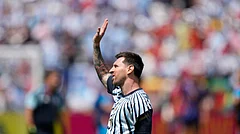
Lionel Messi
The defending champions have once again been inspired by their captain. Messi has scored eight goals and registered two assists, including a hat-trick against Algeria before finding the net against Austria, Jordan, Cape Verde and Egypt. Interestingly, despite his illustrious international career, the 2026 semi-final marks Messi's first-ever meeting with England.
Lautaro Martínez
While Messi has dominated the headlines, Lautaro Martínez has quietly made a major contribution with two goals and one assist. The Inter Milan striker scored Argentina's decisive third goal in extra time against Switzerland and offers Lionel Scaloni another proven match-winner whether he starts or comes off the bench.
What Makes England Vs Argentina Different From Other Football Rivalries?
Unlike most football rivalries, England versus Argentina is not based on geography or regular meetings. Instead, it has been forged almost exclusively through unforgettable World Cup encounters.
Few rivalries can claim to have produced the Hand of God, the Goal of the Century, Beckham's infamous red card, dramatic penalty shootouts and multiple defining moments involving some of football's greatest players.
The political backdrop of the Falklands War has undoubtedly added another layer of emotion, but modern players have consistently tried to separate history from sport. Ahead of the 2026 semi-final, Argentina coach Lionel Scaloni described the match as "just football," while midfielder Rodrigo De Paul said the conflict should be remembered independently of the game.
Yet once the whistle blows, history inevitably returns. From Antonio Rattin's controversial dismissal in 1966 to Maradona's genius in 1986 and Beckham's redemption in 2002, England versus Argentina has repeatedly delivered football's biggest talking points.
With another World Cup final at stake, the rivalry is ready to add another unforgettable chapter.