England lead the official head-to-head 6-3 and the World Cup record 3-2, with the rivalry fuelled by footballing drama and the Falklands War
Defining moments include Rattin's 1966 red card, Maradona's "Hand of God" and "Goal of the Century" in 1986, Beckham's 1998 red card, and his winning penalty in 2002
England and Argentina meet again in the FIFA World Cup 2026 semi-final, with a place in the final against Spain at stake
The fierce football rivalry between England and Argentina is rooted in a mix of high-stakes World Cup drama, controversial refereeing, and underlying geopolitical tensions from the Falklands War in 1982.
Historically, England enjoy a superior record in the official head-to-head count with six wins as compared to Argentina's three. This upper hand extends to the World Cup, where the Three Lions have won three (1962, 1966, and 2002), while Argentina have claimed victories in the 1986 and 1998 editions.
As the two bitter rivals meet in the FIFA World Cup 2026 semi-final at Atlanta Stadium (Mercedes-Benz Stadium), Atlanta, with the winners taking on Spain for the ultimate prize in the sporting world, here's a look at five instances that continue to evoke memories:
World Cup 1966, Quarter-Final


In a fiercely physical match at Wembley Stadium, Argentine captain Antonio Rattin was sent off after 35 minutes by German referee Rudolf Kreitlein despite the referee not speaking Spanish.
Claiming that the referee was biased toward the European hosts, Rattin refused to leave the pitch and demanded a translator. After nearly 10 minutes of delay, he eventually walked off, but not before wiping his hands on the England pennant. He continued the protest, a sit-in on the royal red carpet, reserved for the Queen.
England claimed a hard-fought 1-0 victory, thanks to Geoff Hurst's 78th-minute strike -- a goal still claimed to be offside by Argentinians -- en route to their only World Cup title. After the match, England manager Alf Ramsey refused to let his players swap shirts with their rivals, and later publicly referred to the Argentines as "animals".
International Friendly, 1980
Often regarded as a pre-war flashpoint, at least from a footballing perspective, the two teams met in a friendly match at Wembley amid escalating diplomatic tensions over the sovereignty of the Falkland Islands (Islas Malvinas).
The match was filled with late tackles and mostly spiteful. Diego Maradona, who was 19 years old at the time, was the prime target for English defenders. David Johnson hit a brace, and Kevin Keegan scored one in England's 3-1 win. Daniel Passarella scored the lone goal for the visitors.
The hostility spilt over into the stands with large-scale riots and physical clashes breaking out between travelling Argentine supporters and English hooligans. It required massive police intervention and effectively set a dangerous precedent for future fixtures between the two teams.
World Cup 1986, Quarter-Final
A second knockout meeting in two decades, and in between a war. Played just four years after the Falklands War at the iconic Estadio Azteca with the military conflict fresh in the minds of players and fans, the clash elevated a football game into a matter of national pride. Before the game, rival fans fought in the streets of Mexico City.
In the 51st minute, a leaping Diego Maradona challenged England goalkeeper Peter Shilton for a high ball and used his left hand, a punch no less, to score the opener. The Tunisian referee Ali Bin Nasser missed the handball, legitimising one of the most controversial goals in history.
Four minutes later, Maradona received the ball in his own half. He embarked on a spectacular 60-yard run, dribbling past Peter Beardsley, Peter Reid, Terry Butcher (stepped past twice), Terry Fenwick, and finally Shilton to score the "Goal of the Century." Argentina won 2-1 en route to their second title. Gary Lineker's 81st-minute goal proved too little, too late.
Maradona later stated the first goal was scored "a little with the head of Maradona and a little with the hand of God," thus giving birth to probably the most famous, or infamous, goal description. In Argentina, the victory was widely celebrated as symbolic revenge for the war.
World Cup 1998, Round of 16
An immediate classic, and of course littered with what we now call "dark arts" from both sides. In that knockout match at Stade Geoffroy-Guichard, Saint-Etienne, a teenage Michael Owen scored one of the greatest goals in the tournament's history to give the Three Lions a 2-1 lead after early penalties from Gabriel Batistuta and Alan Shearer.
But before that Owen solo goal, Argentina captain Diego Simeone fouled David Beckham from behind. While lying on the turf, a frustrated Beckham flicked his right leg out, tripping Simeone. The Argentina captain dramatically collapsed to the ground, ensuring the referee saw the contact; the result: a straight red card to Beckham.
England lost the subsequent penalty shootout 3-4 (2-2 AET) after Sol Campbell (81st minute) had a late winning goal disallowed. The British media ruthlessly scapegoated Beckham. Argentina lost to the Netherlands 1-2 in the quarter-finals.
World Cup 2002, Group Stage
Having endured the English backlash, the narrative was built on Beckham's chance to redeem himself. Clubbed in the Group of Death. Argentina entered the match after beating Nigeria 1-0, while England played out a 1-1 draw with Sweden.
Shortly before half-time, Michael Owen went down in the penalty box under a challenge from Mauricio Pochettino at Sapporo Dome, Sapporo. Legendary Italian referee Pierluigi Collina (Italy) awarded a highly debated penalty, and Beckham stepped up under immense psychological pressure and converted.
England's 1-1 draw with Nigeria in the next game, combined with the 1-0 win over Argentina, secured their knockout spot. Meanwhile, pre-tournament favourites Albiceleste failed to progress past the group stage.
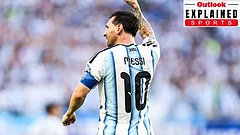
Of course, Argentina won another World Cup in 2022 with Lionel Messi leading from the front, and they are chasing a seventh final appearance. England, meanwhile, have had two semi-final appearances since lifting their first trophy six decades ago.