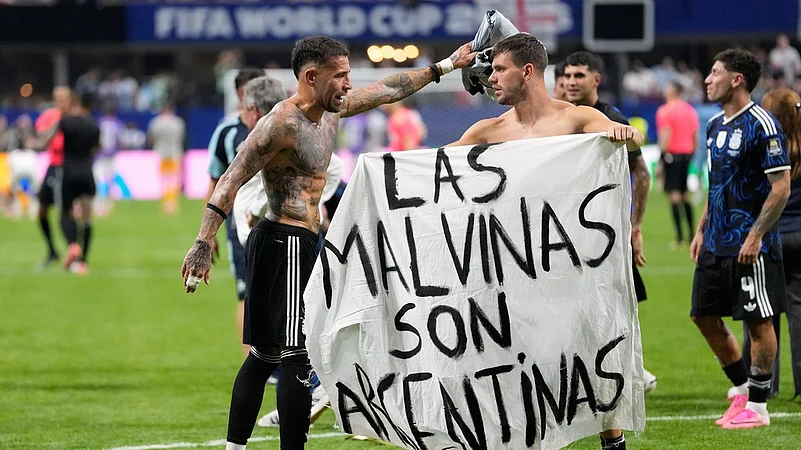
Argentina's Falklands banner triggered a diplomatic clash and FIFA investigation
The White House defended the players, citing U.S. free speech protections
The dispute has escalated tensions between the U.S. and Britain before the final
Following their 2-1 victory over England in the FIFA World Cup 2026 semi-final, members of the Argentine squad sparked international controversy by unfurling a banner that read "Las Malvinas son Argentinas"—a declaration that "The Falklands are Argentine."
The act reignited one of the most enduring sovereignty disputes in the world. For Argentina, the Falkland Islands (or Islas Malvinas) are a core component of national identity, with the country asserting that it inherited sovereignty from Spain upon its 1816 independence.
Conversely, Britain has administered the islands since 1833, a position reinforced by a 2013 referendum in which the islanders voted overwhelmingly to remain a British overseas territory. The geopolitical tension reached its peak in 1982 during a 74-day war that resulted in hundreds of casualties.
The devastating war sparked when Argentine forces landed on the islands to assert a territorial claim. The ensuing struggle resulted in the loss of 255 British military personnel, 649 Argentine soldiers, and three islanders, leaving a legacy of historical trauma that continues to overshadow modern sporting encounters.
FIFA, which maintains strict regulations prohibiting political, offensive, or discriminatory displays inside stadiums, initiated a review of the incident, with many calling for disciplinary action against the players involved.

Why White House Defended Argentina's Banner?
The situation took an unexpected turn when the White House intervened. Andrew Giuliani, head of the White House FIFA task force, defended the Argentine players by framing their actions through the lens of American constitutional values. Citing the First Amendment, Giuliani argued that the team possessed the "opportunity and ability" to make such statements while on U.S. soil.
By reframing the political display as an exercise of individual expression rather than a state-sanctioned diplomatic challenge, the White House sought to underscore its commitment to broad speech protections, even when those expressions spark intense international friction or contradict the political positions of key allies like the United Kingdom.
This move effectively signaled to the international community that in the U.S., the right to dissent and express political grievances—however controversial—is viewed as a fundamental tenant of the host nation's identity, effectively shielding the players from the immediate domestic political consequences that British officials had hoped to see.
What The FIFA Rules Say
FIFA maintains strict regulations that prohibit the use of political, religious, or personal slogans, statements, or images on the pitch, with both the FIFA Disciplinary Code and IFAB laws explicitly banning such displays during matches.
These rules are designed to ensure that stadiums remain neutral environments and do not become platforms for political confrontation or territorial disputes. Consequently, any player or team found to have violated these standards faces potential sanctions from competition organizers or national football associations, which can include fines or other disciplinary measures.
The process for addressing such incidents involves FIFA’s independent Disciplinary Committee, which reviews match reports and assesses the circumstances before determining appropriate action. While precedents exist—such as when the Argentine Football Association was previously fined for a similar banner in 2014—FIFA’s challenge lies in balancing the enforcement of its neutrality regulations with the need for proportionality.
The governing body must distinguish between various forms of expression to ensure that rules are applied consistently without turning neutrality into an arbitrary or overly broad restriction on national identity or heritage.
Precedent
This incident is not without precedent; in fact, it echoes a notable controversy from 2014 when the Argentine national team posed for a photo behind an identical banner before a World Cup friendly against Slovenia. FIFA responded to that display by opening disciplinary proceedings against the Argentine Football Association (AFA), ultimately issuing an official reprimand and a fine of approximately $33,000 for team misconduct and the use of provocative political messaging.
FIFA has consistently intervened in similar instances where players or teams used the pitch to express political stances. In 2018, FIFA fined Swiss players Granit Xhaka and Xherdan Shaqiri for their "double-headed eagle" hand gestures—a symbol linked to Kosovar Albanian identity—during a match against Serbia, deeming the act unsporting and politically provocative.
The Fallout And Island Reaction
The fallout was immediate and polarized. British officials and UK leadership condemned the gesture, labeling it an "egregious violation" of rules regarding political neutrality in sports. They argued that the islands' future should be determined by the self-determination of the islanders, not by political posturing on a football pitch.
The British government also issued a firm rebuke. A spokesperson for the Prime Minister emphasized that while the World Cup title may have slipped away, Britain’s sovereignty over the Falkland Islands remains absolute and unwavering. While Downing Street has deferred official disciplinary measures to FIFA, they have publicly echoed calls from Business Secretary Peter Kyle for a thorough investigation into the players’ conduct.
The government of the Falkland Islands expressed dismay at the stunt, stating they were "disappointed but not surprised" by the provocation. In a formal statement, they appealed for an end to the use of their home as a "political football," reminding the world of the 2013 referendum where 99.8% of islanders voted to remain a British overseas territory.
The controversy was further inflamed by Argentine Vice-President Victoria Villarruel, who took to social media to celebrate the victory, explicitly declaring the islands to be Argentine. She suggested that while such political symbols might be banned inside stadiums, the sentiment remained "in our blood and our hearts."
This incident follows reports that Argentine players had previously engaged in chants referencing the territory—and iconic national players—following their Round of 16 victory against Egypt.
This defense placed the U.S. administration at odds with UK officials, who insisted that politics should be kept separate from international sport. As Argentina prepares for the tournament final against Spain, the incident remains a flashpoint—a reminder of how historical grievances can easily spill over into the global sporting arena, forcing governments and governing bodies to navigate the complex boundary between individual expression and regulated competition.
Distraction Ahead Of Final
Amidst the intense preparations for the World Cup final against Spain, this diplomatic firestorm has inevitably become a significant distraction for the Argentine squad. While the players and coaching staff have sought to maintain focus on their tactical objectives and the gravity of the upcoming showdown, the persistent media scrutiny, ongoing investigations, and international condemnation have placed the team in an uncomfortable spotlight.
his noise threatens to fracture the collective mindset required for a high-stakes final, forcing the camp to navigate the delicate balance of defending their personal expressions while attempting to insulate the locker room from the fallout of a dispute that has moved far beyond the boundaries of the football pitch.
Same Old Donald Trump
The debate over who owns which land is becoming more common, and political leaders are increasingly using bold, populist language to make their points. U.S. President Donald Trump, for example, often took a "bossy" approach toward international partnerships, especially when it came to NATO. He frequently challenged other countries on how much they spend on their own defense.
By questioning whether the U.S. should protect allies who don't meet these financial goals, he used his platform to put American interests ahead of long-standing international agreements. Just like the current argument over the Falkland Islands, these actions ignored traditional diplomatic rules, showing a willingness to shake up global deals to push his own vision of what his country should achieve.