As you drive down the 65-km stretch from Kozhikode to the Muslim belt of Malappuram in Kerala, you won’t be faulted if you feel like you have been transported to South Africa. Every few kilometres there are hoardings of teams participating in the 2010 FIFA World Cup, with local favourites Brazil and Argentina hogging most of the cutouts. You enter Malappuram and people are thronging the streets swaying to K’Naan’s song Wavin’ Flag (tournament sponsor Coca Cola’s choice for World Cup anthem) at the local roadshow under way a full 24 hours before the kick-off between South Africa and Mexico. Football fans rev up on bikes, rickshaws and four-wheelers, each contingent representing one of the 32 nations participating in the World Cup, flying its flags and wearing the team jersey.
It happens every four years, as Cup fever shakes up this sliver of a state. But as is true with every game, fans have favourites and one must agree to disagree. Computer teacher Ismail Villan should know, he’s an avid Italy supporter, a team which doesn’t get much currency in these parts. Which is why for his wedding reception Ismail wore Italy’s jersey, subtly communicating to the guests that this was his day and he would brook no argument on his team’s worth that night. As Ismail explains passionately, “I’ve been an Italy fan from childhood. Their defence is impenetrable.”

But he is in a woeful minority here, for Malappuram and adjoining Othukkungal are Latin American bastions. Kaka and Messi are magic words that stoke passions and trigger fierce debates. Motor mechanic M.P. Rafeek has just bought a second-hand autorickshaw for Rs 18,000 and painted it in Argentine colours. “Argentina will win,” he screams. In a tit-for-tat move, friend Shafeek Parakkal also purchased a rickshaw (for Rs 20,000) and had his boys daub it in Brazilian colours. “No one can beat Brazil,” the boys yell as they race the rickshaw down the road.


Fans all decked up samba-style at a Cup rally in Kozhikode
Meanwhile, at the other end of the spectrum is the city of Calcutta, the home of Indian football and credited for spawning numerous soccer stars. This year, though, the city paused in its Cup preparation to know which way the municipal election would swing—Mamata or the Left. As soccer veteran P.K. Banerjee told Outlook, “You can’t separate the average Bengali from two things—football and politics, in that order.”
Municipal elections over, the city is now giving full play to its passion. Men and women, old and young, sport jerseys of different participating countries. Their flags flutter from rooftops and window sills and the bonnets of cars. In Calcutta, as in Kerala, Brazil dominates (the Outlook-MDRA survey showed 65 per cent of the city supporting it).
Such is the passion for Brazil that its supporters plan to come together at a specific venue telecasting their fave team games, hoping to ensure that their collective fervour will translate into a Samba victory. Filmmaker Anindita Sarbhadicari remembers how during the last World Cup she and her friends would descend on the Inox City Centre, the multiplex which had screened all the matches. “We brought the house down screaming in support of our Brazilian heroes...over swigs of beer, of course.” The passion for Brazil is somewhat of an affliction with the Sarbhadicaris. Father Supriyo, a retired government official, has been collecting World Cup-related articles for aeons. “I keep myself well-informed about the players, their strengths and style so that by the time the game is on, I know the players well,” says Supriyo, adding for good measure, “I’ll be watching every Brazil match.” The preparations also includes, as he puts it, “stacking up the beer crates”.
Besides all this, the World Cup in Calcutta is also about bonding through soccer. A local TV channel is organising ‘parai parai football’ (neighbourhood vs neighbourhood) matches during the month-long tournament. Different neighbourhoods across the city form into teams, each named after a World Cup team, and play a match every day, the game ending around the time the Cup telecast begins. As a channel spokesperson put it, “Sure it’s lucrative for us. But, essentially, it taps into the Bengali’s passion for football. It is a fitting way to bring the World Cup home.”
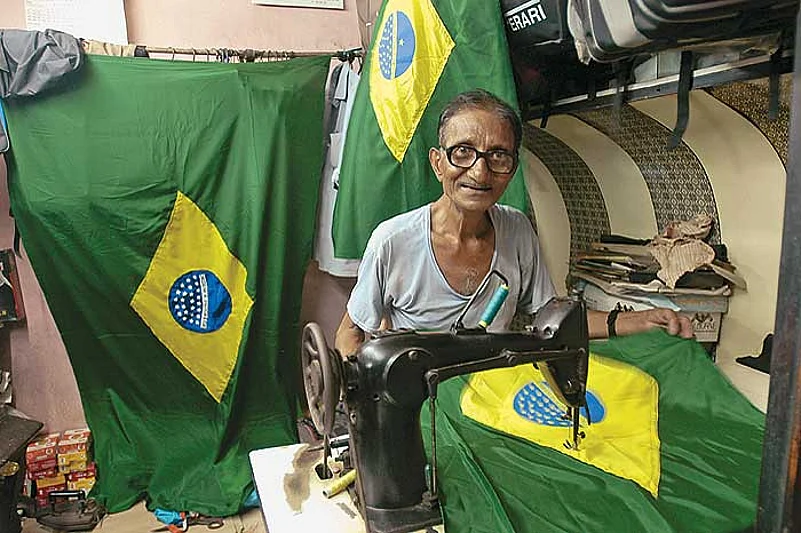
Indeed, it is also the season for megabucks to be made. Sports goods stores in Calcutta are flooded with jerseys and T-shirts. And sales is brisk. In Malappuram, the price of jerseys vary—the Chinese-make costs Rs 200, the non-Chinese ‘original’ import a neat Rs 750. Says cloth merchant P.P. Kamaruddin, “The sale of jerseys in Kozhikode and Malappuram alone must have crossed more than Rs 1 crore.” Meanwhile, electronic companies in Calcutta are topping up offers on rebates for TV sets with ‘special gifts’ like balls signed by famous players.
Now in every celebration, there has to be a few spoilsports (a logic particularly true for Kerala). Which is where the mullahs of Malappuram come in, apprehensive the flock may stray and prefer to watch soccer than offer namaaz. League-level player Zachariah is not a man to lose focus. “We’ll pray later. My prayer now: Let Brazil win,” he says. Former Indian player K.T. Chacko says even politics takes a backseat when the Cup is on.
People in Kerala’s northern districts are not known to keep their anti-imperialist sentiments in check. During the World Cup, though, Chacko says, “you will see England’s fans hurrah their team without fear”. Some are not amused by this temporary divorce of politics from sports. Imam Musthafa laments the fact that “the kids forget that our elders once burnt the English flag to drive them out of the country. And now our children are worshipping the same flag!” Shamseer Vallan, who organised the Malappuram rally, is dismissive of such remarks. “This is a delectable pastime,” he says, adding as an afterthought, “perhaps there’s a generational divide between the mullahs and us.”
Soccer mania also has Calcutta’s barbers in a spot. Cribs Bapi Dolui, “It’s easy to give someone a Ronaldo cut. You just have to shave off the whole back and leave a little tuft in the front. But when someone with practically no hair wants a Kaka cut, it’s like asking for the moon.”
But this is what World Cup magic is all about—it transforms you, however ephemerally, as also your local environment. As Brazilian footballer Douglas de Silva, who used to play for East Bengal, famously remarked during the 2002 World Cup, “It feels like I’m in Brazil.”