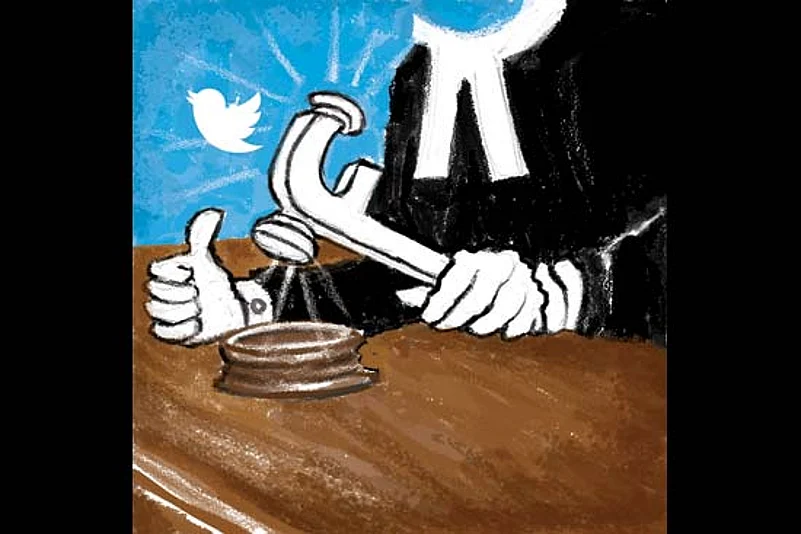

When the Supreme Court struck down Section 66A of the Information Technology Act on March 24, it upheld a long tradition of rulings mostly in favour of free speech. This judgement, in a public interest litigation (PIL) by law student Shreya Singhal, held the clause against posting “grossly offensive” content online unconstitutional.
The problem always was that the description was too vague: what is offensive to me may not be offensive to someone. Who was to be the arbiter of what offends? But there were deeper issues at stake: should giving offence at all be a crime? Why should punishment for online offence be harsher than that for the same offence offline? What is the extent to which the Constitution guarantees free speech?
With school and college students, cartoonists and professors being arrested for online posts, something had to give.
I have enthusiastically welcomed the court’s decision. When Singhal’s PIL was filed in 2012, I was quoted in this magazine as hoping it would succeed. That was the occasion of my filing a private member’s bill in the Lok Sabha seeking drastic dilution of Section 66A. My only regret is that, once again, it had to be the judiciary rather than Parliament that set right an insidious law.
Nevertheless, the ruling is typical of how freedom of expression laws have evolved, not just in India but also in other democracies over long periods of time. Historically, the big breakthrough for free speech came in Europe, from the 14th through the 18th centuries. The Renaissance, the Reformation and the Age of Enlightenment saw science and reason break the grip of religion and church. Most importantly, these changes saw the decriminalisation of blasphemy, which till then had been a heinous crime, attracting capital punishment—as it still does in some theocratic states.




This was crucial, for if giving offence about something as sensitive as religion was no longer a crime, freedom of speech about almost everything else became far stronger. That is not to say that free speech is absolute, either in Europe or elsewhere, but more on that shortly. In India the debate on free speech, at least among common citizens if not academics, is often stuck at the stage of “people should have a right to say what they want, but not to offend someone else”.
From the 18th century on, it is the US that has been held up as the exemplar of free speech, what with its celebrated First Amendment. Indeed, the right to freedom of expression in that country is as close as it gets to absolute: you can’t be arrested for even such inflammatory acts as burning the national flag or a holy book. But all nations have restraints, such as those against deliberate and malicious defamation. The US has the narrowest defined exceptions to freedom of expression, child pornography for instance. But even in the case of hate speech or incitement to violence, it requires “clear and present danger” and “imminent threat” to public order before the authorities can intervene.
What is often not clearly understood, even among champions of US-style free speech, is that those rights evolved over two centuries. They were clarified and enhanced by many significant judgements. The SC ruling on Section 66A refers to many of these judgements from the US and UK, besides domestic precedents. Our Constitution guarantees freedom of speech, subject to “reasonable restrictions”, including “security of the State, friendly relations with foreign states, public order, morality and defamation”.
The decades since 1947 have seen, sadly, efforts by Parliament and assemblies to legislate to curb free expression even further. The authorities too are enthusiastic to implement such laws. An egregious recent example saw a British Raj law being used to arrest a cartoonist for sedition. The UK itself repealed its own sedition law in 2009. Luckily for India, its highest court, like those of other liberal democracies, has consistently worked to uphold free speech. Often, though not always, high courts have followed the example of the SC. Acquitting cartoonist Aseem Trivedi, the Bombay High Court judges noted they didn’t find the cartoons funny, but ruled that citizens are entitled to criticise a government: criticism cannot be considered sedition as long as it “does not incite violence against the government or has the intention of creating public disorder”. I had filed another private member’s bill in the Lok Sabha on similar lines; thankfully, it might no longer be required.
As India’s judiciary keeps narrowing down exceptions to the freedoms guaranteed by our Constitution, it will become ever more important for our citizens to support this evolution. We need to recognise that you cannot have free speech without occasionally giving offence. And that being obnoxious should be distinguished from causing actual harm.
(The writer is a BJD MP. @PandaJay)