Congress MP Shashi Tharoor said the interim India–US trade deal undermines reciprocity.
He argued that India has committed to massive purchases of US goods while facing continued tariffs on its exports.
Tharoor also criticised ministers S Jaishankar and Piyush Goyal for evading parliamentary scrutiny.
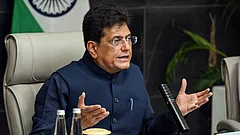
The India–US interim trade deal resembles a “pre-committed purchase agreement” that overturns the principle of reciprocity, Congress MP Shashi Tharoor said on Tuesday, criticising Union ministers S Jaishankar and Piyush Goyal for playing “ping pong” when questions are raised.
“While India may have obtained tariff reductions of one or two percentage points, no East Asian economy has agreed to deliberately dilute its trade surplus with the United States through guaranteed purchase commitments,” Tharoor said.
The Thiruvananthapuram MP questioned how the agreement could be described as reciprocal when one side faces an 18 per cent tariff and the other zero. “It looks less like a free trade arrangement and more like a pre-committed purchase agreement that overturns every principle of reciprocity,” he said.
At a time when India’s bilateral trade with the US is about USD 130 billion, with a surplus of nearly USD 45 billion, the government has, he said, committed to purchasing USD 500 billion worth of American goods over five years. Tharoor argued that this would convert a surplus into a long-term deficit through executive assurance rather than market demand.



“No major economy has ever neutralised its own trade leverage in this manner. While the US continues to impose import tariffs of up to 18 per cent on Indian exports, we have committed ourselves to lower tariffs to near-zero levels, open agriculture, dilute data localisation, soften intellectual-property safeguards, and even redirect strategic energy imports, especially away from Russia, to meet purchase targets.
“This is not strategic balancing; it is economic pre-emption,” he said.
Tharoor said Parliament had not been informed how farmers, MSMEs and domestic industry would be protected, or why India had “voluntarily surrendered” its negotiating power without securing proportional market access or policy space in return.
“I know the government will say wait for the final agreement, it is coming in mid-March, but let them be aware that these concerns exist right now,” he said.
Rejecting comparisons with other Asian economies, Tharoor added: “The government’s claim that India has secured a ‘better deal’ than China, Vietnam, or other Asian economies does not withstand scrutiny. While India has obtained tariff reductions of one or two percentage points as compared to them, no East Asian economy has agreed to deliberately dilute its trade surplus with the United States through guaranteed purchase commitments.”
On the contrary, he noted, China, Vietnam and several ASEAN countries have expanded their trade surpluses with the US despite heightened trade tensions.
“This ambiguity has a direct bearing on the credibility of the budget itself. When both the minister of commerce and industry and the minister of external affairs were questioned on these commitments, they offered no clear explanation of their scale, timeline, or fiscal implications,” he said.

“The reason I mention this in the context of the Budget is that key budgetary assumptions, on trade balances, external financing needs, and overall macroeconomic stability, rest on information that Parliament does not possess and has not been given,” he added.
A Budget framed amid such uncertainty, Tharoor said, was not merely incomplete but asked Parliament to approve figures without clarity on obligations arising from the trade agreement.
“When the two ministers play ping pong with each other, saying it is not in their mandate to answer the questions, each one attributes it to the other,” he said, in an apparent swipe at Jaishankar and Goyal.
“That looks like a rather disappointing game, as when no minister claims ownership of something like this, accountability disappears and Parliament is left staring at a Budget that conceals obligations that the government seems to lack the courage to admit openly,” he added.
Last week, India and the US announced a framework for an interim agreement on reciprocal and mutually beneficial trade, under which the US agreed to reduce reciprocal tariffs on Indian goods from 25 per cent to 18 per cent. The punitive 25 per cent tariff imposed last August over India’s purchase of Russian crude has already been lifted.
The Congress has alleged that the interim Indo–US trade pact is “not a deal but a surrender” of India’s interests and self-respect.