In the next assembly polls, the state could see multi-polar contests and fractured mandates
The results of the general election in 2024 showed that the radical Sikh elements are searching for alternatives
Dalits, who make up one-third of the population, still have to wait for their e say in the power corridors
This year, as Punjab completes 60 years of its re-organisation, it is befitting to look back at the politics and economy as they have unfolded in the state all these years. As for politics, more than any other state, primordial values: religion, language, region, and caste have continued to be the determinant factors, though in varying degrees at different times. Religion played a major role in the politics of representation in colonial Punjab, leading finally to its partition. The post-Partition years witnessed the agitation to make Punjabi in Gurmukhi script the sole official language of the state. Then came the demand for the re-organisation of the state to fulfill the aspiration of a segment of the Sikh community, led by the Akali Dal, to have ‘a territory of their own,’ though language was ostensibly cited as the basis.
The re-organisation, however, did not fulfill the aspiration of those who asked for it. It was jolted by a domineering Centre under the person-based centralised leadership of Indira Gandhi, who viewed state-level parties as antithetical to national unity. There was a deliberate attempt on the part of the centre to weaken or break the Akali Dal. In fact, the party central leadership even interfered with and tried to control its own state-unit leadership by actively promoting factionalism.
The Akali leadership's desperation to capture political power in the now Sikh-majority Punjabi Suba was another factor that led the party to continue resorting to the politics of ethnic-regional identity. The Congress continued to receive the support of both the Hindu and Sikh communities, whereas the Akali Dal was increasingly viewed more as a panthic party. It forced the party to have an electoral alliance even with the Jana Sangh, a party that had a diametrically opposed political agenda.


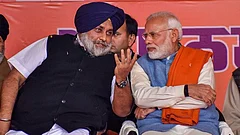
The Emergency, followed by the dismissal of Akali Dal-Janata Party government led the Akali Dal to demand regional autonomy in the form of Anandpur Sahib resolutions. The party’s demands were mostly political and economic in nature and were similar to those made by the DMK, National Conference and even the Left parties in West Bengal.
The moderate Akali leadership was gradually replaced by ultra-radical leadership as a result of the non-fulfillment of the demands by the Centre. Punjab was pushed into the dark era of militancy in the 1980s, especially after Operation Blue Star. The state endured a protracted period of central rule and human rights abuses both by militants and state agencies. Governance suffered as the bureaucracy, especially the police force became politicised and also morally compromised. In terms of the economy, the state became extremely indebted in the 1980s as a result of its need for the centre’s support to fight militancy backed by Pakistan. Additionally, while the agrarian sector was still experiencing a boom, business managed by caste Hindus and Khatri Sikhs left the state's cities, such as Jalandhar and Ludhiana, which were once the centres of industries. Investments dried up. Punjab became a one-sector economy.
Punjab returned to mainstream politics with the 1997 assembly elections, when the Akali Dal formed a coalition government with the BJP with the aim of bringing communal peace and development. The Green Revolution, a flawed technological attempt to alleviate the food crisis in then India after land-reforms or tenancy-related laws failed, had reached its optimum by this point.
The Agricultural Follies
Despite declining returns in the farming sector due to groundwater depletion and soil nutrient value erosion, no attempt was made to shift from paddy cultivation. Agriculture-based industries, crops diversification, and organic farming have not materialised all these years. Cotton and other cash crops have frequently failed, resulting in farmers’ debts and suicides.
Heavy state subsidies and reckless use of water, hybrid seeds, and fertilisers have kept the state's farming sector afloat, but the state’s support won't last forever, nor will the ecological disaster be averted forever. The agrarian distress is likely to accentuate as the centre’s stress has been on the service and manufacturing sectors.
Right since the WTO agreement, western nations have consistently pushed for the opening of the Indian market for their agricultural products. Reforms in the farm sector and access given to foreign agrarian products in the Indian market are bound to resurface covertly due to global pressure. Consider the trade deals India has reportedly sealed with the EU and USA. Any such reforms are bound to bring the farmers on the streets, as was visible in the protest against the three farm bills in 2020-21. What has exacerbated the situation is the reckless economic populism to win elections by parties. Additionally, rampant forest-cutting and sand and stone-mining have been going on unabated. The extensive use of alcohol and synthetic drugs by the state's youth has also severely disrupted the social and economic fabric of the state. The desperate attempt to travel overseas, even illegally, is a sign of the state's youth's lack of hope for the future.
The state's citizens have been frantically searching for a viable political alternative. This was the primary reason for their overwhelming support of the AAP in the assembly elections of 2022. The Party then pledged to eradicate gangster-related violence, end the drug menace, restore the health and education sectors using its "Delhi model," and put an end to institutionalised corruption and mafia raj. There hasn't been much progress on all these fronts, rather mafia-style violence has escalated.
Rampant Discrimination
At the societal level, Dalits, who make up one-third of the state's population, still have to wait for their effective say in the state's power corridors. The numerically significant and land-holding Jat Sikh community dominance continues, making other communities, including caste Hindus and Khatri Sikhs marginal.
The Punjab Village Common Land Act, 1961, which mandated that 33 per cent of village common land be reserved for leasing to Dalits, has remained ineffective, being manipulated by landed peasantry. Landlessness is a growing phenomenon. Though Sikhism abhors the caste system but in reality discrimination is widely practiced. Dalit pop music on social media, the thriving Dera culture, and growing conversion to Christianity are signifiers of the marginalised groups' cultural assertion, though hardly threatening the entrenched social power structure in the years to come. The growing number of Hindi-speaking migrant farm-labourers and artisans, mostly Dalits, settling down in the state, is also a relevant development in this context. The results of the general election in 2024 showed that the radical Sikh elements who were once co-opted within the Akali Dal are now searching for alternatives as a result of the party's decline. Furthermore, a weakened Akali Dal may feel pressured to return to ethnic strident politics in an attempt to regain its panthic vote. By promoting its politics of cultural nationalism and also catering to Deras, the BJP, which garnered an impressive vote in the 2024 elections, can also exacerbate communal divisions to gain Hindu votes.
The political trends will become clearer as the assembly elections to be held next year approaches. The state would most likely see multi-polar contests and fractured mandates. Centre-state relations are another area of concern, as was witnessed recently in the mass protest against the Centre’s attempt to extend its jurisdiction over Chandigarh.
As one recognises the challenges and failures witnessed in the past and also at present, what needs to be done is to address them. The question is whether those at the helm possess the necessary acumen, political will and vision, to take on the enormous task of reviving the state’s fortune. "One starts to get young at the age of sixty," Picasso once said. Would the state be experiencing something akin to that, a turnaround in this instance, reminiscent of the post-partition period?
Ashutosh Kumar teaches in the Department of Political Science, Panjab University, Chandigarh.
(Views expressed are personal)