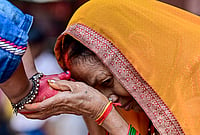
Santhal Pargana, close to the Bangladesh border, is the epicentre of Jharkhand's infiltration debate
The formal announcement of the SIR is expected after February 10.
According to the EC, around 26.5 million voters are being verified
As the JMM chief minister in February 2024, Champai Soren had publicly rejected the BJP’s claims of Bangladeshi infiltration, calling them politically motivated and unsupported by Jharkhand’s land laws. In an interview with Outlook, he had argued that demographic change did not point to infiltration and concluded that there was “no Bangladeshi infiltration here.”
That position did not survive a change in political alignment. After a year Champai Soren resigned, Hemant Soren returned as chief minister, Champai Soren left the JMM and joined the BJP. The shift coincided with a reversal in his public stance, as the infiltration narrative resurfaced in his politics amid the debate over the Special Intensive Revision of electoral rolls.
Even before the Special Intensive Revision (SIR) of electoral rolls has formally begun in Jharkhand, it has triggered an unusually sharp political confrontation. The ruling Jharkhand Mukti Morcha–Congress coalition argues that an intensive revision in a state marked by migration, poverty, and weak documentation risks large-scale disenfranchisement of Adivasi, Muslim, and working-class voters. The Bharatiya Janata Party, however, frames the exercise as a routine constitutional process aimed at “cleaning” electoral rolls, linking it to claims of demographic manipulation and alleged Bangladeshi infiltration.
As parental mapping proceeds on the ground and lakhs of names are flagged for deletion, the SIR has become more than an administrative exercise—emerging instead as a proxy battle over citizenship, belonging, and political power in Jharkhand.


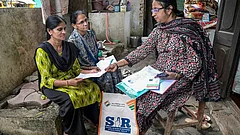
The infiltration debate in Jharkhand has a distinct geography. Its epicentre is Santhal Pargana—particularly Sahibganj and Pakur districts—which border parts of Bihar and West Bengal, close to the Bangladesh frontier. These districts also have the highest Muslim populations in the state, making them central to political claims about demographic change.
Even before its formal announcement, the SIR has escalated political tensions. That escalation became visible when Jharkhand government minister Irfan Ansari, who represents the Jamtara seat in Santhal Pargana, told a public gathering that if any Booth Level Officer (BLO) came to delete names under the SIR, villagers should lock the gate and confine the official until Ansari arrived.
The remark drew outrage, and the Election Commission sought an explanation. Ansari later said he was referring to fake BLOs allegedly extorting bribes by threatening deletions, and claimed his statement had been taken out of context.
Senior BJP leaders—including Union Home Minister Amit Shah and party president J. P. Nadda—have repeatedly raised the issues of Bangladeshi infiltration and the National Register of Citizens in Jharkhand. The SIR has now become the latest political flashpoint.
Anant Ojha, a BJP leader and three-time MLA from Rajmahal in Sahibganj district, has framed the exercise as a response to what he calls “vote jihad.” He has demanded that the SIR be conducted using the 1951 Census or the 1952 voter list, instead of the 2003 electoral roll.
Explaining his position to Outlook, Ojha made a series of allegations, “The demography of Santhal Pargana has changed very rapidly. Infiltrators have created an imbalance.” He said he raised objections with both the Jharkhand State Election Commission and the Election Commission of India after the 2024 Lok Sabha elections.
Ojha alleged that voter numbers in the Udhwa block of Sahibganj rose from around 8,000 in between 2014 and 2019, to 22,000 between 2019 and 2024. He described this as an “unexpected surge” and said similar patterns were visible in other parts of Rajmahal. Outlook cannot verity this exponential increase in voter numbers on its own.
He alleged that booths bordering West Bengal have recorded increases of 60 and insisted that the SIR in Sahibganj and Pakur should be based on the 1951 survey or 1952 voter list to identify those who allegedly entered the Santhal region after 1980.
The formal announcement of the SIR is expected shortly after February 10. Meanwhile, parental mapping is underway across Jharkhand, with around 80 percent of the exercise completed. According to official data, nearly 1.2 million voters have been identified as deceased, long-term absentees, or people whose names appear in multiple locations, and are marked for deletion.
Chief Election Commissioner Gyanesh Kumar visited Jharkhand on January 4 and 5. Another Election Commission team is scheduled to arrive on January 8 to review preparations before the formal announcement.
On the ground in Santhal Pargana the infiltration narrative is being contested.
Lalita Tudu, mukhiya of South Begamganj panchayat in Udhwa block, denied the presence of Bangladeshi infiltrators. “There is no fear here regarding the SIR,” she said. “Those whose names were not in the 2003 list are bringing voter lists of their parents from their natal villages.”
Ishteyak, mukhiya of Dariyapur panchayat in Barharwa block, said people were not opposing the SIR itself but were against the hardships caused by the process. He pointed to families living in the area for three generations who are now unable to prove eligibility because their names—or their parents’ names—are missing from the 2003 list.
“These are daily-wage workers,” he said. “Should they run to government offices for documents or earn their livelihood?” He demanded that the Election Commission simplify the process and conduct proper inquiries where doubts arise.
According to the Election Commission, parental mapping involves matching the 2024 voter list with the 2003 electoral roll. Nearly 26.5 million voters are being verified.
The Jharkhand state Assembly has passed a resolution opposing the exercise. Jharkhand Pradesh Congress Committee president Keshav Mahato Kamlesh accused the BJP of targeting the state for its natural resources and turning the Election Commission into a subservient institution.
JMM leader Vinod Pandey said his party was not opposing the SIR per se, but questioning its process and intent, pointing to reports of large-scale deletions across states.
As mapping continues, anxiety has spread among voters—especially those whose names appear in the 2024 rolls but not in the 2003 list.
Ranchi resident Imran Raza said many such voters even possess 2003 voter ID cards but are still unable to complete mapping. “People are scared about what will happen to them in the future,” he said.
Similar fears are being voiced in Pakur district. In Hathi Mara village of Maheshpur block, resident Imlia Hansda said women who migrated from West Bengal after marriage are being asked to produce their parents’ names from the 2003 list. She cited the case of Sunita Bisra, an Adivasi woman from Cooch Behar whose parents’ names were not listed and who was therefore unable to complete mapping.
Hansda said villagers fear that incomplete mapping could lead to citizenship being questioned and welfare benefits such as the Maiya Samman Yojana being withdrawn.
As Jharkhand awaits the formal rollout of the SIR, the exercise has already reshaped political alignments, revived old narratives of infiltration, and deepened anxieties among voters who fear exclusion long before any final electoral roll is prepared.