Despite a fat IPL pay check, KKR were advised to release the player by the BCCI
India’s refusal to shake hands with Pakistan at Asia Cup was a blip in cricket diplomacy
Will the move to evict Mustafizur further isolate India in the cricket world
The subcontinent has been a kind of Broadway for the theatre of cricketing diplomacy. India, comfortably nestled at the top of the pecking order, has established its presence at the virtual core of the sport, often determining its time and tide. However, as powerful as it gets with the most popular faces, the richest cricket board in the world, and an influential Indian face at the helm of the International Cricket Council (ICC), the lonelier India finds itself in the subcontinent as diplomatic relations with neighbours Bangladesh stand on the line.
With elections looming, Bangladesh finds itself marred with violence, political unrest and shuffle of allegiance and history, as it oscillates between foregrounding fundamentalism and promise of a return to democratic normalcy. Tensions between India and Bangaldesh have soared following Sheikh Hasina's ouster and as instances of Hindu minority violence in Bangladesh grabbed attention. But that the tension would trickle down to the cricket pitch was unprecedented.
Bangladesh left arm pacer and a popular face in the country, Mustafizur Rahman, was picked up by the Kolkata Knight Riders (KKR) in the IPL auction which took place last month, for a mammoth Rs 9.20 crore. As widespread public sentiment to the killing of Dipu Chandra Das and rising tensions between Dhaka and Delhi gained momentum, franchise owner Shah Rukh Khan was again a convenient target for Hindu nationalist factions and news portals in India who launched scathing verbal attacks against the franchise and the actor’s decision to buy Rahman and allow him to take the big bucks home in such an atmosphere.


Following major backlash, KKR were advised to release the player by the BCCI. “Due to the recent developments which is going on all across, BCCI has instructed the franchise KKR to release one of their players, Mustafizur Rahman of Bangladesh, from their squad and BCCI has also said that if they ask for any replacement, BCCI is going to allow that replacement," Devajit Saikia, the BCCI secretary, had told news agency ANI. Bangladesh quickly responded, by banning the telecast of IPL matches in the country and refusing to travel to India for its matches at the ICC t20 World Cup scheduled to take place across India and Sri Lanka in February.
Tossing the coin on cricket diplomacy
Diagonally across the border, cricket stands firmly lodged on barbed wires. Cricket diplomacy has been endemic to India-Pakistan relations for a long time now. From Pakistan president Zia-ul-Haq visiting India in 1987, shaking hands with then India captain Sunil Gavaskar at a moment of heightened nuclear sabre rattling between the nations to the countries fielding a combined XI in Sri Lanka in 1996 putting forth a strong statement in response to Australia and West Indies’ concerns about safety in Sri Lanka, cricket, till a certain point, was not only directed at reshaping kinship between the two nations but also marking the line between a shared obsession and diplomatic tethers. Cricket existed as it was supposed to - loudly, freely and competitively despite frequent diplomatic fallouts. While the sport certainly did not exist in isolation from politics, most attempts were, in retrospect, constructive at building and rekindling ‘friendship’ across decades of tumult. The present, however, is starkly different.
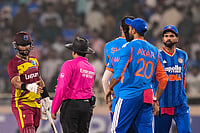
Following the Pahalgam terrorist attacks last year which claimed 26 lives, India faced Pakistan for the first time in the Asia Cup in September, where the Indian team led by captain Surya Kumar Yadav refused to shake hands with the Pakistani team after the match. Yadav said the decision to not shake hands was a “team call” and that they had only come to play. “Some things are beyond sportsmanship. We dedicate this victory to our armed forces who took part in Operation Sindoor and stand with families of the victims of the Pahalgam terror attack,” he had said. In the final, the team also refused to receive the winner’s cup from Asian Cricket Council President Mohsin Naqvi, who also serves as the President of the Pakistan Cricket Board (PCB) and a federal minister in his country.
The last bilateral series between the nations took place in 2012-13, and what has followed is a decade of sparse attempts at clawing back to cricketing normalcy between the camps. However, the refusal of the customary handshake and accepting the trophy, in a way, marks a glaring collapse of the momentum of cricket diplomacy, as unsubtly and evidently as it gets. It expectedly drew strong reactions from across the spectrum, with ex-cricketers and opposition calling it out and pointing at the fallacy of fraying sportsmanship spirit on the field despite choosing to play in the tournament. “Team India sort of weren’t happy with who was handing out the trophy. I don’t feel that belongs in sport. Politics should stay aside. Sport is one thing and it should be celebrated for what it is. Quite sad to see that, but hopefully they will sort things out in the future. It does put the sport, the players, the sportsmen, the cricketers in a very tough position, and that’s what I hate to see. It was quite awkward there at the end,” former South Africa skipper and a popular face in India, AB De Villiers said in a YouTube video.
Diplomacy on a sticky wicket
With Bangladesh however, the collapse comes as a rude shock. From India visiting its eastern neighbour for its first ever test match as an independent nation in November 2000, India-Bangladesh relations have always been stable enough to sustain healthy contests on field without much diplomatic intervention. However, following BCCI’s ban on Rahman, and rising bitterness owing to India providing asylum to a convicted Sheikh Hasina, Bangladesh was willing to bet on its long-standing strategic partnership with India and BCCI, by announcing that it would not play in India at the cost of ‘national humiliation’. Bangladesh’s immediate response of banning the telecast of IPL indefinitely, points at the popularity of the league in the country with BCCI aware of the blow viewership and royalties could take as a result. The ICC has reportedly directed the Bangladesh Cricket Board to travel to India or forfeit points, but the BCB has denied any such ultimatum, saying, “The ICC has conveyed its willingness to work closely with the BCB to address the concerns raised and has assured that the Board's inputs will be welcomed.”
Congress leader Shashi Tharoor, in an opinion piece, has called the move to ban Rahman from participating in the IPL appalling. Tharoor wrote that it “represent a troubling departure from both sporting meritocracy and strategic common sense”. The move places itself alongside the long-standing ban on Pakistani players from taking part in the IPL, which came into force following the 26/11 Mumbai attacks in 2008 and stands till date. As Tharoor points out in the same piece, “To conflate the complex internal dynamics of Bangladesh with something like the state-sponsored hostility of Pakistan is not merely a visceral overreaction; it is a diplomatic blunder that reveals a profound failure of imagination.”
As experts have pointed out, India’s place in the cricketing scheme of things, although monetarily and influentially secured, finds itself challenged following this move. As it stands with battered relations on two different borders, the more rather jarring shade of cricket diplomacy takes the driving seat. Cricket finds itself in the crosshairs and it is to be seen if India’s self-inflicted isolationist move is as defiant a statement as the government wants it to be or widens the gap further, exposing strategic loopholes in a crucial period for sub-continental politics.