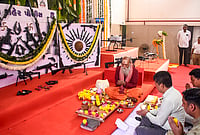
The audience at IIC applauded the humanising cadence of words transcending language, as the poets spoke of courage, dignity and conscience.
Indrė Valantinaitė, from Lithuania, who presented the first poem, on the inaugural day of the festival, believes poetry is a mirror to both the poet and the reader.
At Outlook, poetry has always been a deeply personal and a political act of resistance.
Amid the confusing and maddening smog of bloodlust and rage, poetry is the mirror, the sound of resistance. In a restive world filled with screams, laughter and muted shrieks, poetry offers an eternal stencil for memory and hope.
“A place is not only a geographical area; it's also a state of mind. And trees are not just trees, they are the ribs of childhood,” writes Palestinian poet Mahmoud Darwish in Journal of an Ordinary Grief as he navigates loss and pain. Poetry fusing the personal and the political, has always borne testimony to the times, where voices emerge from nothingness, and the loudest screams drown in a deluge of silence.
At the core of ‘Sansaar’, the international poetry festival organised by The Raza Foundation, was an intense desire to bring together words and voices from places less seen, languages less heard where people continue to negotiate between survival and resistance. The festival being held at the Indian International Centre between Feb 27 and March 1, features the works of eminent poets from Iraq, Syria, Egypt, Algeria, Ukraine, Lithuania, Sudan, Slovenia and Argentina, with eight poets presenting their poems in person.



Witnesses to the rise and spread of violence, murder, displacement, brutality, genocide in their countries, as the poets presented a poem in their mother tongue, the packed hall at IIC accommodated the humanising cadence of words transcending language, as thet spoke of courage, dignity and conscience.

“The world reveals, affirms, celebrates, and interrogates itself in poetry. Our times are deeply troubled as the injured and wounded keep being under assault and marginalised. Conscience, courage, and creativity, the duet of hope and despair, dialogue, and dissent seem to have their last residence in poetry,” said Ashok Vajpeyi, poet, art curator and Life trustee, Raza Foundation as he inaugurated the festival.
Italian poet André Naffis-Sahely, presenting ‘The Year of One Thousand Fires’ and part of Poetry In The World sessions at Sansaar, says, “Poetry should always be looking for the global in the local and what we all have in common is oppression. As such, poetry should serve the most oppressed among us.”
“Poetry is a verbal ecology against indifference. It is an effort of the imagination to make meaning—provisional and fictional, as any meaning is—in order to glimpse the unity of the living. Its places are infinite; there is no single poetry,” says Argentinian poet Daniel Lipara.
Indrė Valantinaitė, from Lithuania, who presented the first poem, on the inaugural day of the festival, believes poetry is a mirror to both the poet and the reader. “By relating stories, I investigate and attempt to uncover the minefields and treasure islands hidden inside of us. Beauty is inexhaustible, just like the pain that surrounds us. Poetry is a way for me to make peace with the constant changes in which we are engulfed, as well as to understand the world, and to accept it as it is,” she says.
Iraqi poet Sinan Antoon, presenting the session, ‘From The Book Of Genocide’, presents his firm stance against numerous declarations on the decline of poetry. “It is abundant and free bread for our hungry souls, the balm for our individual and collective wounds in a capitalist world set ablaze by human avarice and genocidal violence,” he asserts.
Outlook shares poems written by Antoon and Egyptian poet Yahia Lababidi which speak to the bloodied reality and the violent times we are witnessing.
Limbs
Limb: an arm or a leg; a similar part of an animal, such as a wing
(Gaza has the largest number of amputees in the world)
Humans
are not trees
Their limbs don’t grow back
But what happens
to amputated limbs in Gaza?
Are they kept in jars
to wait
patiently
for the right of return
to the bodies
from which they were removed
But there isn’t formaldehyde to preserve them
Are they thrown away into the trash?
Do they congregate somewhere?
Could they compete in the next Olympics?
Do legs keep running, fleeing the bombing?
Do hands punch the sky?
Or beseech a cloud for help?
Are they buried?
So one could visit a body part
that lived in their body
Do they become an army of ghosts?
Sinan Antoon
What to Bring to a War Protest
Bring a candle
burning in your eyes
to lead the way.
bring a bird
nestled in your heart
to set others free
bring a shroud
large enough to bury
the dead past
bring a flag
spotless and white
to surrender pain
Yahia Lababidi

The Raza Foundation, which has dedicated itself to promoting art, culture and ideas for over two decades, ideated Sansaar, as a microcosmic representation of the global family connected by the language of love and conscience, where names from lesser known territories speak of deeply personal realities and truths through poetry.
Acclaimed painters Gopi Gajwani, Manu Parekh, Atul Dodiya, Amitava Das, Mona Rai, Akhilesh, S. Harshwardhana, G.R. Iranna, V. Ramesh, Manish Pushkale, Manisha Gera Baswani, Mithu Sen and Manjunath Kamath contributed works in response to the poems by the poet which were in exhibition at the IIC.
At Outlook, poetry has always been a deeply personal and a political act of resistance. Poetry shows and bears testimony, refusing to bend or give way. Outlook’s Jan 2024 issue, Poetry As Evidence, guest edited by Amar Kanwar, presented a selection of verses that serve as evidence and act as mirrors to the acts and truths of bleak times we are living in.