Trump’s Beijing summit with Xi comes amid continuing US-China tensions over trade, Taiwan and technology.
Marco Rubio’s past remarks on China have drawn renewed attention during the visit.
China previously sanctioned Rubio before allowing him to visit Beijing as Secretary of State.
Trump’s meeting with Xi Jinping in Beijing has again highlighted the balancing act at the centre of US policy towards China. Washington wants to keep relations stable with Beijing, but at the same time, many within the US political and security establishment see China as America’s main long-term competitor.
That tension is difficult to ignore with Secretary of State Marco Rubio travelling alongside Trump for the summit.
Long before becoming America’s top diplomat, Rubio built his political identity around a hard line on China. As a senator, he repeatedly argued that Beijing’s growing influence over global manufacturing, technology and supply chains posed a serious risk to the United States.
“If we stay on the road we're on right now, in less than 10 years virtually everything that matters to us in life will depend on whether China will allow us to have it or not,” Rubio said in January 2025, warning about America’s dependence on Chinese production networks.
Rubio has been especially vocal on Taiwan, the self-governing island that China claims as its own territory. He has argued that the United States needs to move faster to strengthen Taiwan’s military capabilities as China increases pressure around the island.
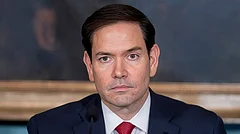


“We need to wrap our head around the fact that unless something dramatic changes... we're going to have to deal with this before the end of this decade,” Rubio said while discussing the military balance between Beijing and Taipei.
Taiwan remains one of the most sensitive issues in US-China relations. Washington has expanded military assistance for Taiwan in recent years, while China has stepped up fighter jet patrols, naval deployments and military exercises near the island. Beijing views American support for Taiwan as interference in its internal affairs.
Rubio’s presence in Beijing is also notable because China had previously sanctioned him over his criticism of the Chinese government and his support for dissidents and human rights issues. The sanctions were imposed during his time in the US Senate and technically barred him from entering China.
Now serving as Secretary of State, Rubio travelled to Beijing after Chinese officials found a diplomatic workaround. According to Beijing, the sanctions applied to Rubio in his previous role as a senator, not as a member of the Trump administration.
Chinese authorities also reportedly adjusted the Chinese transliteration of Rubio’s surname in official usage, allowing Beijing to avoid formally violating its own sanctions framework during the visit.
The summit itself comes at a time of continuing friction between the two countries. Trump and Xi are expected to discuss trade, artificial intelligence, Taiwan, semiconductor supply chains, critical minerals and broader security issues.
Even as both governments try to maintain direct engagement, strategic distrust remains firmly in place. Rubio’s past remarks reflect a wider view within Washington that China is no longer seen simply as an economic rival, but as a competitor challenging American influence across technology, military power and global trade.
(With inputs from Times Now)