An Iranian missile and drone attack damaged Kuwait's airport, killing one person and temporarily suspending flights.
The US military carried out retaliatory strikes near the Strait of Hormuz after downing drones targeting civilian ships.
Global oil prices rose over 2% as the vital shipping lane remains closed despite ongoing ceasefire talks.
Gulf hostilities flared again on Wednesday as an Iranian missile attack damaged Kuwait's international airport and the United States military launched retaliatory strikes near the strategic Strait of Hormuz, threatening a fragile ceasefire and sending global oil prices up by more than 2%.
The cross-border strikes mark the latest disruption to regional stability, occurring more than three months after initial U.S. and Israeli military operations against Iran left the critical maritime trade corridor largely blocked. Despite recent indications from Washington and Tehran that initial progress was being made toward a tentative truce, diplomacy has slowed, leaving the vital energy route closed and world markets highly volatile. Reuters reported that the latest flare-up has cast deep uncertainty over the future of the multi-nation peace talks.
Flights at Kuwait International Airport were temporarily suspended on Wednesday morning after an Iranian drone and missile strike severely impacted diplomatic missions and airport facilities. Kuwaiti authorities and state media confirmed that the assault resulted in one fatality and left several others injured. The country’s civil aviation authority later announced that Kuwait Airways had begun resuming flights specifically from Terminal 4, following an emergency safety assessment and initial debris clearing.

Simultaneously, the military of Bahrain stated it successfully intercepted three missiles and a cluster of drones targeting its territory. The interceptions came as Tehran announced it had targeted the headquarters of the U.S. Fifth Fleet stationed in Bahrain, alongside an airbase and helicopters located in an unspecified regional state. Conversely, U.S. military officials stated that two Iranian missiles aimed at Kuwait either fell short or dissolved mid-flight, while multiple other ballistic missiles completely missed their regional targets.
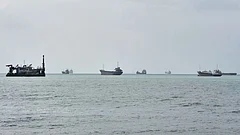


Since this broader conflict commenced on February 28, Iran has repeatedly struck civilian and military infrastructure across the Gulf region, home to numerous American military installations. Hostilities have periodically broken out despite an early April ceasefire agreement. The U.S. continues to demand the permanent reopening of the Strait of Hormuz, which traditionally managed roughly 20% of global oil and liquefied natural gas shipments.
Just last week, both Washington and Tehran signalled a willingness to sign a tentative, initial pact to halt active combat and unblock the strait, leaving complex long-term disputes for subsequent discussions. However, an official agreement remains unsigned. Mohsen Rezaei, military adviser to Iran's Supreme Leader Ayatollah Mojtaba Khamenei, stated on Tuesday that Iran would not allow the U.S. to "overreach" either in negotiations or ceasefire arrangements. Writing on the social media platform X, Rezaei warned that any aggression would be met with a barrage of missiles and drones.
The escalating violence drew sharp condemnation from neighbouring Gulf states. Anwar Gargash, diplomatic adviser to the UAE president, noted on X that the repeated targeting of Kuwait and Bahrain demanded a unified regional stance, writing, "The aggression does not target one country alone, but all of us."

In a series of rapid maritime counter-strikes, the U.S. military confirmed it shot down multiple drones targeting civilian shipping vessels and American personnel stationed in Kuwait. U.S. forces subsequently launched targeted strikes on Qeshm Island, located near the Strait of Hormuz, following attempted Iranian manoeuvres. According to Reuters, Iranian state media countered that the Revolutionary Guards' navy hit a vessel it identified as the Panaya with missiles, in response to what it said was a U.S. attack on an Iranian tanker near Hormuz. "Disrupting the security of the Strait of Hormuz will carry a heavy price for the U.S. military," the Revolutionary Guards were cited as saying.
Amid the military friction, the exact status of diplomatic communication remains ambiguous. Iranian state press reported that Tehran had not engaged with Washington for several days, though U.S. President Donald Trump maintained that discussions are actively continuing. Since mid-March, Trump has insisted that a comprehensive deal is close, which would pave the way for broader talks regarding Iran’s nuclear programme.
In a podcast interview released on Wednesday, Trump asserted that Ayatollah Khamenei was personally engaged in the diplomatic process, stating, "They've already agreed they're not going to have a nuclear weapon." While Trump has reiterated that blocking Iranian nuclear weapon capability is his primary objective, Tehran maintains its atomic programme is strictly for peaceful, civilian purposes. As part of the ongoing negotiations, Iran is demanding a total cessation of hostilities in Lebanon, the release of billions of dollars in frozen oil revenues, export waivers for crude oil, the removal of the U.S. naval blockade on its ports, and continued strategic leverage over the Strait of Hormuz.

The war continues to exact a massive humanitarian and economic toll, resulting in thousands of casualties concentrated primarily in Iran and Lebanon, while destabilising global supply chains. The crisis has also fueled parallel hostilities between Israel and the Iran-backed Lebanese militant group Hezbollah, prompting Israel's deepest military incursion into Lebanese territory in 25 years.
Lebanese security sources reported that Israel sustained heavy strikes on multiple southern towns on Tuesday, despite a U.S.-mediated partial ceasefire framework unveiled just a day prior. On Wednesday, the Israeli military confirmed it had successfully intercepted a "hostile aircraft" that had crossed over into northern Israel.
(With inputs from Reuters)