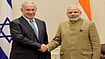
Netanyahu called India a “global power” and Modi a “personal friend” ahead of Modi’s Israel visit, saying ties will deepen across key sectors.
He proposed a “hexagon” alliance including India and regional partners as a strategic axis in the Middle East.
The visit will focus on diplomacy, innovation, and cooperation in AI and quantum computing.
Calling India a “global power” and Prime Minister Narendra Modi a “personal friend”, Israeli Prime Minister Benjamin Netanyahu on Sunday outlined an ambitious diplomatic vision that places India at the heart of a new regional alliance system.
Ahead of Modi’s two-day visit beginning February 25, Netanyahu spoke of building a “hexagon” of partnerships spanning Asia, the Middle East, Africa and the Mediterranean.
At the start of the weekly cabinet meeting, Netanyahu said the visit would highlight the “special relationship” forged between Israel and India in recent years. “We are personal friends; we speak frequently on the phone and visit one another,” he said, recalling their highly publicised 2017 meeting when he and Narendra Modi walked barefoot along a Mediterranean beach — images that fuelled talk of a diplomatic “bromance”.
Modi’s upcoming trip will be his second to Israel, following his landmark 2017 visit, the first ever by an Indian Prime Minister to the country. Netanyahu travelled to India in 2018, and since then, both leaders have maintained regular contact.


“The fabric of this relationship has grown tighter,” Netanyahu said, adding that the visit would deepen economic, diplomatic and security cooperation. Among the areas expected to receive particular attention are high technology, artificial intelligence and quantum computing. “I say AI and quantum not because they are the future, but because they are the present,” Netanyahu remarked, underlining Israel’s ambition to remain among global leaders in emerging technologies.

Beyond bilateral ties, Netanyahu used the occasion to sketch out a broader diplomatic architecture. He described a “hexagon” of alliances comprising India, Arab countries, African nations, Mediterranean partners such as Greece and Cyprus, and additional Asian states. Though he did not provide detailed specifics, the formulation broadly echoes the strategic logic of connectivity initiatives such as the India–Middle East–Europe Economic Corridor (IMEC), which seeks to strengthen trade and infrastructure links across regions.
However, Netanyahu framed his proposal less as an economic corridor and more as a geopolitical axis. The proposed grouping, he said, would unite countries that “see eye-to-eye” in confronting what he termed “radical axes” in the region, referencing both Shia and Sunni extremist formations.
“All of these nations share a different perception, and our cooperation can yield great results and ensure our resilience and our future,” he asserted.
During his visit, Modi is expected to address the Knesset, attend an innovation event in Jerusalem, and visit Yad Vashem with Netanyahu. He will also meet Israeli President Isaac Herzog.
Netanyahu has often highlighted his personal rapport with global leaders, including Modi and former US President Donald Trump, as evidence of Israel’s diplomatic standing under his leadership. With Modi’s arrival this week, that personal and strategic partnership will once again take centre stage.