January 22 marks the 92nd birth anniversary of Vijay Anand.
He was the youngest of the three Anand brothers and collaborated with older brother Dev Anand on many films.
He directed several classics like Guide, Johny Mera Naam, Tere Mere Sapne, Teesri Manzil and more.
He was the youngest of three brothers which is perhaps why, early on, Vijay Anand’s prodigious talent was taken for granted. Yes, he was a part of the family banner, Navketan Films, set up in 1949 by his two older brothers. But Goldie, as he was fondly called, was only entrusted with rehearsing lines with the actors and checking on costumes and make-up. The major creative and production responsibilities were divided between Chetan and Dev Anand.
Yet, Goldie’s first story, jointly written with sister-in-law Uma Anand, bailed out the production house after the debacle of Aandhiyan (1952) and Humsafar (1953) and gave Chetan—Taxi Driver’s (1954) director and scenario writer—a much-needed hit after Neecha Nagar (1946), Afsar (1950) and Aandhiyan disappointed commercially. The musical romance between a cabbie and an aspiring singer, which unfolds in the city of Bombay (now Mumbai), was among the 10 top box-office grossers of 1954. Taxi Driver also made Dev a ‘hero’—that was how he was referred to in the film—not just in the eyes of the audience, but also its comely heroine, Mona Singh, rechristened Kalapana Kartik.



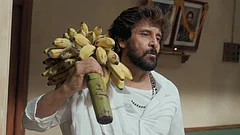
The following year, the couple entered House No. 44, directed by MK Burman, and in 1956, Dev reunited with Sheila Ramani, Taxi Driver’s other woman Sylvie, for a madcap comedy, Funtoosh, which Chetan directed. This shoot however was far from smooth, with tension simmering between the two brothers over the climax of Aandhiyan which was, to Dev’s disgruntlement, edited for the Cannes festival screening. The discord spilled over onto the Funtoosh set with the director stomping out of the set during the filming of “Aye meri topi palat ke aa”. It was left to Goldie to complete this, and another Kishore Kumar song “Denewaala jab bhi deta hai”, both of which were much appreciated after Funtoosh’s release.

Perhaps that’s what gave the youngster the courage to ask his actor-producer brother if he could direct Nau Do Gyarah (1957) when, tired of waiting for Raj Khosla to complete the script of Khali Botal, Dev asked him if he had another story that could be brought to the screen.
The “crazy” request was instantly turned down because Goldie, who was barely out of his teens, had not even assisted his bhaisahab (Chetan Anand) or any other director. But remembering Taxi Driver’s surprise success, Dev was curious to hear his story and asked his baby brother to hop into the car with his wife Kalpana and him and narrate the screenplay to them as they drove down to Mahabaleshwar for a film shoot.
Goldie immediately agreed and took them on a journey with his protagonist, Madan Gopal, who evicted from his home in Delhi for having defaulted on the rent again, is en route to Bombay after getting a letter from his uncle informing that he was leaving Rs 2 lakh in cash and Rs 9 lakh worth of property to him. On the way, Madan stops at a wedding where the bride, disguised as a boy, sneaks into his truck and convinces him to take her along. It comes as a shock to discover that Sardar Nihal Singh is actually a girl, Raksha, and an even bigger shock when he is arrested on charges of kidnapping the runaway heiress. Meanwhile, his uncle has died, and another nephew lays claim to the legacy, while the girl’s groom lays claim to her.

Nau Do Gyarah, which adds up to the amount Madan was to inherit and also an idiom for vamoose…run away...was a fascinating ride. Both Dev and Kalpana were so entertained by the story that by the time his narration ended, Goldie had got his wish.
To everyone’s surprise, the debutant director turned out to be absolutely fearless and revolutionary in his style of filmmaking. He tied the camera to the truck Dev was driving, sitting on top of the moving vehicle with the petrified cinematographer, V Ratra, in front, clicking off the shots he wanted. Goldie even dared to point out to veteran lyricist Majrooh Sultanpuri that there couldn’t be “sunhere badal” (golden clouds) in the song “Aankhon mein kya ji” as they were driving at night when the sun had already set.
Six years later, during Tere Ghar Ke Samne (1963), he had the gall to walk up to Sachin Dev Burman and tell the veteran music director that he wanted him to compose a tune for a song for the film which needed the line “Saans tera mandir mandir, jaise rajnigandha, saath tera madhur madhur, chandni ka Ganga”, the words written by him. Dada Burman did not normally indulge precocious young directors, but having scored the music of Taxi Driver and Nau Do Gyarah, along with Goldie’s second directional Kala Bazar (1960) and also Hum Dono (1961) which he reportedly ghost-directed, the composer, well versed with his genius, agreed.

He returned home with the song situation—Dev’s Dr Anand has grown so distant from his wife, Mumtaz’s Nisha, that he is not even aware that she is pregnant—playing on his mind. At around 10.30 pm, Goldie was surprised by a call from Dada Burman, who normally retired for the night by 10 pm. The composer happily informed him that the tune was ready, and gave it to Neeraj, telling him to take Goldie’s poetry, and the emotions inherent in the line, further. The lyricist added a mukhda—“Hai maine kasam li, hai tu ne kasam li, nahin honge juda hum…”—added a couple more antaras and gave us a song that remains evergreen even after 55 years.
While Tere Mere Sapne (1971), along with Teesri Manzil (1966), Jewel Thief (1967) and Johny Mera Naam (1970) are cult classics today, Goldie is best remembered for the bi-lingual, Guide (1965). Goldie replaced elder brother Chetan, who had to suddenly leave for Ladakh to shoot his own film Haqeeqat (1964). The first thing he did was rewrite the script, pointing out to me in an interview several years later that he was “determined to change the whole look and make it a much better film”.

The English Guide, released in 1960 and directed by Tad Daneilewski, was a disaster, with even RK Narayan, whose 1958 novel had inspired the film, dismissing it as “The Misguided Guide” in a scathing review in Life magazine. Goldie’s Hindi version also opened to a lukewarm response, but then a drought in Gujarat turned the tide and it went on to celebrate a silver jubilee run in Ahmedabad. It was India’s official entry to the 38th Academy Awards for ‘Best Foreign Language Film’. In Los Angeles, the Anand brothers ran into Howard Hawks. The American writer-filmmaker, whose Come and Get It (1936) had bagged Walter Brennan the first ever Oscar for ‘Best Supporting Actor' and Gary Cooper ‘Best Actor’ for Sergeant York (1941), was very impressed with Guide. He believed it stood a good chance of winning the coveted statuette and advised Dev and Goldie to get subtitled prints and host as many screenings as possible for members of the Academy. “But we needed money for that and didn’t even have enough to settle our hotel bills,” Goldie rued.
Short of funds, Guide did not even make the final cut and the Oscar went to the Czech film Obchod na korze (The Shop on Main Street, 1965). But more than two decades after he succumbed to a heart attack, Vijay Anand aka Goldie, who would have turned 92 on January 22, remains unforgettable. And his Guide remains a ‘guide’ to successive generations of filmmakers.