On January 17, 2014, Bengali superstar Suchitra Sen bowed out from the world.
She not only got top billing and featured prominently in the posters, but was also the highest-paid actress of her time.
She did 30 films with ‘Mahanayak’ Uttam Kumar, starting with the 1953 rom-com Sharey Chuattar to Priyo Bandhabi in 1975.
When Deepika Padukone recently asked for an eight-hour workday so she could spend more time with her daughter Dua, she lost two big films, Spirit and the Kalki 2898 AD sequel. Earlier the actress, along with Priyanka Chopra, Anushka Sharma, Kareena Kapoor, Katrina Kaif, Kangana Ranaut and Sonam Kapoor, had actively campaigned for pay parity, admitting that even for Padmaavat (2018), in which she played the title role, her remuneration had been far less than that of her male counterparts, Ranveer Singh and Shahid Kapoor.
However, there was one actress who ruled the box-office on her own terms. Bengal’s ‘Mahanayika’ Suchitra Sen, not only got top billing and featured prominently in the posters, but was also the highest-paid actress of her time, getting an unheard of Rs 1 lakh for the 1962 film Bipasha. It was one of the 30 films she did with ‘Mahanayak’ Uttam Kumar, starting with the 1953 rom-com Sharey Chuattar to Priyo Bandhabi in 1975.

They were the golden couple of ‘Sonar Bangla’, starring in several blockbusters, including Agni Pariksha (1954), Saptapadi (1961), Indrani (1958), Shap Mochan (1955), Pathe Holo Deri (1957), Harano Sur (1957), Shilpi (1956) and Sagarika (1956). Yet, when some critics started saying that she was a success only because of him, Sen turned down all offers opposite the reigning superstar after Bipasha. The decision might have cost another actress her career, but hers peaked with Saat Pake Bandha (1963), opposite Soumitra Chatterjee. The film not only won a National Award—Certificate of Merit for Second Best Feature Film in Bengali—but also bagged the Silver Prize at the Moscow International Film Festival. A rich-girl-meets-poor-boy love story doomed by family interference, it was subsequently remade in Telugu (Vivaha Bandham), Hindi (Kora Kagaz), Tamil (Lalitha) and Malayalam (Archana Teacher).



In 1963, Sen also played a double role in Asit Sen’s Uttar Falguni, opposite Bikash Roy and Dilip Mukherjee. Another National Award-winning film produced by Uttam Kumar, it was remade in Tamil (Kaaviya Thalaivi) and Malayalam (Pushpanjali) with Sowcar Janki and Vijayasree as mother and daughter. However, Sen returned as Debjani turned Pannabai and her daughter, Superna, a lawyer, in the Hindi remake, Mamta. The 1966 film was a top grosser at home and also a blockbuster in Soviet Russia.
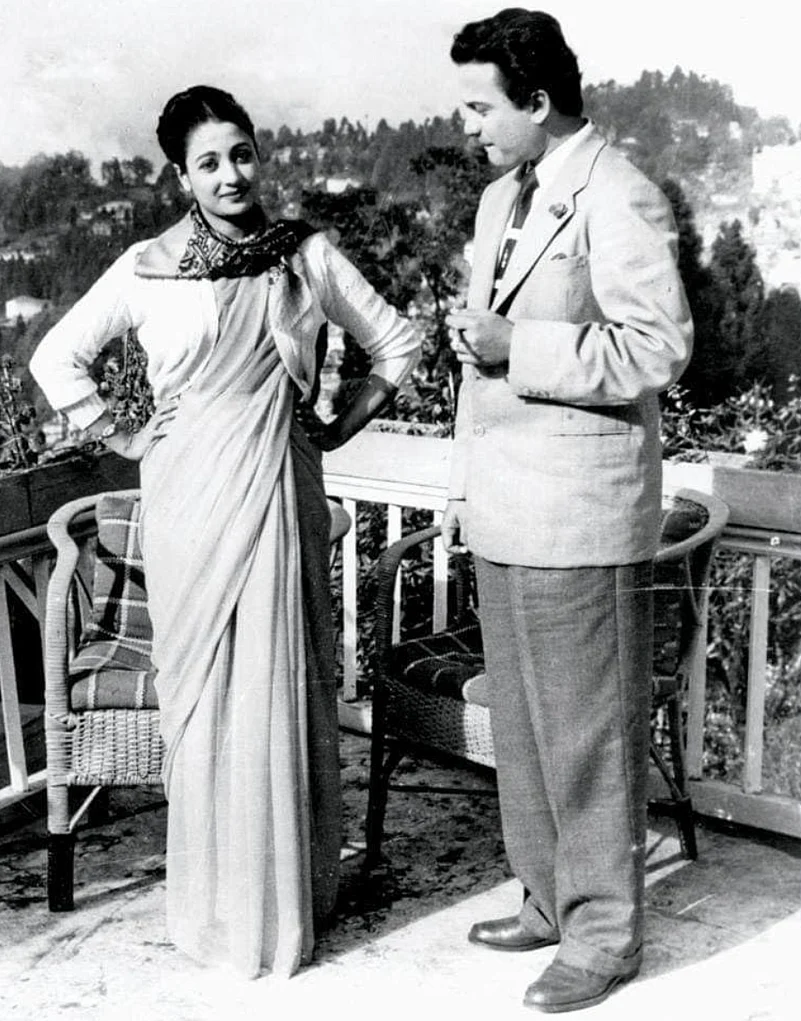
Having proved that she was a best-seller in her own right, Sen reunited with Uttam Kumar to bring two Sarat Chandra Chattopadhyay novels to the screen, Grihadaha in 1967 and Kamallata in 1969. The Bengali litterateur was a favourite and she also featured in three more films, Rajlakshmi O Srikanta (1958), Datta (1976) and Devdas (1955), based on his novels. After Meena Kumari turned him down, Bimal Roy had approached Sen for his Devdas, and she admitted she had accepted her first Hindi film because “It was the first Sarat Chandra story I was offered”.
She made a bewitching Parvati opposite Dilip Kumar’s lovelorn Devdas and when she was shooting in Mumbai, star-gazers crowded Mohan Studio to catch a glimpse as she drove up in her Buick convertible. Her Mamta co-star, Dharmendra, admitted that he had been mesmerised by this “picture of beauty” in Devdas too and had been dreaming of working with her. “It is said that when you want something dil se, the universe conspires to give it to you,” he had smiled, admitting shyly that the actress had always told him she loved his smile.

Three years after Devdas, Kumar and Sen appeared in different stories in Musafir, the directorial debut of Bimal Roy’s editor, Hrishikesh Mukherjee. Reportedly, neither charged even a rupee for the 1957 episodic film. Almost two decades later, she played a politician in Aandhi, directed by Roy’s one-time assistant Gulzar. She had insisted on dubbing her own lines, promising that she would learn to speak Hindi fluently. By the end of the shoot, she had taught the unit Bengali while her Hindi diction was far from perfect and marred a wonderful performance.
The film was released in 1975 to strong objections from the Congress party on her character’s uncanny resemblance to Indira Gandhi and banned after 20 weeks, when Emergency was imposed. It returned to the theatres after the addition of a scene, which had Aarti Devi standing in front of a portrait of the then Prime Minister, saying Mrs Gandhi was her role model.

Aandhi was Sen’s last Hindi film. In fact, ‘Madam’, or ‘Mrs Sen’ as she was usually called, even disappeared from Kolkata’s studios after Pronoy Pasha in 1978. There were rumours of a mysterious illness. Her husband’s premature demise also was a big blow and bleached her life.
Roma, as she was originally christened, had married Dibanath, the wealthy son of an industrialist, at just 16. They lead a charmed life, their home always full of people and pets and parties every night. Moon Moon had revealed that her mother, who had once celebrated Saraswati puja, Durga puja, Easter and Christmas with bhog, cakes an unbridled enjoyment, stopped doing so after her father passed. They had separated by the time, but despite persistent rumours about Uttam Kumar, Sen never married again and immersed herself in work. But even that didn’t bring much solace and in the 1970s, she took diksha from Swami Vireshwarananda and turned to spirituality.

In my book, Prosenjit Chatterjee: Beyond the Spotlight (2025), co-authored with Prosenjit Chatterjee, the actor shares that since Raima was working in the film, Sen took a keen interest in their Chokher Bali (2003). “After its release, Raima would tell me that her dida (grandmother) would occasionally enquire about what I was doing next. Sitting in Moon Moon-di’s apartment, which was located right opposite hers, I would often wonder about our desi Garbo who had retired prematurely and vanished from the public eye,” he recounts, rueing that while he has worked with her daughter and granddaughters, his only memory of Mrs Sen is a photograph in the family album of him as a child sitting in her lap and she kissing him fondly.
But even though only a handful of people saw her face in 36 years, the curiosity surrounding the diva never faded. Her fans continued to rhapsodise over her luminous beauty, which shone through even in black-and-white. Journalists continued their efforts to ‘unveil’ her with one even checking into the hospital where she was recuperating and stealthily clicking some pictures. He got a painting done, live on TV, to give viewers an impression of how Sen looked like now, when he was legally barred from leaking out the pictures. The gimmick got him TRPs, but generated huge outrage.
On January 17, 2014, Suchitra Sen bowed out from the world. She was 82 and still as big a star. The family respected her wish for privacy. Even during the funeral, her face remained veiled.