Legendary Bollywood director Shakti Samanta turns 100 on January 13.
His son Ashim recalls his father's equation with yesteryear superstars Rajesh Khanna and Sharmila Tagore.
He fondly recollects the making of classics like Aradhana, Amar Prem and more.
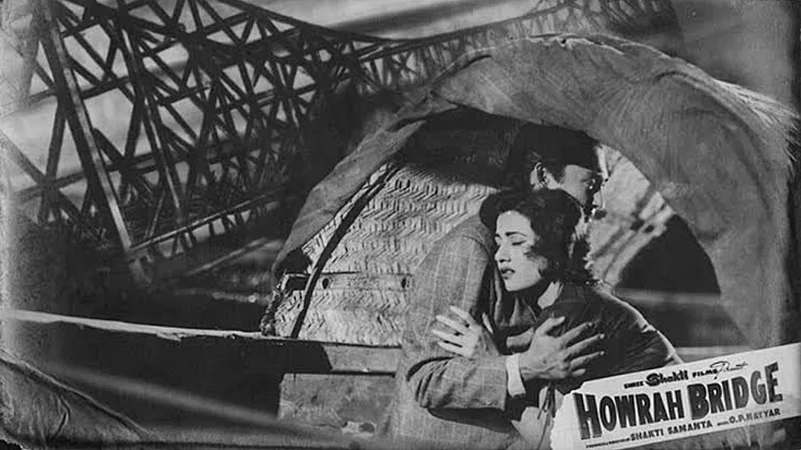
When he was around four years old, Ashim watched his father Shakti Samanta’s 1958 crime-thriller, Howrah Bridge. In the film’s climax, the hero, Ashok Kumar, chases the villain up the iconic bridge and the duo duel at the top till a cop shoots KN Singh. As he sways precariously over the edge, Kumar grabs the briefcase carrying the priceless family heirloom, which had brought him all the way from Rangoon to Kolkata, moments before Singh plunges into the river below.
“I was too young to be mesmerised by the beautiful Madhubala, but I was impressed with that fight and tried to replicate it at home, clambering up our bedroom grill with a side pillow, punching it and throwing it to the floor before jumping on to the bed,” Ashim laughs at the memory.
Howrah Bridge has remained a favourite, as has its song “Yeh Kya Kar Dala Tune”. Years later, his father told Ashim that a beautiful shot of Madhubala’s scarf floating away in the breeze to gently settle on Ashok Kumar’s face, the actor holding it between his teeth, drawing closer to his leading lady and dropping a kiss on her cheek, met with objections and had to be edited. “It was a chaste kiss, but the censors found it ‘too sexy’ and insisted on it being cut,” Ashim shares with a grin.


Talking of sensuous romantic tracks, a decade later, Sharmila Tagore and Rajesh Khanna set the screen on fire in Aradhana (1969) and “Roop Tera Mastana, Pyar Mera Deewana” became the muse for many seduction songs on a stormy night. Ashim informs that Sachin Dev Burman had composed two tunes and played them both for his father. When asked for his opinion, Shakti Samanta told his music director that he would go with the one he picked.
On his way out, Pancham (RD Burman), SD Burman’s son, caught him on the stairs and admitted he preferred the other tune. Since it was his choice too, the filmmaker told him he could record it instead of the one originally agreed to. “Then come up and tell my father that because I’m not going to,” the younger Burman retorted and Samanta was forced to retrace his steps. Since both were his compositions, Dada Burman didn’t fuss over the change. “There have been many rumours circulating about “Roop Tera Mastana”, but this is what was told to me by dad,” recalls Ashim.
Aradhana made Khanna an overnight superstar. But surprisingly, the actor didn’t want to do the film even though it had him in a double role of father and son. He only agreed because as the winner of the All-India Talent Contest, he was contractually bound to work with Samanta, who was a member of the United Producers, which along with Filmfare, were the organisers of the contest.

“Kaka believed it was a woman-centric subject and didn’t want to play second fiddle to the heroine. That was also why he wasn’t too keen on Kati Patang (1970). Dad assured him both films would be superhits, and he was right,” shares Ashim, pointing out that after Aradhana’s phenomenal success, Samanta, Tagore, Khanna, the two Burmans and lyricist Anand Bakshi became a winning team.
Like with Khanna, Samanta was also close to Tagore, who made her Bollywood debut in his Kashmir Ki Kali (1964) opposite superstar Shammi Kapoor. “I remember the entire family went to watch Satyajit Ray’s Devi and soon after, Dad signed her,” informs Ashim, who as a nine-year-old school boy had accompanied his father to Kashmir for the film’s shoot, since it was his summer vacation. He remembers Tagore as an extremely confident girl from a progressive, educated family.
She went on to do Samanta’s Sawan Ki Ghata (1966), An Evening in Paris (1967), which made her the ‘60s diva—and Aradhana—which bagged her the Filmfare Award for ‘Best Actress’. She would have been the obvious choice for Kati Patang, but she was pregnant, so Samanta signed Asha Parekh, who had really impressed him during Pagla Kahin Ka (1970). “Sharmila always regretted missing out on this film and expressed her disappointment to me on at least two occasions till I pointed out that she had got something even better in Saif,” Ashim smiles.
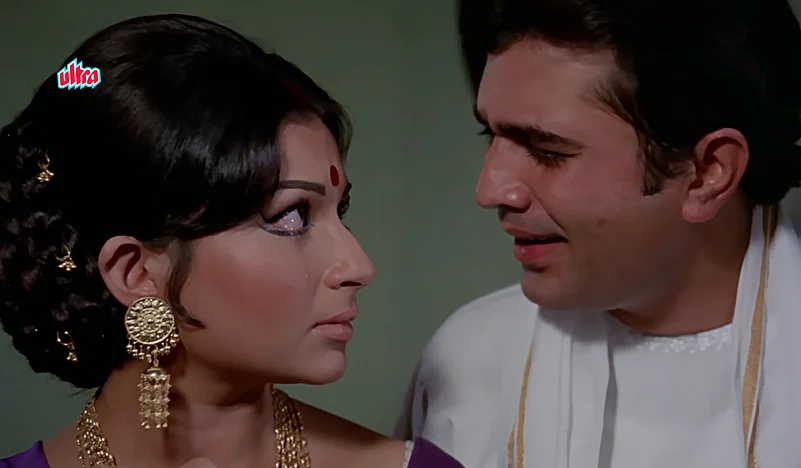
The actress was back in the race with Amar Prem (1972). As Pushpa, the courtesan with the heart of a mother, she continued from where she had left off in Aradhana. Only the Samantas saw the change in her. “During Aradhana, Sharmila had been reluctant to trade her trend-setting bouffants for chalk in her hair. When Dad insisted she had to do it, she gave in grudgingly, saying, ‘Okay, if I must, but I don’t want to.’ But by the time Amar Prem came along, Sharmila knew a good role when she saw one and told Dad she was doing the film whether he liked it or not. She didn’t even argue over the deglam look later in the film,” Ashim chuckles.
The idea for the film came from a Bengali short story, Hinger Kochuri, which Samanta read. It was penned by Bibhutibhushan Bandopadhyay, whose novels, Pather Panchali and Aparajito, Satyajit Ray had adapted on screen. Even as he was trying to get in touch with the writer for the film rights, he learnt that a Bengali film based on the same story, Nishi Padma (The Night Lotus), had already been released in October, 1970. Co-written and directed by Arabinda Mukhopadhyay, it starred Uttam Kumar as Ananga Dutta, a lonely businessman looking for love and Sabitri Chatterjee as the ill-fated Pushpo. It was the highest-grossing film of the year and had bagged two National Awards, for ‘Best Male Playback Singer’ (Manna Dey) and ‘Best Female Playback Singer’ (Sandhya Mukherjee). Still, Samanta decided to go ahead with the Hindi film, with Khanna playing the businessman, Anand Babu in this version, and Tagore as Pushpa, because the story had touched his heart.
He bought the Hindi remake rights from the producer of Nishi Padma, Shantimoy Bannerjee. He stuck to Mukhopadhyay’s screenplay, but roped in Ramesh Pant who had written the dialogue of Kashmir Ki Kali and Aradhana, to pen the lines for Amar Prem. His “Pushpa, I hate tears” is a cult dialogue today.

“He didn’t have to, but Dad felt morally obliged to pay the original writer and after learning that Bibhutobushan Bandopadhyay was unwell and confined to the bed, went to his house to meet him. With tears in his eyes, the overwhelmed author caught Dad’s hand and admitted that the handsome sum would really come handy. It was an emotional moment for both of them and gave Amar Prem its soul,” recounts Ashim. Arabinda Mukhopadhyay bagged the Filmfare Award for ‘Best Screenplay’ and Ramesh Pant for ‘Best Dialogue’.
Half a century later, Amar Prem remains unforgettable and so is Shakti Samanta who would have completed a century run today. Ashim remembers him as a methodical filmmaker, who took good care of his staff and was very clear about what he wanted. “Nothing ever went wrong with his shoots except for the weather, over which he had no control. Every penny was well spent, which is why even if a film didn’t work, no one ever lost money,” he signs off.