






Ben Wheatley’s Normal, starring Bob Odenkirk released on April 17.
It is set in the fictional town of Normal in Minnesota, where an amateur attempt at a bank robbery spirals into dark revelations about the said town.
For an action film, Normal’s strength lies in the finesse with which it captures the town’s mundane everydayness.
Written by Derek Kolstad and lead actor Bob Odenkirk himself, director Ben Wheatley’s new film, Normal, is a neo-Western caper set in the fictional town of Normal in Minnesota, where an amateur attempt at a bank robbery spirals into dark revelations about the said town. Navigating this chaos is acting Sheriff Ulysses (Bob Odenkirk), posted in the town during its transition phase to a new Sheriff. Named after James Joyce’s modernist novel, Ulysses’ narrative voice comes in the form of voice messages to his estranged wife. It is bound to remind any viewer familiar with the novel of the stream-of-consciousness monologues of its protagonists, depicting the ennui of the city of Dublin. In the film, the town’s ennui, which is also explored through Odenkirk’s narration, acts as the calm before the storm that reveals the irony in its name.
The film, however, does not shy away from exposing its violent gene from the outset. It begins with a sequence involving Yakuza (Japanese mafia) boss Obayun (Takahiro Inoue) and his mercenaries. The initial ‘normalcy’ of the Minnesota town, where one is transported right after the violent encounter in Tokyo, unsettles one with its calm. It is framed through the expansive whites and gloom of what seems to be a snowy season, as a disconcerting contrast to the blood that is splattered in the beginning and that—which the film by now has already established—will flow. For an action film, Normal’s strength lies in the finesse with which it captures the town’s mundane everydayness. The cinematography and lighting perform an exquisite job in inserting a sense of gloom amidst the quotidian routine.


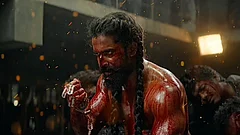

The writing starts to falter from the time the film moves into its main conflict, even though it succeeds in not falling into the trap of moral binaries. Based on the fascinating premise of a sleepy town’s connection to the Japanese mafia, the film fails to follow through the critique it proposes of a failing state and infrastructure that makes way for such a relationship to exist. It perhaps gets too involved in creating shock value through its stylised violence to keep up with the intrigue it had created in the first half. The character of Japanese mafia boss Obayun, who starts the film on a high note, is not explored in the depths that a character as complicated and colourful as him deserves. While Odenkirk stands out as Ulysses in his inimitable style, the film would have done better for itself if it had given more screen time to Inoue’s Obayun. Special mention must also be made of Jess Mcleod, who plays the late Sherriff’s daughter, Alex. The interactions between Ulysses and Alex form some of the most poignant parts of the film. So are Ulysses’ matter-of-fact voice notes to his wife that are his way of yearning, or how he deals with his internal conflicts that are shaped by past trauma. Intimate human interaction, psychological conflicts and internal monologues are what truly stand out in the film. Normal does a beautiful job of exploring the turbulent minds of both Ulysses and Alex. The writing also shines in spurts through its detailing of some of its supporting cast, such as conflicted drifter-turned bank robber Lori (Reena Jolly), mysterious bartender Moira (Lena Headey) or a cunning old lady determined to protect her town’s secret. However, it fails to hold together the larger narrative in a cohesive way that can accommodate all its quirks and adventures.

Large parts of the action sequences are choregraphed to infuse comedy into their gore; and they succeed in delivering it quite well. However, the film stops just a notch below the quality of action sequences Hollywood is used to churning out, considering it shares its writer with the John Wick franchise, known for its excellent action sequences. The invocations of Tarantino’s filmography are unmissable—especially in the involvement of the Japanese Yakuza and the stylisation of its action—but lack his narrative thrust.
Despite the evident loopholes, the film is a fun watch and does not make one feel bored at any given point, even when it is depicting the boring everyday on screen. That is because even at its most seemingly non-happening points, either too many things are happening, or there is a premonition of too many things happening. This perhaps also forms the film’s hubris, which, even though sparks in bits and moments throughout the film, fails to contain these sparks to create a shining whole.















