




Summary of this article
Kartavya opens with a promise but struggles to hold itself together by the end.
Saif Ali Khan delivers sincerity despite the film's uneven character writing.
The film works best when exploring caste, power and small-town politics.
For a while, Kartavya makes you believe you are watching a sharp, hard-hitting crime drama rooted in the realities of Haryana. Then the cracks begin to show, and what starts with tension and purpose slowly slips into something far more familiar and forgettable.
The atmosphere is tense; the investigation unfolds with intrigue, and the film appears interested in exploring the ugly overlap between caste politics, policing, and blind devotion. There is texture in its setting and confidence in the way it introduces conflict. But somewhere along the way, the film slowly sheds that promise, revealing a far more generic and frustrating story beneath.
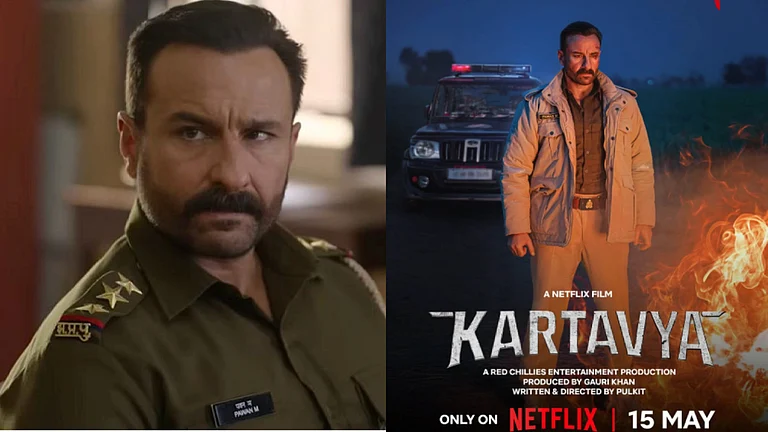
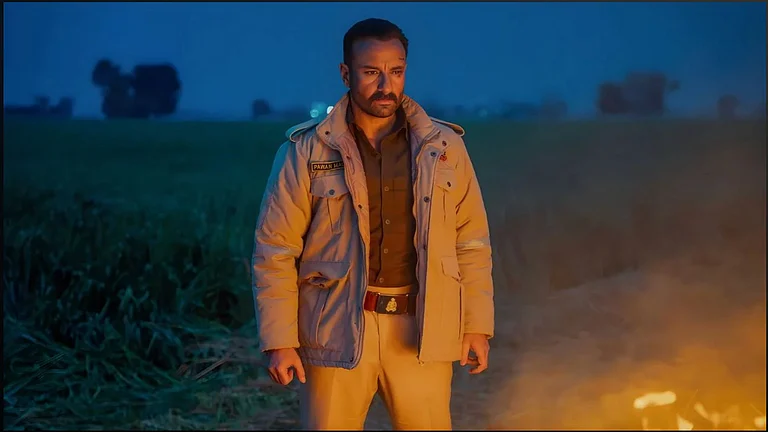
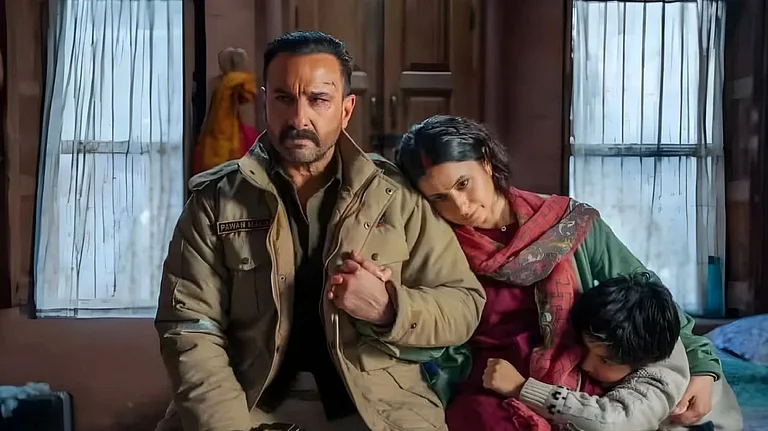
Directed by Pulkit, Kartavya places itself firmly within the dusty, violence-ridden landscape of Haryana, where honour killings, khap panchayats and political influence exist as part of everyday life rather than shocking exceptions. The film follows Pawan, played by Saif Ali Khan, an upright police officer trying to investigate the murder of a journalist while navigating pressure from both the system and powerful local figures.
Very quickly, the investigation opens doors into a larger network of corruption involving a self-styled godman, missing children and caste-based violence. On paper, this sounds like the foundation for an intense crime thriller. The problem is that the film introduces these threads without ever fully resolving or developing them properly.

The writing is easily this film’s biggest weakness.
There are entire portions of the story that feel abandoned midway. The beginning sets up questions that the ending never answers satisfactorily. Certain motivations remain unclear and major reveals arrive without emotional or narrative build-up. The investigation itself starts to lose shape as the film progresses, almost as though the script is more interested in moving from one dramatic moment to the next than in actually constructing a coherent mystery.
This becomes especially noticeable with the character of Anand Shri, played by Saurabh Dwivedi. The film positions him as a deeply influential and dangerous figure, but he never feels fully realised. His menace remains surface-level. There is no psychological depth, no unpredictability and no strong ideological presence behind him. He comes across as a half-written villain carrying the weight of ideas the screenplay never properly explores.
And that is frustrating because Kartavya occasionally shows glimpses of a much stronger film beneath the surface.


The sections involving khap panchayats and caste violence are among the film's most effective moments. There is something deeply disturbing about how casually conversations around murder and "honour" take place within these communities. The film captures that normalisation well. The violence is not treated as shocking within the world of the story because, for many of these characters, it has become tradition disguised as morality.
What also works is the portrayal of policing itself. Kartavya does not entirely romanticise the system. It acknowledges how power operates within law enforcement and how political influence often matters more than justice. There are moments where the film effectively exposes the uncomfortable relationship between police, local power structures and religious influence. The idea of a god figure becoming more powerful than the law itself feels believable within this world.
At the same time, the screenplay rarely digs deeper into these themes. It touches them and moves on.
Saif Ali Khan does what he can with the material. There is sincerity in his performance, and his restrained approach suits the film's tone. You understand the kind of exhausted morality the character is trying to carry. But the role never evolves enough to allow him to fully command the screen. It feels like a character written in broad strokes when it could have been far more layered.
The same problem affects Rasika Dugal. She is severely underutilised. The emotional possibilities surrounding her character are visible, but the film barely spends enough time exploring them. You constantly feel like both actors deserved stronger writing.

Ironically, one of the more refreshing aspects of the film is simply its setting and texture. Hindi crime dramas often reduce Haryana into caricature, but Kartavya at least attempts to present its characters with a little more complexity. Not every Haryanvi character here feels reduced to loud stereotypes. That restraint helps the world feel slightly more grounded.
Visually, the film works in parts. The dusty roads, dim police stations and isolated rural spaces create a believable atmosphere. Pulkit understands how to build visual tension in the early portions of the film. Some scenes unfold with patience and controlled pacing, particularly in the first act, when the mystery remains engaging.
But pacing eventually becomes another issue. Once the narrative begins piling up subplots without resolution, the film starts dragging emotionally. The tension weakens because the story itself loses direction. By the final act, Kartavya no longer trusts its own investigation enough to stay focused. The supporting cast, including Sanjay Mishra and Manish Chaudhari, are functional but underwritten. The one performance that genuinely leaves an impact comes from Yudhvir Ahlawat, who brings vulnerability and emotional realism to the screen in brief but effective moments.

In the end, Kartavya feels like a film with strong themes trapped inside a weak screenplay. It wants to talk about caste, corruption, masculinity, blind faith and systemic violence, but it never fully commits to unpacking any of them with depth. For a while, it convinces you otherwise. Then, slowly, scene by scene, it starts to unravel into something far more ordinary.